|
(EDITOR'S NOTE: Charles Black, Enquirer military writer, is on his fifth reporting assignment in Vietnam, and en route to the war zone has visited various military hot spots in the world. This is another of his daily articles about combat missions on which he accompanied U.S. troops.)
CU CHI, Vietnam - Capt. Joe Seery bunked in one end of the shack Delta Troop had turned into a combination operations-orderly room.
There was one corner set up as the medical center. With a coffee pot, a selection of boxes and water cans to sit on, a communications center with radios blaring, the shack by and large was a compact and endlessly interesting a center of activity as I've ever been around.
Seery and I sat outside in the late afternoon sunshine. He had his shirt off, sunning a luxuriant pelt. Three Huey's with a white greyhound painted on the nose and a LOH scout helicopter with the triangle insignia of the 3rd Squadron, 17th Air Cavalry, commanded by Lt. Col. John Phillips of Columbus, were in a patch of grass in front of us. To their left, a Long Range Reconnaissance Patrol team was checking through the astonishing load of weapons, supplies, and gear they carried on their five day adventures over on the Oriental river. A cluster of radio antennae outside of an abandoned mess hall indicated the operations center-officer's quarters of Lt. Col. Joseph Zummo's 51st Long Range Reconnaissance Company.
Seery indicated it with a cigar he was smoking.
"They go out and sneak into their area, along the river. They radio in what they see, enemy activity of any kind. Sometimes, real often, they radio in for help. If they get spotted out there the only hope they have in this kind of terrain is to get help in a hurry. It's not like up in the mountains or where there is timber. They use nipa palm and stuff in the canals and banks, and so does Charlie. If they happen to both decide to use the same patch, that's when we go to work, we go and pull them out of it," Seery said.
He added some other missions then. The platoons might be called to sweep an area to search out some local situation, they put in night ambushes in likely spots, but getting the "lurps" out of trouble is the primary responsibility.
"I'll get my shirt and introduce you to Lt. Col. Zummo, then we'll go to chow and when we come back I'll give you a rundown on the map, how the area's covered, where the teams operate, stuff like that," Seery said.
I'd heard of Zummo long before this but had never met him. He isn't easy to meet, just easy to hear about. He has been in this part of the world for five years. Laos, Thailand, Vietnam, Malaysia, Korea, if there has been special military adventure in Asia, Zummo has been involved. He was out of the same Special Forces world as Lt. Col. Newell Happersett, now in Okinawa, or Lt. Col. Charles Beckworth, now commanding a battalion in the 101st Airborne Division, and other such legendary types.
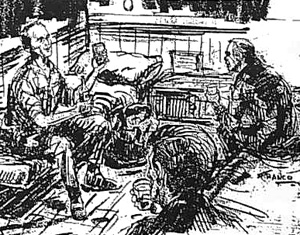
The lurp building was L-shaped, the operations area being in the short arm of the L, the long, dark, cavern of the other arm lined with cots and piles of rucksacks, weapons, other gear. Zummo was in a corner at one end, sitting on his cot studying some papers in a folder, a drink and an ashtray arranged on a footlocker.
He didn't get up, just waved at a vacant cot on the other side of the footlocker and turned and fished in a rucksack and got two mismatched, chipped glasses out of it and a carefully nurtured bottle of Scotch. He looked at the glasses before he handed them to us.
"Little dust in them," he observe. "Look what I got in the courier plane, though. You won't notice the dust."
|
Somebody produced two ice cubes from a refrigerator in another corner which I'd missed because of the darkness, Zummo had a bare light bulb hanging down over his cot to help him keep up with the office work. He poured very carefully measured drinks and put the bottle back very reverently into the rucksack, which seemed to serve as filing cabinet along with its other purposes, since he shoved the file into it with less gentleness that he had the bottle of Scotch.
I told him who I knew that he knew. He named some people I knew. We were on the same ground then and he shook hands, reached back into the rucksack, and added an exact quarter-inch to the Scotch in our glasses to show his approval of my being allowed to hang around the area for a few days.
Zummo was terribly thin, but since I first heard of him people have told me about that. He eats now and then, he sleeps sometimes, he is as apt to be up suddenly at 2 a.m. as at 2 p.m. He is completely involved in military adventure. He hasn't taken any real leave from this world here since many years ago. His stamina is beyond explanation, like only a zealot's can be.
His penchant for isolation, long range patrols, secretive exotics, is symbolized, in a way, by a compass set into the band on his wristwatch.
The mess hall was getting a good business when we got there. The chow was good. The accommodations were interesting. None of the tables were level, for example. Not just off kilter, but with a tilt of three or four inches to some of them.
"I don't know, they were like that when we got here. We think they built them outside so they would sit level on the hill and then moved them in, but the chow's good," Seery said when I asked about them.
We got one with a little less cant to it that the other and they filled me in on the routine.
The lurps stayed out five days, but the water was deep and Zummo said if it affected their feet because of constant immersion, he might put them on a three-day schedule. They carried frozen - dried rations, which turned into a very good meal indeed when water was added, real luxurious field rations. They weighed very little and tasted good. (I sampled some several times, they were quite popular.) Water was a problem. The water in the river area, a tidal one, was brackish, so they had to carry a full five days worth with them.
When they came in and debriefed fully, they turned in spot reports in whispered radio messages, they had three days to rest, get their gear back in order, etc., then they came up on the schedule again.
It wasn't a bad life in its way, they didn't have to withstand the terrible, physical tests of infantry moving all the time and they had considerable time off and few details to bother them when out in the field - but the tension and danger of spending five days out there, in a little group of five or six men, spying on enemy movements, doesn't make it a job with a long waiting list of applicants.
The men all went up to Nha Trang to the lurp school operated there by the Special Forces, a project Beckwith had originated back in 1965 with the Special Forces Delta Teams which did this same thing in the Central Highlands.
"When they get kicked out of an area, I take the same team and put them back in there. That's their job, to scout that area, and you can't allow anything to get in the way of it. If they get found out, we get them out, but they don't finish their scout because of it. They go right back into that area again and finish the job. They don't like it, they don't like me for it, but they do it. They're proud of being lurps and I intend to see to it they have a reason to be," Zummo told me.
|