|
(EDITOR'S NOTE: Charles Black, Enquirer military writer, is on his fifth reporting assignment in Vietnam, and en route to the war zone has visited various military hot spots in the world. This is another of his daily articles about combat missions on which he accompanied U.S. troops.)
TAY NINH, Vietnam - There were two Air Force pilots in tremendous danger when WO George Jones saw them from the cockpit of his tiny LOH scout helicopter about 3 p.m. Sept. 4, 20 miles north of here.
"They're about 200 meters apart, their parachutes are tangled in the trees. It's going to be hard to get a big chopper in to get them," Jones radioed.
His observer, Sgt. Dave Wasko saw one of the injured men moving but could only see a limply hanging figure when he peered at the other F-4C jet crewman.
CWO2 Denver Jewell was in a Cobra gunship circling above the low flying scouts, giving them gun cover. He was also the senior man on the scene. Jewell is a long seasoned veteran of combat tests, an aggressive pilot who, with his copilot-gunner Leonard S. Constantine, is often a leading figure in the exploits of Troop B, 3rd Squadron 17th Air Cavalry.
He took over directing the action now.
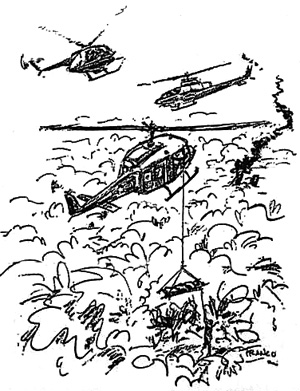
There were other choppers coming, an Air Force Husky model rescue helicopter with special winch equipment, and helicopters from the 187th "Crusaders" company were answering the distress signal.
Jewell and Jones decided after a radio conference that the LOH had the only chance to get down into the trees and elephant grass and rough terrain. There just wasn't room for one of the Hueys or the Air Force Husky to make it when it arrived. Jones went down into the little clearing.
The big, fast jet fighter had been shot down by 12.7 mm. anti-aircraft fire. The Forward Air Controller who had seen the air action and called for the men from Lt. Col. John Phillips' 3rd Squadron 17th Air Cavalry to help had described it as a twin-barreled weapon of great accuracy. Others were ringed around the area, close to the North Vietnamese Army's sanctuary bases just across the sacrosanct Cambodian border.
Looks Fragile
Jones' LOH is egg shaped and looks as fragile. It has dozens of patches where bullets have hit it without knocking it down, but a big, thumb-sized 12.7 mm. slug, a shade bigger than a U.S. caliber, would hit it like a cannonball, and both Jones and Wasco knew it. But they went down into the jungle despite the threat.
Jones hovered his chopper as low as he could get in the tangled elephant grass and Wasko jumped off, armed with a .38 pistol and great concern for the unconscious Air Force pilot dangling like a dead weight from parachute harness in a tree 50 meters away.
He fought his way to the pilot and was able to get him to the ground, cutting his gear free from the thorns and stiff branches. But the pilot was big and unconscious, badly wounded, and Wasco was small. The elephant grass was like a barbed wire entanglement. The way to the chopper was up a steep hill. He couldn't carry the man. He was afraid he would injure him worse by improvising some drag technique. The LOH couldn't get any closer.
Men here acquire a kind of special understanding for situations like this and don't require much conversation in talking them over. They get a knack for conveying tremendously complicated messages to each other by signals and by simply indicating the situation.
Stays to Guard
Somehow Jones and Wasco agreed that if Wasco couldn't bring the man to the LOH and the LOH couldn't go to get him, then Wasco would stay and guard the airman while Jones flew to get help.
|
It is worth noting again that Wasco decided to do it this way in a jungle where only a short time ago heavy enemy weapons had knocked down a jet and that he was armed with a a .38 pistol; that the LOH's descent into the jungle there had given an exact location of where he and the injured man were located, and that when asked why he had elected to stay behind with the hurt man he simply looked astonished, surprised that any other thought could come to anyone than to stay and guard a helpless comrade in such a situation.
He spent 15 minutes down there, giving what first aid he could, staying by the unconscious pilot, eyeing the thick elephant grass and jungle, waiting for Jones to come back with more men.
Jump into LOH
Back at the Special Forces camp, already informed of the problem by a radio call from Jones, the crewmen from a UH1H (Huey) sent there to stand by for such vicissitudes by Maj. James McManus, B Troop commander, ran and jumped into the back of the LOH before Jones had fully landed.
Sp4 Theodore Sobeleski, the Huey's doorgunner, and Sp5 Herbert Grant, a big, strong crewchief, were ready to jump when Jones put his LOH back into the hole in the tree canopy.
They went up to the watchful Wasco. Jones said "Wasco was under the pilot trying to lift him and Grant just picked him up and the others tromped a path through the elephant grass and he brought him to the ship."
It took some doing, but Jones got the overloaded little helicopter out and back to the camp again. Grant and Sobeleski carried the airman injured by the ejection, but on his way to a hospital - and men here have learned that is almost the equivalent of life, when a wounded comrade is gotten on board a medical evacuation helicopter.
A Crusader Huey from the 187th Aviation Company with the 25th Infantry Division, which operates the U.S. part of the war in this area, tried hard to get in for the other wounded airman.
The chopper pilots saw a bomb crater which had torn back the jungle canopy and let down into it - this was all going on while Wasco held his lonely vigil by the other airman - and one of two things happened, the chopper was hit by gunfire or an Air Force Husky chopper which had just arrived struck it with its rotor wash. (It probably was a combination of both, in fact. Wasco heard three shots fired during this, from between him and the other rescue attempt 200 meters away. The Husky pilots reported ground fire, as well.)
'Copter Cracks Up
The Crusader helicopter cracked up in the bomb crater, rolling into a tangle of wreckage, the men aboard had luck. Nobody was hurt.
Capt. Gregory N. Patulea, on his second tour in Vietnam and a famous Cobra pilot, had arrived over the rescue effort as this complication developed. CWO Robert M. Reed and PFC John D. Myers were in the LOH which completed the cavalry scout-gun team.
Jewell, who had been ramrodding things, had filled Patulea in on the situation over the radio and the Captain took over. He told Reed to go down and get the wounded man while he flew gun cover for the crew of the crashed Crusader Huey.
Reed took his little LOH down to the trees. The Husky was lowering a line from its rescue winch but the Crusader crew had already radioed before the crash that they believed the pilot to be too seriously wounded to be sent out by a hoist, that his wounds were such that the method might be fatal.
Reed hovered in front of the Husky and by hand signals the pilots decided that the Air Force craft would back off and let him try to get the badly wounded man out in his scout ship and then the Husky would get the four men from the downed helicopter to safety.
The wounded man was put into the Huey returning from its other flight to the hospital. It took 45 minutes for the whole thing.
|