|
(EDITOR'S NOTE: Charles Black, Enquirer military writer, is on his fifth reporting assignment in Vietnam, and en route to the war zone has visited various military hot spots in the world. This is another of his daily articles about combat missions on which he accompanied U.S. troops.)
TAY NINH, Vietnam - Some how out of the confusion around Tay Ninh during the events after a night attack was spoiled on Aug. 19, there came an inkling - a dark, illogical blob of an inkling it was, but the outlines could be discerned in a couple days.
The enemy had intended to move into the town and hold it for three days, this from prisoners and captured documents.
He hoped to lure the U.S. and Vietnam commanders into using heavy firepower to drive him out and pile up the usual propaganda points ensuing from such fighting.
Raid and Run
He wanted to cause Gen. Creighton Abrams' strategy of defense for Saigon to be twisted out of shape by the pressure on Tay Ninh, spiritual center of the 2-million or so Cao Dais in South vietnam and of publicity value whatever its military uselessness.
The area, from a hard military point of view, is more trouble than it is worth so long as the enemy can raid and run to safety in nearby Cambodia.
He hoped to be able to overrun a U.S. outpost firebase and trumpet that tactical embarrassment to the powerful foe into a Paris advantage and to lend another straw to some television and press pundits who seem to grasp at them to find enemy "victories."
He fought as much for the edification of the crowds then milling toward Chicago as for possession of Tay Ninh.
Abortive Moves
None of these came to pass because he simply couldn't take the losses dealt him by the U.S. and Vietnamese troops he faced and because neither the U.S. command or the Vietnamese command were easy to trick anymore. Intelligence was too accurate, the Abrams' method of defense too intransigent, and the crowds and headlines too fickle.
Failing to draw any comfort from military or political success - there were abortive moves by reporters too overawed by it all to be certain of their facts to turn Tay Ninh into a "Battle for the City" but embarrassed second appraisals followed in about every instance - it took four days, until Aug. 23, for the next pattern to emerge.
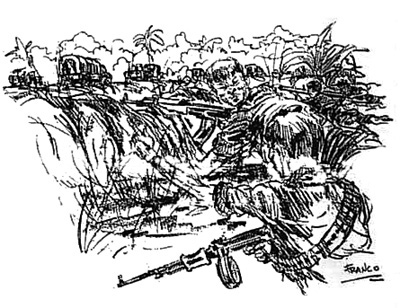
On that day the enemy lay in wait in a rubber plantation on Highway 26, the main supply route to Tay Ninh, and ambushed a U.S. road convoy.
It was a classic as to tactical quality and also as to the quantity of damage done in any such encounter I've seen or heard of since the entry of large scale forces here in 1965.
Oddly, the press which had been overabundant with adjectives in describing non-existent "invasions" of Tay Ninh city (the last flurry of such reports earlier in September described hamlets outside the city as "suburbs" and thus moved the war into the town, where they were apparently determined to have it fought) briefly described this ambush as "backfiring on the enemy" in the only stories about it I have seen. He didn't get credit for the only thing he did right in the whole operation as a result.
Extent of Defeat
But it signaled the extent of the defeat he had suffered - more than 900 dead men were left as the price for his military adventurism around Tay Ninh - and the emergence of a new pattern of fighting there.
He concentrated on attempting to cut and mine roads and to ambush convoys between Tay Ninh and Cu Chi and Tay Ninh and another 25th Infantry Division forward base at Dau Tieng. This "on the cheap" operation was punctuated by raids on Fire Base Rawlings, Fire Base Buell and another fire base (artillery and maneuver force base camp) called "French Fort" north of Tay Ninh.
His ambushes never came up to the original standard of excellence again, however. They were costly to our convoys on occasion; we lost the frustrating casualties road mines cause, there were temporary crises over cut roads - but the convoys rolled through, and the ambushes cost him many more dead men than they were worth when the results were tallied out.
Screening Roads
Helicopter scouting and shooting by Troops B and C of Lt. Col. John
|
Phillips' 3rd Squadron 17th Air Cavalry commenced screening the roads and turning up the embarrassed ambushers before they could get into action too often. Firepower punished them too often.
Where one or two ambushes a day had been the rule in early September and the last week of August, none had even been attempted in the period from Sept. 20 to Sept 25. Dogged road clearing by the 25th Infantry division kept mine incidents at an uneconomical-for-the-enemy minimum during the same week.
The harassment of vulnerable, hard to guard, road convoys fizzled out as a method of keeping an "offensive" alive because it cost too many dead men and soon quit getting results after the promising start.
Results Were Obvious
All of this could be seen from choppers and on the ground, the most obvious progression downward fro a big-scale offensive which went wrong through diminishing dimensions of military effort to a final sullenness. This frittering away of activity continued into a full lull as the enemy pulled back commencing about Sept 25 and quit trying to keep up even a symbol of offense except with raids along the Cambodian border. These were significant, however.
So long as his sanctuaries exist in Cambodia, he can harass Tay Ninh, or more remote bases: pose a threat to Saigon: menace the hard-won reaches of II Corps, or play any cynical trick he pleases in any future diplomatic or military situation which may develop. He can simply bide his time for opportunity and concentrate enough force to hit strategic targets by surprise. That is the rub in assessing the results of his Tay Ninh operations or any other ones in II Corps or III Corps. It is the problem in foreseeing any good future for any political settlement which neglects eliminating those bases.
Forces Can Run
His main forces can run to safety, retrain, be replaced, re-equipped, and new plans made in absolute security now. South Vietnamese main forces have to guard a country's property, lives and security while he does this and leaves the war to guerrilla vandals, terrorists, and small units.
It was this original combination of main force conventional offensives and guerrilla support which caused disaster to the South Vietnamese army in 1964-1965.
They could not cope with the better equipped and more heavily concentrated main force sent from North Vietnam, while still guarding the countryside and cities against Viet Cong guerrillas inspired and equipped from North Vietnam, mythology of the era notwithstanding.
He can repeat every step of his last plan at Tay Ninh in almost exact detail and expect success if American firepower and manpower were pulled out of there, because of the North Vietnamese forces stationed in Cambodia where they cannot be eliminated. He can, at the moment this is written, try it again even in the face of American force there, knowing that pursuit--which hurts him the most in dismantling his forces after a setback--can't come far at Tay Ninh because of the Cambodian border. He can do this in any time ahead when a situation looks favorable if the problem isn't solved.
Cambodia is Key
All of the U.S. dead and wounded from the northern border of II Corps south, since 1964, can be traced directly or indirectly to the sanctuaries in Cambodia, where the force the inflicted them or made it possible for local guerrillas to inflict, has had its rear bases and sanctuaries. All of the talked-about and debated-over issues of this war are spurious when compared to the real basic problem of it all, Cambodian sanctuaries, which just never seem to come up as an issue.
To illustrate this point, it is necessary only to go to the exact spot on Highway 26 north of a town called Go Da Hau south of Tay Ninh where the August 23 ambush was so successful - and review the same ambush as he attempted to pull it off on May 29 during the preceding offensive effort against Saigon. It demonstrates the perpetual threat Cambodian bases pose.
That it didn't work that time didn't deter him from trying it again in August - but it was quite a tribute to Capt. Russell W. (Bill) Mengel, now the intelligence officer of the squadron, then the commander of Delta Troop, which now was in Capt. Joseph Seery's charge when I visited it at Cu Chi.
Delta Troop was performing its classic function in an air cavalry squadron then of "road running" with its gun jeeps and riflemen charged with keeping Highway 26 open for business.
Delta Troop slam-banged its way into fighting success that day, with a full share of heroes and exploits.
|