|
(EDITOR'S NOTE: Charles Black, Enquirer military writer, is on his fifth reporting assignment in Vietnam, and en route to the war zone has visited various military hot spots in the world. This is another of his daily articles about combat missions on which he accompanied U.S. troops.)
TAY NINH, Vietnam - A road ambush set on Highway 26 just north of a town called Go Dau Ha on the main supply route from Cu Chi to Tay Ninh was an enemy success.
It cost us more than 20 vehicles, 30 U.S. dead and terrible embarrassment - but it was simply a tactical highlight which the North Vietnamese and Viet Cong Main Force operating here couldn't exploit because they lacked the force and willingness to do so.
But it emphasized some points, political and military, about the enemy capability of dragging out a war with raids, ambushes and other gambits in the areas close to Cambodia's border.
Since there have been attacks on Special Forces camps at Dac Lop, Katum, [text missing] . . nther, places within a nights walking distance of the North Vietnamese bases and men in Cambodia.
There has been an upswing in city terrorism by assassination teams.
Small, carefully scattered squads have opened fire on helicopters in too consistent a manner for it not to be part of an operational plan.
Road mining and blocking, ambushes and sniping, anything military - cheap in price which doesn't risk big casualties for main force units, seems to have been the style since September 15 or so.
Political Implications
The political implications would be to possibly spotlight the great, unnoticed failure in this war to eliminate Cambodian sanctuaries and turn it into an issue. A war of light, scattered action with occasional carefully planned raids, all aimed at "slow bleeding" of U.S. forces would demonstrate that this could go on for a long time. Finally, despite this contradiction, it is more probable now than at any time since 1966, a dramatic turn in negotiations will result.
The military implications are simply that he could not mount a major "Third Offensive" against any objective which has either military or psychological importance with the force he mustered for this effort. It was a complete failure for him. The enemy had planned and readied this effort since his May Offensive was drowned in blood and it could only claim an overnight occupation followed by an arson-marked withdrawal from three blocks of Tay Ninh.
Despite confused reports in the ensuing 30 days, enemy forces never again even penetrated the city of Tay Ninh. The nearest they came to it was a sneak entry into three obscure hamlets 1 1/2 to 4 miles from that town. Once more they fled quickly.
The most immediate consideration in all of this, and the most important, is how sensitized the American public and politicians will become as "big" war news fades out and the press commences elevating smaller events into prominence simply because that's the war that is.
Judging Standards
Now events are being judged by the standards of the big offensives of Tet and May, so Tay Ninh really didn't get the treatment which would have been accorded it before these events.
As time goes by with nothing big that's new, a battle at the Katum Special Forces camp (correctly assessed at present as not meaning very much) will have gained new stature. The portentous " . . . is Katum, then, the Dien Bien Phu of this war?" ploy can come back into television vogue. The fate of a Katum can be pondered in long, analytic articles, which touch everything from a significant early poem by Ho Chi Minh to a strategic appraisal by Senator McCarthy.
When this occurs, (and barring a military failure on our part or a suicidal, all or nothing, decision on his part, it will occur. It is as drearily predictable as most other broad brush pictures from here have been) it can be accepted by Hanoi as a face saving situation, a symbolic "position of strength," and whatever Hanoi has decided they intended to do in the beginning will be done in Paris.
Imply Knowledge
Judging how long this might take would imply a personal knowledge of the egos and eccentricities of the power structure in Hanoi and expertise on the mechanics of that structure, its internal arguments and personalty cliques, etc. That is impossible. It should be a short process in relation to the life span of this conflict and judged against how long it could be dragged out by the enemy on a low scale-high publicity basis.
No complete end to hit and run North Vietnamese warfare, or all of this country's internal guerrilla harassment, can be brought in any foreseeable future which does not include eliminating his forces in Cambodia. Given the general situation as it is now, a hundred years' war could be kept alive by raids, harassment and headlines so long as the enemy made such a political decision, and so long as unpopulated Cambodian wilderness is reserved for his comfort and safety between operations and as a supply base for other activities.
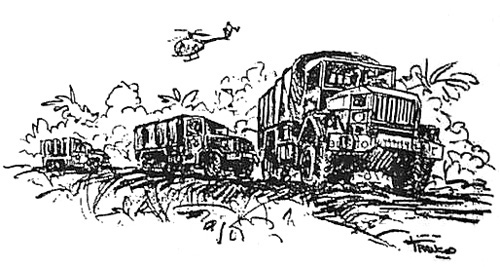
To show the way this could occur, four events on Highway 26 at the same spot by the same rubber plantation 10 miles south of Tay Ninh, six miles west of a bulge in the Cambodian border, 15 miles or so northwest of Saigon, can be judged.
|
Put in reverse chronological order:
Land Mines
1. About Sept. 15, a truck and armor personnel carrier struck landmines and were destroyed at this point with one U.S. soldier killed and two wounded. The road was repaired and the stalled convoy went through without further incident.
2. About Sept. 5 an ambush was discovered by helicopter scouts, gunships, artillery and air strikes called in. U.S. armor and mechanized infantry swept the area clear at a total cost of 26 enemy dead, with no U.S. casualties.
3. On Aug. 23, a convoy was ambushed which cost at least 22 vehicles and more than 30 U.S. dead at a cost of 46 dead to the enemy in all actions growing from the ambush, helicopter pursuit, air strikes, etc.
4. (Skipping back over mines, sniping incidents, producing small casualties for both sides) On May 29, helicopter scouts alerted by Troop D, 3rd Squadron, 17th Air Cavalry, discovered an ambush of the same order as the one which came later in August, a big one, laid in depth. Troop D, commanded by Capt. Russell W. (Bill) Mengel, flanked the ambush and killed 27 enemy left behind, an unknown number not found or carried away, and a convoy came through without incident. U.S. losses were one dead and two wounded, one 106mm. recoilless rifle-mounted gun jeep shot up but repairable.
There is a big lesson in this which implies that if a road is close to an enemy base which isn't eliminated by offensive action - or which is impossible to eliminate because of the Cambodian border - it can be expected to produce trouble. It will demand expensive manpower to keep clear and open, there will inevitably be an ambush that works or a mine which connects, and there will be men killed and wounded and damage done.
Lesson Illustrated
The lesson is illustrated by simply listing these few of the many events along just two miles of Highway 26. The conclusion is proved. So long as there is Cambodia, the enemy can drag out violence in South Vietnam, with or without guerrilla support. Since the length of this war has been so long, there are hard core guerrilla organizations which can be expected to function to the last man, and be able to recruit a few people for decades, given supplies, support and hope from Cambodian bases. Only a few such can suffice to keep violence alive. Guerrillas also depend on Cambodia.
Now to the May 29 events and background.
Mengel is young, as most captains of this era are young, personable, very, very bright, and anything he does has the imprint of tremendous enthusiasm about it. He is an ardent student of ways and means whatever job he is handed, full of curiosity and interest over what his day brings. The success of his time with D Troop reflects these things.
A single troop of cavalry in each air cavalry squadron - there are five of these in the Army to my knowledge and a new reality of an idea that has been around since helicopters - is designated a "ground troop." It has half a dozen recoilless rifle jeeps, "Gun jeeps", and a fleet of other jeeps mounting machine guns and carrying riflemen, machine gunners and mortarmen as passengers with trailers containing their homes and possessions. All of these, men, jeeps, their trailers, etc., can be lifted by the Huey helicopters of the squadron. This was Mengel's unit, the ground troop.
Reserve Troop
The ground troop, Troop D or Delta Troop as it is usually called, functions as a reserve of riflemen to be thrown into fights the air troops get into with their rifle platoons each; as a road running force or ground screening force; as a company-sized outfit which can do infantry company jobs if called on, such as sweeps, ambushes, security missions, etc.
It isn't at all impressive to see this outfit, wearing a wide choice of hats with a red beret being fairly standard, lined up near a company of armored cavalry with their tanks and armored personnel carriers.
Yet during the three months in which it secured Highway 26, there was never a successful enemy ambush. Not a single ambush was set which wasn't discovered and ruined before it was sprung. Snipers and mines and ambush attempts occurred. Delta Troop took casualties, but it accomplished something which had been a frustrating problem for armored cavalry units on the same road in spite of its lack of armor and firepower.
May 29 is simply the best day to pick because it offered almost all of the big lessons and small lessons. What the enemy will probably do and why, could be touched on, noting the final overwhelming importance of Cambodia in this war's ending and in any future peace here, and such matters are the big lessons.
The small ones add up to a startling tactical consideration that perhaps all of that speed, armor and firepower enjoyed by an armored cavalry unit actually puts them at a tremendous disadvantage in securing supply routes in a war of this kind. It is evident that any complacent belief that these units are the end answer to the whole problem will get us into a lot of ambushes. A combination seems called for instead.
|