|
(EDITOR'S NOTE: Charles Black, Enquirer military writer, is on his fifth reporting assignment in Vietnam, and en route to the war zone has visited various military hot spots in the world. This is another of his daily articles about combat missions on which he accompanied U.S. troops.)
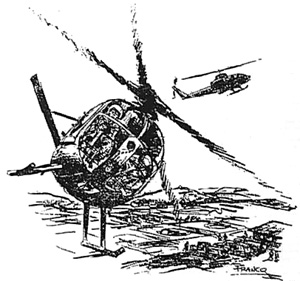
CU CHI, Vietnam - Capt. Joseph Tuck, the bones of his left leg smashed by an AK-47 bullet, gave up trying to stop the flow of blood from the wound when his scout-observer, PFC Richard Edwards, lost consciousness from his own wound in the right leg.
Edwards slumped over the controls of the LOH, jamming them, sending the little chopper into a plunge toward the wastelands 10 miles west of here, 27 miles northwest of Saigon.
Tuck said he was growing weaker, losing vision, his leg paralyzed, but somehow he managed to pull Edwards off the main stick controls. The LOH cockpit is small and Edwards slumped over onto the cyclic control on the left, jamming it. Tuck was unable to pull him from that position.
It left the Captain from Troop B, 3rd Squadron 17th Air Cavalry, with pedal controls he couldn't operate and the stick and throttle.
Tuck called to Warrant Officers William Kane and John A. Garrison, flying in the Cobra gunship which covered his scout during the action in which the men had been wounded. Tuck said he couldn't fly the LOH. He said he was going to try to land it.
Garrison thought about this. The country down below was deceptively quiet - an area where great numbers of enemy can slip into positions overnight from their Cambodian sanctuaries and where small Viet Cong forces are continuously manning infiltration stations, etc. The two-seat Cobra couldn't pick Tuck and Edwards up if the LOH went down. It could only circle and try to protect them until help from the Troop came with more Cobras and the rifle platoon.
Garrison worried about this. Then he told Kane, in the copilot-gunner's seat up front, to take the controls. Garrison had something very important to do.
He said he prayed.
Then he called Tuck, speaking slowly and very firmly into the radio to the wounded, almost-delirious captain.
"You must not land, Tuck. Listen to me. You can make it back to Cu Chi - you can and you will - I'll help you," Garrison radioed.
Commenced Responding
Tuck was very halting on the radio, he was in terrible straits under normal conditions with a wounded observer jamming important controls, the pain, shock and loss of blood from his wound made these unthinkable now. Yet he commenced responding to Garrison's radioed messages.
Garrison found that Tuck was too near loss of consciousness to follow any complicated instructions from him.
He began to talk very simply, very slowly, and the extent of Tuck's problem almost overpowered him at times during the minutes that followed.
He told Tuck which way to turn, altitude directions, gave him encouragement, and Tuck responded, falling back instinctively on training and experience to fly the only way he could, by adjusting the speed of the rotors and by making whatever changes the limited controls allowed him to make.
Once there was a terrible moment when Tuck lost communications. Blood in the floor of the cockpit had flooded the bottom of the helicopter and shorted out the radio. Somehow Tuck grimly worked through the problem of switching from one of the ship's radios to another auxiliary set and the business went on.
|
The pair of ships came into Cu Chi. Ground crews were soon there on the metal pad, rescue trucks ready, the air cleared of other ships. Tuck radioed one last message to Garrison and Kane.
'Wish Me Luck'
"I'm going to bring her in on a sliding landing, wish me luck."
Sliding the chopper on its skids was about all Tuck could manage with the controls gone which were jammed by by the still-unconscious Edwards or denied him because of his paralyzed legs.
He controlled the rotor speed, the ship jerked downward, one time it flared up and veered badly to the left but Tuck caught it. Then the LOH landed, easily and gently.
Tuck was too weak to raise his arms to the knobs which shut off the engine. He managed to pull the handle of the emergency fuel cut-off valve however and shut the LOH down, and collapsed.
He said he remembered nothing at all after that, but Kane remembers that when the Cobra landed and he raced to the LOH, Tuck waved him away and pointed feebly to Edwards and refused to allow anybody to take him out of the helicopter until the unconscious PFC was safely removed. Then he lost consciousness again and was hurried to Cu Chi hospital. The road after that leads to an evacuation hospital, Japan, and home for final treatment for both Tuck and Edwards.
I heard about all of this when I came in from a paddy-level inspection of the kind of country which had hurt Tuck and Edwards with the B Troop rifle platoon.
Three Friends Hurt
Three more of my friends were hurt that day, in the rifle platoon, as we slogged, swam, and cursed our way through the hours. Shrapnel from grenades and a terrific explosion which came when we destroyed a cache had wounded them in turn. It had been a grueling, miserable, filthy day, full of personal mishaps as we had crawled and worked through bunkers and holes, dropping grenades into hidden entrances, paddy water and mud rushing into the caved in bunkers and spider holes as they were destroyed, making it impossible to check the results.
Lt. Col. John A. Phillips told me about some of what had happened with Tuck and Edwards when the three Hueys from Maj. James McManus' Bravo Troop pulled us out of one last paddy just before dusk and we climbed off them back at Cu Chi, all muddy and tired and full of our own aches and pains.
The other ships from Bravo Troop were coming in from Cu Chi, they were switching to operations further northwest, near Tay Ninh. The 3rd Brigade 101st Airborne Division (Airmobile) attached to the 25th Infantry Division had the information it needed to find a fight. Tuck and Edwards had assured that.
I had two other good friends in the Cu Chi hospital, PFC Robert Darnell of the 51st Long Range Reconnaissance patrol and S.Sgt. Ira Holding of B Troop rifles, by now, too.
"Col. James C. Smith, you remember him from the 1st Air Cavalry, he's the deputy commander of the 1st Aviation Brigade here now, is going to give Tuck and Edwards Purple Hearts and Distinguished Flying Crosses tomorrow. Robert Williams, brigade Gen. Williams (Maj. Gen. commander) may not be back in time from a field trip he is on, but he will be there if he can. How about staying in and we'll go up there tomorrow in my bird?" Phillips said.
I wanted to do that. I wanted very much to see Tuck, Edwards, Holding and Darnell, and Smith was an old friend indeed, he once commanded the 1st Squadron 9th Cavalry, which originated the squadron concept, and then took over a brigade in the 1st Air Cavalry Division.
|