|
(EDITOR'S NOTE: Charles Black, Enquirer military writer, is on his fifth reporting assignment in Vietnam, and en route to the war zone has visited various military hot spots in the world. This is another of his daily articles about combat missions on which he accompanied U.S. troops.)
CU CHI, Vietnam - Maj. Gary Luck and Capt. Clifford Lawson were in the back of the Huey with Sp5 Lee Riech and Sp4 James Melvin on the guns when I had something catch my eye up on the instrument panel to the right of Lt. Col. John Phillips - a big, red light.
We were going down.
We were on the way from Di An, headquarters for 3rd Squadron 17th Air Cavalry, to the field hospital here at Cu Chi. Capt. Joseph Tuck and PFC Richard Edwards were to be decorated for a heroic flight back from a fight on the Saigon river while badly wounded. It quite suddenly was not just a helicopter ride.
All of us were staring at that red light and the sickening manner in which the oil pressure needle made a steady sweep down to "zero".
Phillips was working, hitting switches, controls, and we were on the way down. A chopper can "autorotate" by letting the rotors windmill, giving it a parachute effect. It usually works. It wasn't a new experience for any of us. Therefore, we shared mutual terror gracefully.
Phillips' voice came over the intercom, he had been on the radio with a "Mayday" transmission already.
Good At This
"I'm pretty good at this part of it. I've had a sloppy spell right at the last second a time or two, though," he was saying cheerfully.
It wasn't that way this time, not to me. The Huey, loaded with the command radio console as well as passengers, didn't even bump that I remember. (Phillips said it did. It seemed quite a gentle, slick landing to me, however. After contemplating the rice paddy coming up towards us for several hundred feet I'd achieved my own standards of what was a bump and what wasn't and this landing was a thing of beauty according to that standard.
The problem with having performed an outstanding feat of airmanship in settling a wounded Huey down in a rice paddy is that nobody takes time to congratulate the pilot.
The problem is just half solved. Having got onto the ground safely, it remains to stay alive until the radio calls which have gone out on the radio before we went down got assistance.
Picks Likely Spot
Luck and Melvin took off with a machinegun to the right. Lawson and Riesch to the left. I picked a likely spot, there was a small ditch and some weeds and other comforts offered there, to the right of where Luck and Melvin were setting up the machinegun and I headed there.
So there we were, a squadron commander, Luck, the adjutant, Lawson, the assistant personnel officer, WO Robert L. Colores, the co-pilot, myself and the crew, all in a perimeter around the Huey, looking awkward and out-of-place in a dry paddy a few miles outside Cu Chi. It was a high priced squad, led by a Lieutenant Colonel with machinegun sections commanded by Captains and Majors equipped with its own correspondent.
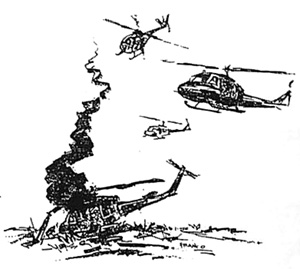
We never were put to any test in our first combat assault as a unit, however. Two little LOH choppers snarled down over the trees and into a tight circle around us, their mini-guns looking like long lost friends to the ones down on the ground. There was a heavier rotor beat, and a
|
Shark slid over, a big Huey Cobra with real big death in its rocket pods if the situation called for firepower the LOH's couldn't handle.
Keep Positions
We kept our positions. Then I saw another gunship take up the overhead orbit and suddenly a Huey slick ship was in my view. I wasn't looking up to count helicopters at the moment, they had to get in front of me to get noticed, and this one came right down in front of me. That was ours. Infantrymen from McManus' Troop, from Capt. James M. Montgomery's rifle platoon were fanning out between us and the place trouble seemed most likely, a treeline and hill.
I got up and stretched. It was a beautiful afternoon, a breeze was blowing. We'd even landed in a dry meadow instead of a green paddy. There were some little flowering bushes in the hedgerow near my ditch and I admired them. a Huey landed near our disabled ship. I waited around until Luck and Melvin picked up the machinegun and trotted that way with them. On the ship we all sat back and laughed and slapped each other's backs and shook hands with Phillips and copilot Colores. Another H model Huey was going in to attach a sling to the command chopper so it could be lifted out and brought to Cu Chi and fixed (it had a broken oil line.) It got quiet then, the last few minutes to Cu Chi and the award ceremony and hospital visit we'd planned to make. I don't know what the others were thinking about as they smoked and studied the landscape going by under the rescuing Huey's open doors. I know what I was thinking about.
Just a few days before this I'd been alone in the back of Phillips' chopper as we circled and prowled down on the surface of a wet piece of ground dotted with brush and palm scrub, watching a Huey turn itself into a ball of fire, sweating out the men in it.
Heard the Call
One of them had been "The Gunfighter," Col. Hank Emerson. We didn't know if he was out of the burning ship or not. We'd heard the call, like one we'd made just a few minutes earlier, and it was near where we were flying, on the way down to A Troop commanded by Maj. John D. Jenks who had been fighting like cavalrymen dreamed of fighting in support of Emerson's 1st Brigade 9th Infantry Division.
"You've got to spend some time with us with this 1st Brigade of the 9th. We find a fight. The Gunfighter comes and fights! There isn't any long delay while people make up their minds and argue and the scouts and Cobras get shot up trying to hold a contact for them. He gets out there in a hurry. You get a fight and that's what he wants," Jenks had told me.
I had been looking forward to seeing Emerson. We'd last met in that bamboo thicket over by Dak To where he'd had his battalion command post in 1966 during that wild battling, when he commanded the 2nd Battalion 502nd (Airborne) Infantry.
He'd come back as a brigade commander.
My intention of seeing him was going up in the smoke of his Huey as we circled it. We spent a long time prowling at low level until infantrymen got out far enough to get into a fight with the enemy who had shot down Emerson's chopper. We went back to flying cover over the smoke and flames then, waiting for word. We thought Emerson was finished
Then the radio said he had been pulled free, badly burned under his right arm, cut and bruised, but alive and not seriously hurt. The pilot and crew chief were dead. Seven men were alive.
The infantry were all around then, and our part in it was over. So we went on to Troop A. I didn't get in to see Emerson, he went on to a hospital in Jana. I was within 50 feet of him, but I never got to see him.
That's what I was thinking about on the way to Cu Chi after we lucked out.
|