|
(EDITOR'S NOTE: Charles Black, Enquirer military writer, is on his fifth reporting assignment in Vietnam, and en route to the war zone has visited various military hot spots in the world. This is another of his daily articles about combat missions on which he accompanied U.S. troops.)
CU CHI, Vietnam - This has to be the biggest monster of a base outside the real monsters along the coastline. The 25th Infantry Division went in for a big one so long as they were building a headquarters.
First Infantry Division style seems to be more prolific in building big base camps, they have five dandies, but for sheer bulk, the 25th is right up in the running with the Marines up in I corps. I always marvel at it.
We landed in some odd corner or other of the base and a jeep was waiting. Maj. James McManus. B Troop commander, was chewing on a cigar and scowling with some worry showing around the stogie. He'd had some moments of concern over us.
Mac's scout ships, Cobra gunships, and riflemen, had assisted us in getting here after Lt. Col. John Phillips, 3rd Squadron 17th Air Cavalry, had settled his command ship into an emergency landing out in the Vietnam countryside. Mac asked about our health, got good reports, and seemed happier.
We headed on over to the hospital here, quonset hut-style construction with air conditioning and covered walks and nurses, who wear fatigues, work long hours, see all the worst results of a war and little of the excitement, triumphs, drama, or other factors which have an allure for men (who admit it or not but feel it universally). They were all very beautiful to me as we passed by the wards.
Capt. Joseph Tuck and PFC Richard Edwards were to receive Distinguished Flying Crosses and Purple Hearts after their dramatic flight from sure death to safety.
Both were hit in the legs as they risked their lives to locate an enemy position on the Saigon River so it could be destroyed by Cobra gunships. They had been wounded while scouting for infiltration toward Saigon. They found one link of the complicated enemy route system and caused its destruction.
Somebody spoke to me. I had to look hard to recognize S-Sgt Ira Holding in pajamas instead of faded jungle fatigues, slippers instead of muddy jungle boots, and with a dignified bald spot instead of a steel pot.
He had a thick bandage on his left arm and a grin on his face.
"I didn't figure I had much of a hole in my arm until the doctors modified it, getting that metal out of it. I've got a dandy now," he said.
I stopped and we talked about his arm.
Even with the unscheduled landing in a paddy, we were still ahead of Col. James Smith, deputy commander of the 1st Aviation Brigade, who was to make the presentations to Tuck and Edwards at hospital bedside ceremonies. I stayed with Holding a while. Smith, hard working and dynamic, an outstanding figure with the 1st Air Cavalry on my visit to them last year, keeps a long and tightly organized schedule.
Smith wasn't due in for 30 minutes and he wouldn't waste any of his working time being early or anyone else's being late.
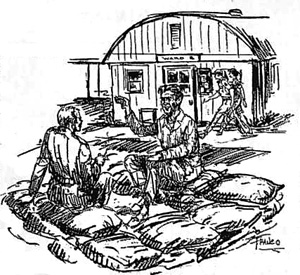
We sat on some sandbags and talked about how he'd gotten the hole in his arm, just five days before this.
I was still limping from the same day's activities. A couple of other people had smaller holes than Holding's wound, but were back on duty with the B Troop rifles. Holding's arm had caused concern, both from the severity of the wound and for other reasons around the squadron.
He is probably one of the best small-unit tacticians and very finest field NCO's I've ever known. When you walk with Holding, you walk with experience, maturity, toughness, fighting zeal properly mixed with common sense, and tremendous reliability. You just know that what you're doing with him is the best possible way to do it under the circumstances.
|
There have been odd moments out of the field when a certain amount of diplomacy, moderation and second thoughts would have been equally valuable to my buddy Holding, though. Such as the time he lost his Platoon Sergeant stripes in a moment of zestful living and short temper back in the States just before coming to Vietnam.
He was simply acting as platoon sergeant still, simply because he is so absolutely competent and qualified for it that it would be ridiculous not to have him doing so. The chastening had no effect on his standing in B Troop as a top NCO, but had improved his own outlook on affairs outside the combat field, Holding told me.
So with 23 years of soldiering and tremendous talent, he'd been considered a cinch to get his stripes back. There was a promotion board meeting soon. Holding was going up in front of it. B Troop had a real family crisis over whether Holding would get his stripes back or not.
Then he got this arm wound. At first, the doctors said it would take five or six days to get him back to B Troop. Then they found it was a much worse wound, a jagged chunk of shrapnel was embedded deep in the forearm muscle, than either Holding maintained it was or they had thought when they made their original diagnosis.
They operated and got the big chunk of metal out, it was a shard which made a narrow puncture of an entry, then turned and cut a wide interior wound.
They had to "modify" the entry wound to get the long fragment removed, much to Holding's disgust. (He seemed to think they had done it because "they were short on arm wounds and needed a specimen.")
If a wound will take two weeks to heal, in the doctor's judgement, the patient leaves a field hospital and goes to an evacuation hospital on the coast. If they decide it will take more than 30 days there, he is usually sent to hospitals in Japan. There, if the healing needs more than 60 days, he is sent to the United States.
Holding was ticketed for an evacuation hospital and probably a hospital in Japan, at the least, when he made a profanely desperate telephone call to the B Troop orderly room to get help.
McManus came over and explained the problem. The doctors and hospital officials were sympathetic. If Holding missed this board, McManus told them, he'd miss the one sure chance he had of getting the stripes back which went with the job he was actually doing. If he was evacuated out of Vietnam, he'd miss the board. No stripes, perhaps no second chance.
The doctors kept him at Cu Chi, where he'd been brought by the medical evacuation ship from the water-logged, mud-bottomed world around the Hoc Mon Canal.
Got His Stripes
He got to the board, courtesy of their understanding, arm lame, but not letting it show. He was sharp and impressive - and made number two on the list for the entire 12th Aviation Group choices for promotion. He got his stripes.
SFC Fred Garroway, maintenance sergeant of the squadron, was top man on the list.
It gave me a lot of personal satisfaction. Garroway was a phenomenal NCO and an easy man to spot in a crowd of good NCO's. Holding's talent lies out in the hard, isolated world of the infantry, but still showed through to a promotion board. You like having your friends getting official endorsement as good men.
I'd met Holding because McManus insisted a) that he was the best platoon sergeant in Vietnam, b) that McManus' rifle platoon was classy enough to deserve just that, and c) because Mac got me interested in his personal feud with one specific individual of a Viet Cong. (Garroway I knew at Fort Benning with the 34th Aviation Battalion. He was a very old friend.)
Holding and I talked about it, sitting on the sandbags in front of his ward. That Viet Cong and the B Troop commander, and the unsettled contest between them.
|