|
(EDITOR'S NOTE: Charles Black, Enquirer military writer, is on his fifth reporting assignment in Vietnam, and en route to the war zone has visited various military hot spots in the world. This is another of his daily articles about combat missions on which he accompanied U.S. troops.)
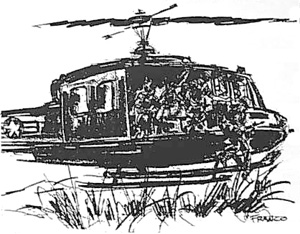
CU CHI, Vietnam - I've never asked what men think about while riding a Huey to a combat assault.
It isn't my idea of a proper question to ask during the assault and the thoughts are too fragmented by the impact of the event itself, in that moment when the chopper settles in and men, already poised, commence leaping out for whatever comes next.
Nobody can be expected to think back and recall exactly what he was thinking about on the way to that kind of a moment.
I've heard men talk about exactly what they were thinking about before a parachute jump or a chopper assault later, but I don't think they could be really that accurate and that specific in their recollections.
A recalled memory doesn't suit the question "--what do you think about before" . . . it asks a man to define a vague jumble of fears and maudlin sounding memories which came up in no logical pattern.
That's why the expression "sweating it out" came into usage.
It covers the subject without being embarrassingly specific or evasive and vague.
We sat there on the metal floor of the Huey, wind blowing in the open doors, gear feeling awkward, looking down at the watery-green surface or occasionally at another helicopter filled with men doing the same. Blankly staring out the door or picking at some buckle or strap on a piece of gear as if it were very important, the rotor and wind noises stop conversation, every man is involved in the very private world of "sweating it out."
One Foot Out Door
I had one foot out the door, the wind was beating on it. The flat green of rice and weeds splintered with the sheen of water under it and cut into squares by hedgerows were all studied with intent interest as if they were new instead of the same old frightening story.
I've kept count of these things, 119 of them now, and it was a bad habit to start. I had those moments, just when I felt the chopper sliding down toward a puff of red smoke the LOH scout ship had left behind it as it skittered along a paddy, when knowing exactly which number combat assault you are making is worrisome. It gives rise to special mathematics.
The chopper was swooping down fast now in a noisy, rotor-flapping descent toward the paddy. The absolute, self-pitying misery came to me for a few seconds, the despairing depth to which a violently seasick man can sink when 200 miles from any shore is as close as I can describe this particular part of a combat assault for me.
Bad Feeling
It is a bad feeling I always have when the chopper is still too high and too fast to get out of and too low for any self-delusion that the testing moment can be put off. I'm certain not many feel that way, that's just my personal moment of desperation. Some, I imagine, actually enjoy the clamoring excitement of that final few seconds in the air.
S-Sgt. Ira Holding, platoon sergeant of the "aerial-rifles" from Troop B, 3rd Squadron 17th Air Cavalry, Lt. Col. John Phillips' unique fighting unit was by me, on my right.
Holding had both feet dangling out of the chopper, now. One hand was braced on the scarred metal deck, ready to push himself on out at the right moment. He looked intent, frowning a little studying the brushy little rise of dry ground which appeared suddenly as the Huey came over the end of the LZ.
A businessman looking at the morning's work on his desk has about the expression Holding had as he made that final [text missing].
|
[text missing] . . . a man in the chopper door. The paddy had slowed its trek by the door, the distance down there from the skids to the brown-yellow water speared by the green rice was just inches. There was a movement from Holding just as I swung my other foot out the door and left the helicopter, he landed just as I did and we both surged against the water, trying to get distance from the chopper.
Beat A Hurricane
There was a terrific noise, the rotors beat a hurricane down at us, the water we fought against was flattened and rippled by the rotor wash.
The mud under the water was uneven, slippery, it grabbed my boots and held them or squirmed under them. The rice stalks tangled in gear. The water felt cold at first, thigh deep. I crouched as low as I could into it, bent forward, moving out to my part of the little circle you make to give the chopper room to get out of there.
This has always been the worst time for me during any combat assault which I can remember, this first movement toward cover in some strange way and very hostile feeling place.
Noise Is Gone
Suddenly the rush and noise of the choppers is gone. You realize now how comforting those tight quarters in the helicopter had been with other men and their gear wedged against you, lending strength to each other through their closeness.
That comfort of companionship is gone, now. These are good, seasoned men who shy away from each other, pushing for dispersion and as much distance as they can get toward the objective all in a rush. They've learned to resist the false security of crowding together and accept the hard facts of how to survive against fire in the paddies.
I could see the first cover, a slimy, muddy, sparsely-grassed mud paddy dike right in close to the high ground and its cover. The place any enemy we caught here would certainly claim for himself, that high ground was where I wanted to be and the paddy wall was the place to get first to make it there.
Fell Onto Dike
I fell onto the side of the mud dike feeling the mud soak into my fatigues, rolling on my left shoulder to get oriented with the others. Holding was already working with the radio. The squads were being checked by the NCO's, three men were just finishing their run over on the right.
I found a strap which didn't suit me and tugged at it. It was muddy and wet and wouldn't adjust, but it gave me something to do.
Holding looked at me and pointed ahead, then we were moving again, over the dike, feeling tall and ungainly, like a stork. Then into deeper water, into slippery mud, and suddenly we were bulling through a curtain of thorns and brush and flopping down behind a little earth wall traced through a patch of clearing.
Holding was studying the area now, looking at it hard and quickly. His shoulders settled and he grinned at me. "No sweat! We got a cold LZ! No sweat," he pronounced.
So when riflemen moved out along the hedges, walking carefully like men hunting snakes, looking for holes and bunkers, it was something new to sweat out. Which hedgerow had the enemy in it?
Always something new to sweat out.
The game had changed though, so anything you've learned, any luck you can claim, can start working for you now. You aren't at the mercy of vehicle luck anymore.
You're in a pool of careful isolation, working it out for yourself. And you wonder exactly what the others are really thinking about as the platoon commences its edgy progress into the brush ahead, but it just isn't the kind of question you should ask one of them just now.
|