|
(EDITOR'S NOTE: Charles Black, Enquirer military writer, is on his fifth reporting assignment in Vietnam, and en route to the war zone has visited various military hot spots in the world. This is another of his daily articles about combat missions on which he accompanied U.S. troops.)
CU CHI, Vietnam - I walked along becoming infuriated over the ways so many young and excitable correspondents seek out ways to use the word "ambush."
This frustrated anger about the eagerness of my contemporaries to search out an ambush in every firefight is always one of the more illogical thoughts I carry along on such walks as the rifle platoon from Troop B was making.
If I got shot doing this, some jerk would probably search eagerly, as if for a prized nugget, trying to establish that I was one of the statistics of an "ambush," implying that there was something crafty and cunning in what the Viet Cong had done and something clumsy and stupid in what we had been doing in order to get caught that way.
As we moved into the hedgerows and the remnants of some old house sites, we were looking for something we would be very lucky to see until we had taken the brunt of any shooting which started.
Need To Be Shot At
If we were hiding in the holes and bunkers buried in those thick hedges, he would have to take our fire to find us. Since we were hunting them, unless somebody had tremendous luck in spotting some enemy who was especially stupid, the chances were that we would find him by being shot at. This would be no ambush. We knew what we were going into.
Everybody knows this when moving into areas like this or into the outlying jungles, mountains, rubber plantations, or across paddies. Sometimes there are ambushes, planned and deliberate ambushes, which work. Both sides use them. Ours are more deadly when they are good ones. We have better communications, equipment and more firepower to bring them off properly. Good ambushes are rarities, for either side.
It's a weird thing to do, to think about something like that as you try to pry a section of thick brush and grass apart with your eyes, but I did it. I wrote part of a strong editorial about the subject in my head as I stepped over some dead bamboo, looking carefully first for signs of a booby trap, edging close to the brush line. Another infuriating thought, that . . .
My feet became sensitive as I put them down onto the turf and I had to make myself move ahead to get over this. The thought of booby trap or mine left me finally, the brush was close and there was a more immediate problem.
Seeing Is Believing
Maj. James McManus, B Troop commander in Lt. Col. John Phillips' 3rd Squadron, 17th Air Cavalry, has stated - not bragged or contended by stated - that his platoon was good at this. I saw how good now.
Never since we left the choppers had any little advantage of terrain been overlooked or any man moved except with a kind of spare economy which put him in exactly the best place he could get as quickly and carefully as he could get there. There hadn't been any talking.
S.Sgt. Ira Holding growled once about "bunching up" when three men eddied in too close to each other. The radio had been laconic.
Ahead of us there was something which took a big part of the threat out of those paddies, the little LOH scout helicopter worked out there like a beagle, poking into bad places and checking out the route ahead of us. Capt. James H. Montgomery, the troop commander, was in the LOH, piloted by Lt. James (Pop) Ingraham.
'Flies' Point
Holding ran the squads on the ground. Mongomery, 50 meters out front in the LOH, its skids just over the ground, zipping here and there to look at the problem from different angles, was walking point for us. He called Holding and told him about places to check, holes to hunt for, that a bunker appeared to be empty but that there was sign it hadn't been empty long.
In the hedge, riflemen were poking and prying, looking for a bamboo ventilator, a track, anything which would locate a hidden spider hole trapdoor.
"Over here, in this corner. I think it is old but I've got a spider hole," somebody called.
"Take care of it," Holding said.
Ground Shakes
there was a pause, some movement over there to our right, then somebody yelled "fire in the hole" and I stepped behind a thick, stumpy tree and waited. there was a gout of mud and logs, a muffled explosion, the ground shook.
|
Somebody on the left found another one, an open fighting position, a new one with green branches camouflaging the dirt. He and his buddy had a sack of AK-47 ammunition and a big block of C-4 plastic explosive in a plastic bag. Holes were being found and blown, bunkers caved in. We found oddments of uniform and web gear.
"They're like that now. Used to, you wouldn't find them even . . . [text missing] . . . They aren't as good as they used to be," Holding said.
"They are leaving stuff behind worse than we do," some rifleman joked, he had his left hand full of equipment, throwing it onto a green plastic sheet.
Isn't Showing Me Much
"Yeah, but you guys don't sweat out resupply like he does. If you had to make out like him, you'd learn not to scatter stuff all over the landscape. This just isn't showing me much, the way he leaves his stuff behind him. They don't fight like they used to either," Holding said again.
We kept looking and poking. We found mango seeds, piles of them, where he'd been pulling them from trees on the high ground we were on. They had been eaten just lately, during the night.
"I get a squad, maybe a platoon out of this. Look over there, that path, it goes up to a village. Local Cong meet him here, he gets some chow and holes up, just a small unit, then he moves out at night. He was here yesterday, he left last night. Nothing big," Holding decided when we came to the other edge of the clearing.
He grinned at me.
"How do my boys look?"
"You know how they look. They're good at it. They didn't pass anything up back there. Where we headed now?"
More Paddies
He waved to our front, more water, more paddies, a long, long way over another little hump of high ground, then beyond it the scrub palm and swamp brush of a canal line. There were hedgerows and other brush lines meandering through all this, angling into the main canal over there.
"Out there. Check it all. Work out this side of that little canal to the big one, then we'll go amphibious and go on the other side and to it some more. Be a long, wet day and that's about the best I can promise, too. He's got positions in every one of those places. He can be in any one of them. We find those bunkers, we blow them, with him in them if we are lucky. We find him, we holler for the old Cobra gunships and do our stuff. Be a long, wet day.
It was. A long, wet day. We had two men hurt in the middle of it, hand grenade fragments when they blew a bunker with an ammunition cache in it that went up like a big bomb.
Holding got hurt when we found a big box sunk in the water . . . [text missing] . . . bomb crater there. My right hip felt as if I'd broken it when I managed to kick my way out of the mud and water. The LOH was busy, scouting, then running over to pick up people who needed a lift and getting them to high ground where a chopper from the lift section could settle in and get them more readily.
Holding kept walking. I was holding to a man's shoulder, unable to lift my right foot up high enough to get through the mud. We came up to a deep canal and got through it. Then I came to a hedgerow, covered with water just to the top of the earth berm under it. I thought I saw movement and was too close to it to do anything except simply lunge at the source of the movement. It was the worst possible thing to have done.
A man is so hair-triggered and his senses so very acute at certain times that a broad stream of fierce red ants, the kind that make a nest of leaves and attack anything which they can reach like little drops of hot metal, look like some flickering danger signal. I smashed into the bush where I'd seen it, my bad hip forgotten in the urgency of grappling with whatever was giving me the scare. I tackled a million red ants who returned the gesture.
'Hell, Duck Him'
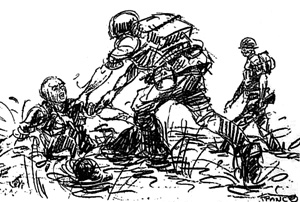
I stumbled back into the water, there isn't anything except a hundred burns which could feel like those red leaf ants. I jerked off my jacket and slapped and brushed. Holding yelled to somebody, I didn't notice who.
"Hell, duck him . . . duck him in the water, get those things off him."
Somebody ducked me, thoroughly and brusquely. The ants quit biting.
I came up feeling better. We picked 40 or 50 off which the ducking hadn't handled and I gave up smoking for the rest of the day, my cigarettes were in a plastic bag which had a hole worn in it, I found.
That finished it. We got up onto dry ground finally, everybody relaxed, muddy, tired, three men wounded, a hundred holes checked, a dozen bunkers blown, no enemy, a lot of his gear. A long, wet day.
|