|
(EDITOR'S NOTE: Charles Black, Enquirer military writer, reports from Vietnam on his fifth assignment in the Far East. On his way to the war zone he has visited various military hot spots throughout the world.)
DI AN, Vienam - The evening briefing at MACV in Saigon comes up with some interesting revelations some days, but the one I went to on my first day back here wasn't one of them.
People kept coming up I knew. Joe Treaster, (New York Times now, a PFC in the 2nd Infantry Division back in the old days) and I missed most of the briefing's small detail while we caught up on things. I'd eaten lunch with Horst Faas and Peter Arnett of AP so that annual ceremony was taken care of. This is the fifth of one of those "first lunches in Vietnam" with Arnett and Faas around the old Royale Cafe.
A couple of officers, looking different from the usual in Saigon, their jungle fatigues a little more faded and dusty, boots a little more scuffed, faces more tired, made signs to me through the open door.
I eased over there while someone talked about captured rice. The big lull was on in the war then and it was reflected by the bored and even polite questions asked by the newsmen. When the war is moving they are more harrying and questioning.
"You Charlie Black?"
"Right."
"I'm Capt. Clifford Lawson, this is Lt. Cecil Yarbrough. You know Lt. Col. John Phillips?"
"Sure I know him. Is he here?"
"That's why we're down here. We got a jeep. You finish here and we'll go up to Di An (west of Saigon) and show you the squadron," Lawson said.
"Squadron? What squadron?"
"Hell, there's just one! The rest of them are just trying . . . 3rd Squadron, 17th Air Cavalry. He's commanding it now. Got here in July," Lawson said.
He was from the cavalry, no doubt about it. They usually talk that way about whichever unit they're from.
"I was going on up to the 1st Air Cav Division tomorrow. Fixed up with a ride on a courier plane," I said.
|
"You better stay down here with us. This is where the war's going to start and we're spread all over the area. Guarantee you, if they make an attack on anyting in III Corps, one of our Troops will be in the middle of it. You can get up north when something breaks," Lawson argued. "Besides, the Colonel sent us to get you."
I couldn't argue with that approach. We made a deal to go up on Tu Do Street and extract my gear from the bowels of the Eden Rock Hotel (my civilized clothing I'd packed and left with Faas to keep at his house here until I got back) and go on out the road to Di An.
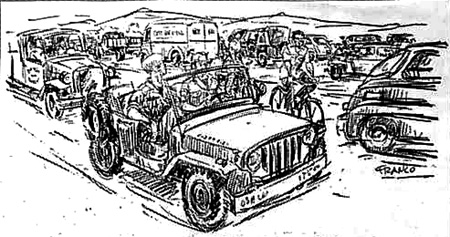
Saigon bid us a proper goodbye. Somebody put a parking ticket on the jeep when we stopped at the hotel. (Nobody pays parking tickets if it's attempted, in fact, but they are busy as can be writing them all the time.)
The road to Bien Hoa is a magnificent one. It was one of the first U.S. aid projects ever started here and was quite a controversy in its day. The monsoon had hit and as usual, all the concrete telephone poles had collapsed and made a tangled mess of communications lines along the road.
Convoys roared along in both directions. Lambretta scooter-trucks, army trucks, jeeps, commercial trucks, and an occasional ox cart, all raced on the 19 miles of good road. We circled around the vast headquarters complex built at Long Binh in order to get the huge American population out of Saigon. It now appeared as if a fair portion of Saigon had moved out around Long Binh with villages all over the place.
It was reassuring to note that things were still operating as usual in certain areas of the war. The huge, glassed, air-conditioned buildings of the headquarters were all painted a kind of dark cream color. At least half the huts, buffalo sheds, stores and tin roofs in all of the villages within ten miles of these buildings also sported a coat of the same paint.
"They probably liked the color so much they all went down to the store and bought some for themselves," somebody said.
"Naw, that's where the guys cleaned their brushes after they quit work on these headquarters building," somebody else offered.
Nobody was unfeeling enough to think that three times as much paint as was visible on the U.S. building seemed to have made its way out to the villages through possible skulduggery. Somebody from U.S. Aid just made a statement at a press conference that all of that kind of thing had been stopped since a new inventory system had gone into effect. It wouldn't have been kind not to have believed him. He believed it himself I am certain.
We turned out of the headquarters country and off up a bumpier and muddier road and got to Di An at dusk, in the rain, in time for chow.
|