|
(EDITOR'S NOTE: Charles Black, Enquirer military writer on his fifth assignment to the Asian war zone, recently accompanied U.S. forces in an engagement with enemy soldiers in Vietnam. This is the first in a series of articles explaining the encounter which lasted from 7 a.m. to 10 p.m.)
LONG BINH, Vietnam - Troop A's helicopters and men live in comparative luxury here at this big base with two story wooden barracks, a good mess hall, and other refinements which come with such huge U. S. military concentration.
They don't get to see much of all of the things outside of their little corner of the Long Binh world except while flying over it. Their work is done elsewhere and takes too much of their time end energy to allow touring the base facilities.
I ate breakfast at 6:30 a.m., coffee and doughnuts and a stolid stare at a cigarette burning down toward my fingers, and walked down a duckboard walk to the barracks nearest the helicopter pad.
A few jeeps were out front. A sign said this was the headquarters and orderly room of Troop A, 3rd Squadron, 17th Cavalry, commanded by Maj. John D. Jenks (whose late father was once a reporter for The Ledger-Enquirer Newspapers) with Maj. Michael D, Pierce as executive officer.
I drank some coffee in a paper cup while sitting on the ubiquitous brown, plastic-covered sofa ranged under a display of war trophies presented to Troop A, by the 9th Division and 199th Light Infantry Brigade which they have assisted in fighting in recent months.
There is a sample of about every North Vietnamese weapon in the book in Jenks, office. The brass plates on them are compliments sent from the infantry units they helped out of a jam or toward a victory.
Weapons Collection
They are impressive because the military is a competitive world in which units don't often give glowing praise to other units, especially unofficial praise. These in-family, unofficial mementos of esteem are the truest form of praise.
There are three valorous unit citations end two nominations for a Presidential Unit Citation pending, originating from the same units which sent the wall trophies. The unofficial awards back these up.
Sitting Different
The week before I came, a brigade commander put Jenks in for a Silver Star and the division commander - jealously proud of his own outfit but so impressed he was almost at a lack of words at what he had just seen - told Jenks that the "aero-rifle platoon from your troop is the best infantry platoon I have ever seen since I've been in the Army."
Jenks and Pierce finished up a discussion of administrative business about the time I had finished touring the little military museum. We went out to Jenks' jeep, me carrying a chest protector (called a chicken plate in the vernacular here) and a helmet both too large and making me feel clumsy.
Sitting in a helicopter presents a different problem than moving on the ground, however, so the things wore sensible enough.
I've never liked helmets of any description - a personal eccentricity, I find, as most infantrymen sweat by them in a fight but simply hate to
|
wear them to get to the fight - but the chest protector felt good before the day was done.
Even the fact that it was two sizes large and too long was OK when the right moments came along.
I took pot luck on sizes. With borrowed gear only too small can be turned down. Too big is acceptable. There is a kind of courtesy to be observed when borrowing gear. Take what is offered if you can get into it and make do. (If it can be improved on, your Army host will notice it and try to help with a second choice. If there isn't any second choice, you should be happy with what you got.)
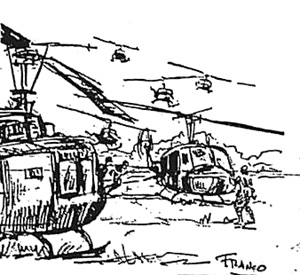
The jeep marked "A-6" took us out to the helicopter Jenks uses a UH-1C stripped of its gun mounts but with crew chief and doorgunner using their M-60's. Jenks said he took the guns off because he is "supposed to be the commander and I was going in and shooting too much."
There were the usual quick introductions to copilot and the crew. I missed the manes, as always, knowing they would become familiar after a few hours. They were just young faces and varied forms then.
The door gunner was a young Negro who was shyly polite. The crew chief had a mustache but looked like a teen-ager with a mustache. The copilot a lieutenant who had a mustache but looked about as youthful as the crew chief. He was tall and lanky, the crewmen were short.
Is On Second Tour
Jenks is athletically built and tall, and like most men of his rank who are professional soldiers and aviators, is on his second tour here.
One was with the Special Forces in the Mekong Delta, working with "Mike Teams," the quick reaction forces sent out to help camps in trouble.
He started this one in March. He has it just about half finished.
I spent just this one day of this tour with him. It wasn't the most exciting or the least exciting he has had or will have.
But during the day spent with him I watched the deaths of 17 enemy soldiers very carefully, five of them killed by the young, bashful doorgunner; three prisoners of war taken; idled along while some more or less peaceful aerial police work was done; was shot at by a man I could watch close his eye to aim an AK47; saw three helicopters hit; saw the rescue of a Special Forces Camp CID company after it was put to rout in the beginning; heard a young Special Forces officer live out the peculiar end horrendous problems of an adviser in trouble; saw two Viet Cong units simply wiped out of existence; watched a science-fiction intelligence gadget actually work, and finished 12 hours of actual flying in the chopper by taking part in a night extraction of a U.S. infantry company down in the Rung Sat Zone swamp.
The war went under me, by me, around me, and was sometimes in the chopper with me, as if I were sitting in some kind of a planetarium equipped a thousand different views of Mars.
It commenced immediately after the chopper took off from Tan An, accompanied by two LOH Scout ships and two Cobra gunships, on a search mission for the 2nd Battalion 60th Infantry of the 9th Division.
Jenks had landed and had gone up to the battalion operations center, then came back with the scout mission for the day. There was very little said except, to tell the others where we were going and why and we took off.
|