|
(EDITOR'S NOTE: Charles Black, Enquirer military writer, is on his fifth reporting assignment in Vietnam, and en route to the war zone has visited various military hot spots in the world. This is another of his daily articles about combat missions on which he accompanied U.S. troops.)
LONG BINH, Vietnam - While we refueled I talked to S-Sgt. Roy Wooten and Platoon Sgt. William J. Barber of the rifle platoon. They told me Sp5 Mike Binder was "still in a daze."
It was Binder's first ride in an LOH. He is regularly a crew chief on one of the lift helicopters that haul in the rifle platoon and doesn't often get a chance to shoot, most of his experience being that of getting "shot at."
Wooten said Binder killed four people during the day, enemy shooting at him "so close he thought he was getting powder burned."
"He got a lot of war out there in a hurry with that 'loach' riding," Wooten said.
The pilot of the loach, WO Russell Scudder, had taken his first ship home full of holes and gotten another, I found. (He went through two more LOH's by getting them bullet riddled two days later.)
Oddly enough, there was considerable sentimental concern among the riflemen about that particular ship. Not just the usual concern about having a piece of valuable equipment out of action, but a sentimental worry.
That LOH had been the chief figure in a big ceremony I'd seen the day before all of this. Maj. Gen. Robert Williams (former commander of Fort Rucker, then head of the technical evaluation group at Fort Benning during the 11th Air Assault Division tests, now commander of the 1st Aviation Brigade here) had been on hand.
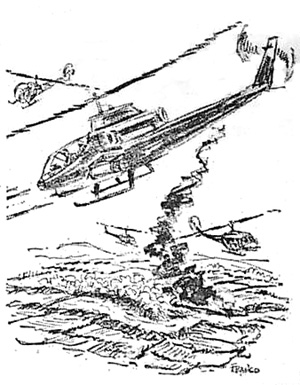
The ship was the first of its breed to reach a kind of golden goal, 1,000 flying hours. The first one in the Army to fly that long. It had been gleaming at the ceremony - with more than fifty patches attesting to what that 1,000 combat hours had meant in the way of bullets.
The week before the ceremony there was a crisis, it took 14 hits with about 965 hours on it. Maintenance heroes got it patched up again and it had finished that magic 1,000 hours with a final scout just before the big ceremony.
A Hughes Aircraft Company official had given out plaques and a certificate, Williams had shaken hands and passed congratulations, it was a big day for Lt. Col. John Phillips, the commander of the 3rd Squadron, 17th Cavalry, and a bigger one for Alpha Troop maintenance men, pilots and clerks and riflemen alike. That particular LOH was the pet of the squadron.
It had seven more holes in it and the word was that it would not fly any more for A troop. Maj. Delano Brister, the maintenance officer, was out of miracles for the battered old scout.
'Hit in the Heart'
"They shot up the main frame, hit it in the heart this time. It'll have to be rotated to the U.S. and be rebuilt. Won't be the same loach," a rifleman told me. "It made that 1,000 hours, though. They ought to get it and put it in the Fort Rucker museum, leave those last bullet holes in it."
Scudder was on the way with his new scout, Binder still riding with him; WO Stephen Leon with WO Barry Tronston were coming in a second loach. I found out we had owed the last battle to WO Steve Jay, WO Herb Darque III, crew chief Sp5 Franklin Nobrega and gunner Sp4 John White. They'd run the "sniffer" helicopter which had spotted the place. That battle was still going on over there with the infantry fighting hard and other gunships still working as was another scout team.
We left the pad at Duc Hoa and headed south for the new emergency.
This one had been on the radio now and I got the details through my helmet earphones, all wired directly into the war.
A Special Forces A team commander, "Tinny Tempo Six" on the radio, who had a camp on the Mekong River, had sent out a CIDG company with a Vietnamese captain in charge, advised by a youthful voice we couldn't hear yet but which would become very familiar during the afternoon as I suffered through his trials vicariously. He was "Tinny Tempo Five".
I wish I could meet the men who were involved in this down on the ground, not just know them by their radio signs and their voices, but I had no wish to do so on this particular afternoon. Tinny Tempo Six said the CIDG company was near a Viet Cong village, a brazen collection of huts built in the open in a VC controlled district, getting heavy fire from two sides.
They'd walked four hours to get there. As they moved on line to assault the village, they were taken under fire from a treeline along a big canal and from another running at right angles to it along a smaller canal. Then fire came from a grove of trees jutting up out of the flooded paddies on their east as well as from the south and western legs of the enemy defenses.
'In a Bad Way'
"The Cong is around them, they're around the village, the village seems vacant. He's in a bad way. That's a new company, a new Dai Ui, he doesn't have much control now, it's falling apart and we've got that one man and his interpreter down there. We don't want them there by themselves, and it's getting that bad," I heard once on the radio.
I don't believe that message was from the A Team commander. It came from "higher" as people up the chain of command are referred to, and I missed the source in the chorus the radio was making now with Jenks making plans with his forces, coordinating with the 2nd Battalion, 60th Infantry, even talking to an Air Force forward air controller who was heading that way.
|
It described the situation, whoever sent it. It was falling apart very badly down there. We first had trouble finding it. The Special Forces men had one smoke grenade. One of the Cobras sprinted by our command ship, a UH1C, to get on station and ready to fight, and as he passed over, the American on the ground threw the smoke. The Cobra was heading for map coordinates, which were off 1,000 meters to the west, as we were. He missed seeing the smoke. It made it very complicated for the next ten minutes.
I heard the young voice for the first time as we passed over the big canal.
'Way Over Here'
"I'm over here, way over here, damn it, come on to the village," he was saying, excited and desperate.
"Tinny Temple Five, this is Silver Spur Six. Now you and I have to get together. You're out of smoke. Now do you see my helicopter? Over," Jenks calm and somewhat exasperated drawl cuts in on the air.
There is confusion. Tinny Temple Five gave us flight directions, told us to make a turn, then shouted ". . . you're turning away from me. Oh my God, (then a kind of embarrassed laugh) you've got a lot of helicopters up there! I guess I've been watching the wrong one. Identify which one to direct, please, over."
It's hard to get over the gulf between ground where the brush or a dike a few feet away bounds the world and the sky, where the world looks simple, like it does on a map. Jenks did it by having Sp4 John Russell, his door gunner, drop white phosphorous grenades. He circled the white puffs and the man on the ground got him spotted.
'Don't Know Terrain'
"Let's see! You see the village? No, you're 1,000 meters west of me! I can't direct you over here. I don't know the terrain," he said, his voice very much under pressure.
Jenks snarled at him.
"Now young man, you settle down. We're going to get you out of this. You just settle down and we'll get coordinated and working here and you'll see what I'm talking about. You don't have any more problems, now. You get with the program. I'm going to fly a straight line from where I am right over to you. You just tell me, take your compass and look, what direction I am from you and how far, and then tell me when I'm over you, if I don't spot you, over," he snapped.
Things got calmer after that. The radio directed us to fly east 1,000 meters, then corrected us a little south for 300 meters, then we spotted them, a long line of men huddled against an earth wall in brush, wearing tiger suits, not firing.
Then Jenks and the suddenly cool young voice worked out a 40 mm. grenade run for the Cobra handiest, down a canal, the one on the southeast.
"That's it, oh baby, that's on it! Do that some more, on down that line to the south, then that big treeline," the voice said.
"That treeline on the big canal?" Jenks asked.
"Man, if that's a canal over there, that's where I want it. I can't get up high enough to see too much," the voice came back.
Cobras took turns rocketing there.
A Huey from A Troop equipped with a CS (teargas) dispenser came on the radio. "Ok, One Seven, you go on up to that grove, the one I'm marking now (Russell threw smoke as we dived in) and just CS it to your heart's content. You've been wanting to try that thing, here's your chance. Have a ball," Jenks said.
The Huey happily dived down onto the grove, a cloud of blue smoke filling the air down there.
Firing broke out from one of the "bad pieces of terrain" the voice on the ground was complaining about. A Cobra dashed in, rocketing. The shooting stopped from there but the rockets, 10 meters from the green CIDG soldiers, had a horrific effect on the friendly troops. I could see them running, moving out across the rice paddy, away from the little group of men with radios.
"They're saying you're shooting too close. Shortly his interpreter, apparently, says they're scared. The commander won't do a thing I tell him to, and he's lost control of them, they're taking off on us," he said.
Jenks got snappish again.
"You tell those fools that if we have to we can shoot rockets 25 meters in front of them. Those people are 100 meters from those things. You get that office and get those people under control, you can do it," Jenks said. "This stuff is going to get them out of their trouble if they get some sense down there."
Jenks said on the intercom then ". . . I hope he makes it! He's in real trouble. He's got a world of trouble!"
I could see the slow process, men running and yelling at the troops. The pause, then the scattering men drifting back together and then running quick for the shelter of the earth wall and the brush again.
A Cobra had laid a line of 40 millimeter grenades very precisely along a line of brush which was directly in front of their line of retreat. There was VC firing coming from there then. They would have run into a death factory if they had crossed the last earth wall between that brush and their scattered ranks.
"He made it! He got them back again. He'll make it," Jenks said.
Scudder came on then. He had been down hunting death and violence. He had found some. He had killed three VC by the river with his miniguns.
|