|
(EDITOR'S NOTE: Charles Black, Enquirer military writer, is on his fifth reporting assignment in Vietnam, and en route to the war zone has visited various military hot spots in the world. This is another of his daily articles about combat missions on which he accompanied U.S. troops.)
LONG BINH, Vietnam - Things were becoming very complex in the world of "Tinny Tempo Five" - just 30 minutes after the desperate young voice had sounded in my earphones.
Then he had been a lonely young American Special Forces officer with things going very badly. His CIDG company, out on what should have been just a training patrol for a new, green unit, had been surrounded.
The Vietnamese officer in charge suddenly had become stubborn, refusing tactical advise. The irregular soldiers in the command had commenced drifting out of any control exerted by the commander and the U.S. advisor was lonely and desperate.
Then the scouts and gunships from Troop A, 3rd Squadron 17th Cavalry had showed up and after a tense few minutes, it looked as if the unit was being put back into a disciplined body of men instead of simply some young and frightened peasant boys running for their lives. Enemy fire had been silenced, three of them killed by a questing scout, others killed or driven to cover by the thundering Cobra gunship rocket runs.
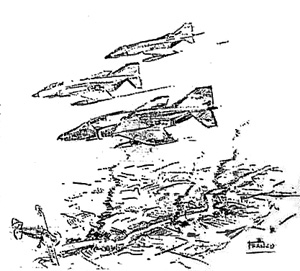
Four jet fighters appeared and the Air Force Forward Air Controller (FAC), who had been busy buzzing around in his little light plane, was directing them in on targets he had been keeping books on. Big, billowing napalm streams appeared. The blast of bombs and rockets punctuated events in the jet arena.
There was, one way and another, a 360-degree circle of fire, shrapnel, bullets, tear gas, and friendly eyes and weapons sketched around "Tinny Tempo Five," the NCO's radio call sign, the only identification I am able to give him. He was busy down there, along with his earth-wall and brush-line, walking along, running sometimes, talking and gesticulating.
He got the CIDG lined up while the complicated ring of fire was kept alive by new entrants into the business of helping him. Just half an hour earlier, that bit of cover represented what he must have accepted as his last stand position, and probably one he would have had to make himself.
There was much more coming into his little isolated world, however.
A company of U.S. 9th Division soldiers from the 2nd Battalion 60th Infantry was suddenly jumping out of helicopters and moving across the paddies on the side where the CIDG had been first hit, and where two had died.
One of A Troop's lift ships, with CW2 Steve Jay, W1 Herb Darque III, Sp5 Franklin Nobrega and Sp4 John White on board, took off from Long Binh and went to the Special Forces camp, four walking hours away but minutes by chopper, and picked up a load of ammunition. They suddenly landed near Tinny Tempo Five and little CIDG troops ran out and grabbed the boxes and crates and hurried back to the earth wall.
That problem had been coming up on the radio for several minutes, the CIDG had fired wildly and were almost out of bullets when the momentary panic had struck, adding to that problem and making it tough on the young NCO to argue for holding where the unit was, on the verge of sweeping and destroying the Viet Cong village stronghold they had reached when the ambush hit them.
The NCO got his troops on line. They stood up, firing, and went into the village, seven big straw huts, actually. Little groups edged ahead, firing the straw. The flames revealed that the interior of each was filled with a huge, mud and timer bunker. They threw grenades into these.
There was a sudden spirited assault by some of the CIDG. It looked quite different than what had happened before. Then the green troops reverted to their old undisciplined ways and they threw weapons down and chased chickens and ducks with complete oblivion to the threat of an enemy left in the area.
|
Having His Troubles
Tinny Tempo Five was complaining to Tinny Tempo Six, his boss, that he was having as much trouble as ever getting them out of the village so they could sweep on into the trees not covered by American troops (who weren't meeting any resistance behind the rolling wall of fire put down from the air and who were already searching out positions abandoned by the Viet Cong, or lost by the seven dead men they found in them.)
"Leave it up to those G.I.'s, you're out of trouble now so let's not push your luck," Major John Jenks, A Troop commander who had come in and salvaged the day with his scouts and gunships, advised on the radio.
"Get those people lined up and get on back here. Get back here ASAP! (As Soon AS Possible - with a note of command implied.)," Tinny Tempo Six said to his NCO, making Jenks suggestion official.
It was getting dark. The battalion commander of the 2nd of the 60th had companies to pick up all over the area. One, over at the second site of the second fight of the day, was still shooting and would be a night extraction job. Jenks said A Troops would take care of that one.
Helicopters Short
But there were just so many helicopters available to the unit Jenks was supporting. They counted out a little short of what the outfit on the ground needed to get back together so the next events in its share of the war could move ahead on schedule. Jenks had some lift ships and some good pilots. He offered to help.
It was about 10 hours worth of riding in the helicopter. Perhaps 12 hours after I'd had coffee and headed for the helicopter back at A Troop's home in Long Binh. The night extraction seemed an unthinkable addition to the day, but so had everything else since 10:30 a.m.
And all I had to do was ride, I reasoned. The work would be done by men whose day had been just as long and a lot tougher than mine. And it did round it all out.
We had captured a prisoner: reacted to intelligence and had a fight; established an area as being peaceful; found another fight through scientific intelligence methods; rescued a lost situation for a Special Forces Advisor; seen Civil Affairs at work as compensation was paid for a wrecked house taken over by the Viet Cong; seen another village burned and looted by angry Vietnamese irregulars after the Viet Cong defenders had ambushed them; seen a medical evacuation, resupply, three combat air assaults into firefights; seen a bit of the special politics of this war worked out as Vietnamese officials granted permission for operations or denied them for whatever reasons; seen a method of sparing innocent women and children while stopping sniper fire by use of tear gas from a helicopter; watched the intricate process of applying aerial firepower; seen gallantry and fear, despair and triumph, men killed and wounded and men escape death by inches; been shot at an uncountable number of times and watched some of the men as they did the shooting . . . why not a night extraction?
I recounted, to Jenks over the intercom, the list of complexities the day had offered and made a very lame joke.
"That'll still leave the rest of the night. What are we going to do next?"
"Oh, that's right. We've got a squadron party tonight. Saying goodbye to a couple officers leaving, having the new, junior lieutenant recite "Fiddler's Green," the old Cavalry poem . . . you know, a real ceremonial. Be starting a little late, but that will take care of the slack time, anyway," he told me.
I lapsed into silence and smoked in the darkness, watching the rotating red light on the rotor wash the doorguns with sudden blushes of color. I looked at flares, tracers and explosions off on the black horizon as we went toward the last two hours of work before we could relax at a Squadron party.
Just the thing I needed most except possibly a good case of pneumonia or a broken leg, I decided. (I enjoyed it, in a numb and dazed fashion, but I didn't look forward to it just them.)
|