|
(EDITOR'S NOTE: Charles Black, Enquirer military writer, is on his fifth reporting assignment in Vietnam, and en route to the war zone has visited various military hot spots in the world. This is another of his daily articles about combat missions on which he accompanied U.S. troops.)
DI AN, Vietnam - Capt. Michael Vicelleo whipped the tiny LOH scout helicopter into a tight pedal turn at about five feet of altitude and 60 knots and tilted it handily for me to inspect a line of nipa palm and hedge growth as he paraded sedately along in front of it.
"Take a look in there pretty good. They get back into those holes and bunkers and shot me down from right in there last time I was over this place," he said through the helmet earphones which seemed directly connected to the pit in my stomach.
"If you see something, holler," he added.
"Friend, if I see something you can absolutely depend on me hollering," I promised.
The hedge line had the typical threat to it of almost all such growths in this country. Years of war, years of digging, years of one side or another moving back and forth over the landscape, has turned most of the populated areas and adjacent strips such as the one we were scouting into an immense fortification.
The holes here were fighting bunkers, the kind dug by the Viet Cong or North Vietnamese. They dig a hole, roof it with sticks, pile dirt on the sticks, making a little bunker. Gras and bushes sprout making a kind of natural camouflage over a hole dug to be hidden at the start. They add to the camouflage as they move in. The trick isn't just to spot a fighting hole, you can throw a rock and hit one of those just about anyplace, the trick is to spot signs that somebody is IN the fighting hole at the moment you happen to see it.
That's what I was looking for as Vicelleo darted, hovered and wriggled the little helicopter along the position. A new branch broken and placed as camouflage instead of old ones is a good sign. A piece of plastic poncho, not beaten into the mud but laying up on top, some gear, signs of eating, a fresh footprint, or the muzzle of an AK-47 with flashes coming out of it - all of these are important to look for.
My eyes were so wide I had to push the flight helmet back off my forehead a couple of times. All I saw were those old bunkers with scars of bullets and rockets around them.
"It looks clean," I finally ventured.
"Hey, that's a shame. I was certain if they weren't over in that hedgeline they'd be over here. Don't you worry, I know a place where we can find some for sure," Vicelleo assured me, the perfect host. "Well, let me show you how I got shot down."
It was just what I wanted him to do most the the moment but I told him if there was anything else he had in mind instead to just not worry about my education. He told me it wasn't any trouble and he was kind of curious about looking at it again himself. So he showed me.
"They were shooting up those other bunkers with the Cobras. The 25th Infantry Division was sending in the infantry to get those seven 122mm. rocket launchers I told you about, over beyond that hedgerow there. Davis and I (his observer, Lt. Robert Davis) had just checked where you and I went. We saw some people, signs of them. So I whipped around in a circle (doing so) and used the minigun to hose them down," he said.
The LOH was boring in on the bunkers. The minigun was in a kind of cylindrical pod just beneath my left foot, a gatling gun which pours out 20 seconds of fire at 6,000 rounds per minute, then runs dry of ammunition in an LOH. Its function is to get them out of trouble with people they find while the scout scoots off out of the way of the gunships who can shoot for a long, long time indeed.
|
Turned and Got Them
"They stayed down, but as we came up over, you see that ditch? Between the bunkers and the river? Six or eight right in there, Davis saw them, they had AK-47's and they were shooting. We turned and got them, like this, Davis shooting out the side with the CAR-15 (a stubby carbine version of the M-16 each LOH has on board with a box of clips) and we got everyone of them," Vicelleo said.
There was grisly evidence of it in the ditch. The Viet Cong had quit any pretense of tending to the bodies of their dead as they once did. They litter the countryside now, grim markers for battlegrounds.
"We made another turn and came back over, Davis dropped a smoke grenade right here, and wham! Some old boy was shooting a machinegun right up the bottom of the ship from about six feet under, where you are." (I fidgeted toward his side of the chopper.)
"We made it about this far, 50 meters, and plunk, right down in the paddy, she just didn't want to fly no more. So there we were with that cat shooting at us from back there and everybody busy over there. We got out and got down and those gunships saw us and rolled in, and that was that. They finished them. Then the slicks picked us up," he said.
"When it all got finished, we got 43 of those people killed, those rocket launchers, a whole pile of weapons and gear. You wouldn't think there'd been a fight like that looking at this place, would you?" the pilot said, taking us into a sudden humming bird-like rise so I could view the place from 100 feet.
Flat Paddy Land
He was right. It was just flat piece of abandoned land, the rice once there choked out by weeds and reeds, the little rows of brush and trees innocent in appearance, obviously too scrubby and poor a cover to hide anybody.
But they did. Vicelleo spotted it, a sampan pulled under brush, hidden, tucked away so that only a flash of wet lumber gave it away, just across the river from us.
There was some more of the maneuvering, buzzing, circling, playing cat and mouse then, a game which makes you giddy if you aren't very hardened to helicopters at low level, but which is exciting as a steeple-chase when you get caught up by that kind of flying.
The Cobra talked in the radio. Vicelleo kept playing. The fishermen here weren't friendly. Sampans here are war goods haulers. This is free fire land, shoot at anybody land.
There was a lot of it before the problem of the sampan and of some bunkers which came into view during the scout of the sampan were solved. The Cobra's rockets took care of the bunkers. CAR 15 fire solved the problem of the friendly fishermen's day and sampan and the minigun, a howling noise to have by your left foot, ripped out a line of brush where some more holes were spotted.
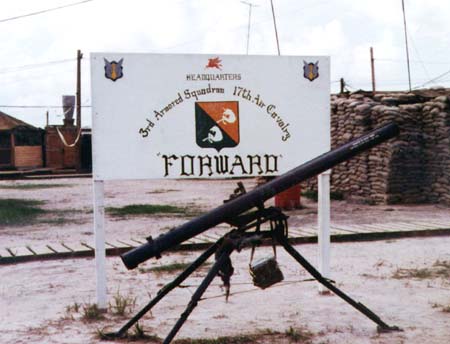
It was an interesting fire demonstration, exciting, and I was glad it was over when it was over and we zipped up high, out of harm's way, to head back here to Bravo Troop, 3rd Squadron 17th Cavalry's helipad.
"About an hour and a half is as much as you can handle of that at a time. You can stay on station longer, but an hour and a half, that's about how long a man can stay on top of that kind of thing. Get refueled, sit down and rest, then make another run when your turn comes. Scouting is like nothing else in the world," Vicelleo said.
He was right, an hour and a half at once is enough, I agreed.
|