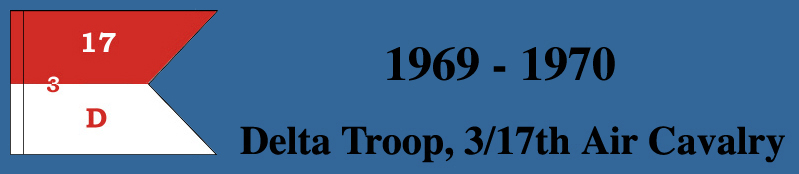
OrientationWhen I first arrived in Vietnam, I shuffled around at the replacement battalion in Long Binh until somebody shipped me over to 12th Aviation Group. After the Group personnel clerk and I exchanged suitable paperwork, he shipped me off to Di An, where I found the 3/17th headquarters. The squadron clerk and I exchanged more suitable paperwork, then we chatted about the location of the Coke machine and the john, and I listened to him click his tongue about my assignment to Delta Troop. The tongue clicking sounded a little ominous, but I was a brand new second lieutenant and did not yet know the ways of clerks in a combat zone. Sometime during in-processing, the clerk handed me an orientation pamphlet, so I could get "orientated". I got around to reading it later that evening: 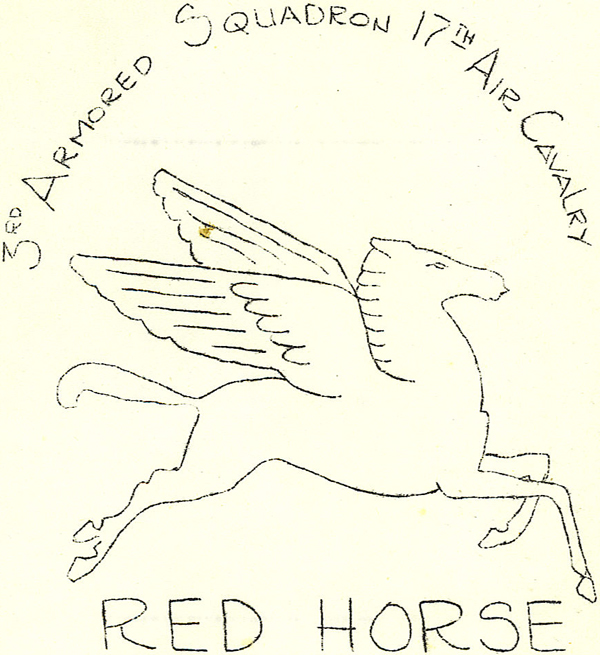 Page 1 |
|
DEPARTMENT OF THE ARMY SUBJECT: Squadron Commander's Welcome All Newly Assigned Personnel As your commander, I welcome you to the Red Horse Squadron, a unit which combines the latest and best features of Army Aviation with the proud, time-honored traditions and proven tactics of the Cavalry. Throughout history, Cavalry, as the light mobile arm, has been the "eyes and ears" of our Army. Mounted originally on horseback, then vehicles and tanks, and today on helicopters; the Cavalry's primary mission has always been to find the enemy and prepare him for destruction. Our mission here is no exception. Continuously since its arrival in the Republic of Vietnam, the 3d Squadron 17th Air Cavalry, has performed an outstanding job, The units we support have naught but praise for air cavalry. This reputation has been achieved through hard work, dedication and sacrifice by the officers and troopers of the Squadron who have preceded you. Whatever your assigned task in the 3/17th, be assured that it is vital to the accomplishment of our mission. Our force structure is "lean and mean", therefore every man must do his best. Such activities as maintenance, supply and administration are just as vital to our operation as good flying and accurate shooting, for without proper support our aircraft and crews cannot fly their missions against the enemy. I therefore urge you to pitch in, learn your job and perform it to the best of your ability. You will find that those working along side you are doing the same. In this manner, you will find that a year in Vietnam will pass quickly, and by the end of the tour, you will have experienced a deep sense of accomplishment and pride, both in yourself and in the unit in which you have served. JOHN B. FITCH Page 2 |
|
UNIT HISTORY The 3d Squadron, 17th Cavalry was constituted 1 July 1916 in the Regular Army as Troop C, 17th Cavalry, and organized 9 July 1916 at Fort Bliss, Texas. The unit was inactivated 26 September 1921 at the Presidio of Monterey, California, and disbanded 9 March 1951. The unit was reconstituted 1 March 1957 in the Regular Army, assigned to the 11th Airborne Division, and activated in Europe. Concurrently, 11th Airborne Reconnaissance Company consolidated with Troop C, 17th Cavalry, and the consolidated unit designated Troop C, (Reconnaissance Airborne), 17th Cavalry. The unit was relieved from assignment to the 11th Airborne Division 1 July 1958, and activated 15 November 1958 in Europe. The unit was activated 15 March 1962 at Fort Knox, Kentucky as Troop C (Airborne), 17th Cavalry, and inactivated 16 January 1963 at Fort Knox, Kentucky. On 1 February 1963 the unit was redesignated as Headquarters and Headquarters Troop, 3d Squadron, 17th Cavalry, and assigned to the 11th Air Assault Divi sion (organic elements concurrently constituted in the Regular Army). Troop B (Airborne), 3d Squadron, 17th Cavalry, was activated 7 February 1963 at Fort Rucker Alabama. The 3d Squadron (less Troop B), 17th Cavalry, was activated 19 March 1964 at Fort Benning, Georgia. The unit was relieved from assignment to the 11th Air Assault Division on 30 January 1965 The 3d Squadron, 17th Cavalry, was inactivated 1 July 1965 at Fort Benning, Georgia. With the increased buildup of US Forces in Vietnam, the need was expressed for a means to gather field intelligence as well as increase reconnaissance capabilities which would be immediately available to the field commander. Due to this need, the unit was then activated 25 November 1966 at Fort Knox, Kentucky, as the 3d Armored Squadron, 17th Air Cavalry. Those personnel assigned to the squadron at that time immediately started planning and making preparations for the training program. Training exercises were later conducted at Camp Atterbury, Indiana, and the Mountain Ranger Camp, Dahlonega, Georgia, as well as the Fort Knox Reservation. These training exercises stressed air cavalry tactics as applied in various terrain situations. At Dahlonega, the squadron received five days of training and practical application of ranger techniques as taught by the ranger committee. Advanced unit training commenced 5 July 1967 with the squadron making road and air movement to Camp Dawson, West Virginia. Through the cooperation of Page 3 |
|
the West Virginia National Guard and the staff at Camp Dawson, elements of the 19th Special Forces Group (Airborne) of the West Virginia National Guard and the Maryland National Guard were made available to act as aggressor forces during part of the training period. Troop ATT's and squadron level training were also conducted at Camp Dawson which provided the squadron with an excellent opportunity to prepare for the squadron ATT, On 25 July the Squadron returned to Fort Knox. The squadron ATT was administered by the US Army Aviation Group (Prov) from Fort Knox. The testing area selected was the Green River area near Camp Bellsville, Kentucky. The ATT, conducted 2-4 August, covered all aspects of the squadron's operations with emphasis being placed on the activities of troop and squadron command posts. Upon conclusion of the ATT, the squadron was declared combat ready. The preparation for overseas movement began 5 August and continued until the departure of the squadron from CONUS on 10 October 1967, by ship. The advance party arrived at Di An, Republic of Vietnam, on 14 October and started preparations for the main body which arrived in-country on 31 October 1967. The squadron prepared a base area at Di An and participated in in-country training with the 3d Squadron, 4th Cavalry, Phu Loi; 1st Squadron 5th Cavalry, Bear Cat; 11th Combat Aviation Battalion, Phu Loi; and 2d Brigade, 1st Infantry Division, Di An. The squadron became operational on 1 December 1967 and participated in Operation "Buena Vista" with the 199th Light Infantry Brigade. In support of this operation the squadron killed 113 Viet Gong and NVA. On 8 December the squadron commenced Operation Yellowstone with the 25th Infantry Division. The squadron established a forward tactical base at Soui Da, conducting reconnaissance operations in War Zone "C". During the support of the 25th Infantry Division, the squadron gained their fame by killing 209 Viet Gong and NVA, destroying over 400 structures, and large amounts of Viet Gong and NVA supplies. During the first Tet Offensive the squadron was instrumental in the defense of both Saigon and the Bien Hoa - Long Binh area. This operation was extremely successful, inflicting heavy losses on the enemy, Approximately 479 Viet Cong and KVA were killed, and 127 Sampans and storage areas destroyed. During the second offensive launched on the Saigon area, the squadron was instrumental in curbing and intercepting the enemy forces coming from War Zone "C", inflicting heavy casualties on the enemy before the units reached the Saigon area, and killing over 700 Viet Cong and NVA. In the months following Tet, the squadron conducted extensive armed visual reconnaissance, road convoy security, checkpoints, and hunter-killer team tactics in creating an enviable combat record. The air cavalry squadron has proven itself to be an outstanding intelligence gathering unit for higher headquarters, and a first rate combat unit as well. The squadron can move, shoot, and communicate under almost all combat conditions and has never failed to find the enemy. Page 4 |

Page 5 |
|
GENERAL INFORMATION 1. ARRIVAL Regardless of the troop to which you are assigned, you will initially report to the Squadron headquarters, where your records will be brought up to date, checked for accuracy and placed in the proper personnel and finance files. Upon your arrival at your assigned troop, you will draw the proper equipment and bedding from the troop supply. You will meet the troop 1st Sergeant or Commanding Officer for a brief orientation of your area and troop organization and policies. 2. UNIFORMS With the exception of flight crews, fatigues are the duty uniform throughout the Squadron. Flight crews are being equipped with the fire retardant "Nomex" flight suit as they become available. The black pin-on collar insignia is now authorized for enlisted grades and may be procured through the several commercial sources on post. Either the jungle fatigue or the standard fatigues may be worn. The two uniforms however, will not be mixed. 3. LAUNDRY Free laundry service is available thru unit supply. Several laundries run by Vietnamese nationals are available on post. Most of then offer three (3) day service and they will also launder your civilian clothes. 4. FOOD AND SANITATION Because of local sanitary standards, caution must be exercised concerning food procured on the local economy. This is particularly applicable to off-post obtained raw vegetables, unpeeled fruits, water, ice, and milk products. The Surgeon's office can provide additional information concerning specific items which should be avoided. 5. MAIL SERVICE Mail service to and from Vietnam is excellent. First-class letter mail travels to and from Vietnam by air, with service to most points in the United States averaging three to five days. While stationed in Vietnam, you have free mailing privileges for air/first class letter mail and sound recording tapes. Your complete return address and the handwritten word "Free" (in lieu of postage stamps) should be placed on outgoing mail to United States, Puerto Rico, or other possessions of the US where domestic mail service operates, or any Army, Navy or Air Force Post Office. Do not write "Free" on mail to foreign addresses; the APO will stamp "Port Paye" on these items. You can also advise your correspondents that first class letters with normal surface postage are usually sent to Vietnam by air on a space available basis. Page 6 |
|
Parcel post packages weighing five pounds or less and measuring less than 60 inches length and girth combined are moved by air on a space available basis between Vietnam and the west coast of the United States. Movement of parcel post is by surface unless the air mail rates are paid. Personnel are cautioned that certain prohibited items such as flammables, liquor, weapons, obscenities, and US or foreign currencies are not permitted to be mailed through postal channels. Members of the Armed Forces stationed in Vietnam are entitled to a $50 customs exemption on bona-fide gifts purchased in authorized facilities of the Armed Forces. Special customs tags (POD -Form 2966 or 2967), available at the Army Post Office, must be completed and affixed to all outgoing packages. Until you get a more definite address, your mail can be addressed as follows:
6. TELEPHONE SERVICE A Mars station is located near the Headquarters troop orderly room at the Di An base camp. These telephone calls are placed via radio to an amateur radio operator in the U. S. You then pay for the charges from the receiving station to your home. All calls, of course, are collect. Vietnam is thirteen (13) hours ahead of Eastern Standard Time. 7. FIREARMS The mailing or introduction into Vietnam of personally owned firearms is prohibited. Individual weapons will be issued upon arrival at your unit of assignment. Weapons must be kept readily available at all times and carried when away from the base camp. 8. RELIGIOUS ACTIVITIES The Squadron Chaplain has an office at Squadron Headquarters and also at Support Command Chapel. Besides worship services in the Chapel, Protestant services are also held in the Troop Areas and the personnel are encouraged to participate in these services. The schedule of services is as follows: PROTESTANT WORSHIP
Page 7 |
|
CATHOLIC WORSHIP
JEWISH SERVICES
The Chaplain's Office hours are: 0900-1130 at Squadron Headquarters and 1430-1630 at Support Command Chapel. During the other hours, he will be visiting the Troop areas, and he is available any time to the personnel for counseling and assistance. The Chaplain is assigned to assist and lead the personnel in moral and spiritual affairs. You are invited to avail yourselves of his services. 9. AMERICAN RED CROSS The Red Cross furnishes excellent service at their offices throughout the III Corps area. You should notify your dependents that in case of the death, serious illness, injury or other emergency involving your immediate family, they should notify their nearest Red Cross Chapter or Field Director. The local Red Cross will transmit the needed facts regarding emergency leave to the Vietnam Red Cross Field Director who, in turn will then notify the serviceman and also confirm the facts of the situation to the proper military commander who has authority to grant emergency leave. Financial aid to pay for transportation and expenses in the U.S. will also be provided to the serviceman by the Red Cross, if needed. Depending upon individual preference and financial circumstances, this aid may be provided as an outright gift, or as an interest-free loan that can be repaid in small monthly payments over an extended period. These Red Cross services, like all Red Cross assistance to servicemen, are given free of charge through the contributions of the American people. 10. RECREATIONAL FACILITIES Free movies are shown nightly within most units. The American Forces Vietnam Network provides AM and FM radio programs as well as television shows. The Stars and Stripes newspaper is published daily and distributed without charge to personnel of 3d Sqdn 17th Cav. Periodically, USO and other shows are presented. Additional activities are planned for the future. Recreational activities are conducted under the auspices of the Special Services Officer. Various types of sports equipment and games are available for loan through the unit Special Services Officer. 11. EDUCATIONAL OPPORTUNITIES (USARV Reg 621-5) Educational opportunity is one of the greatest benefits available to you in your military career. Regardless of whether you make the military service a Page 8 |
|
career or return to civilian life, the emphasis on personal advancement toward success in your profession is education. In Vietnam you will find an Army Education Center staffed by professional education advisors at each command. These centers will provide you with educational information, classes, correspondence courses, testing and counseling. The educational goals of the Army as outlined in AR 621-5 and USARV 621-5 are:
Despite the environment and additional working hours of duty in Vietnam, a carefully prepared plan of study can enable you to pursue your educational and personal goals For further information on these programs call or contact the Squadron Assistant Adjutant. 12. POST EXCHANGE The PX stocks most essential items, as well as some gift items and clothing. Luxury items and cigarettes are rationed but the ration is liberal and adequate. Although most items are normally available, individuals with particular cigarette brand preferences may wish to bring along an adequate supply to last you initially. 13. ELECTRICAL APPLIANCES All electricity used by 3d Sqdn 17th Cav units is 110 volts 60 cycle. American appliances, including electric razors, work satisfactorily. Most personnel have found it desirable to bring a radio, an electric iron and a camera. With the exception of an iron, these items can usually be procured at the Post Exchange in a variety of styles and price ranges,, Television sets, tape recorders, photographs, electrical fans, and small refrigerators are also normally available at the PX. Air conditioners are not available in the PX. These are "nice to have" items in most locations if you are able to ship one in your hold baggage. 14. RATION CARDS (USARV Reg 60-7) During your initial processing, you will be issued a ration card for post exchange purchases Three rationed items are liquor (3 bottles per month) cigarettes (6 cartons a month) and beer (3 cases per month). Other items such as tape recorders, fans, watches, slide and movie projectors, radios and certain cameras are controlled items and will be marked on your card at the time of purchase. The sale, barter or trade of items purchased through Armed Forces or Commissaries is prohibited Page 9 |
|
15. VIETNAM TOUR (USARV Reg 614-30) The normal tour of duty in Vietnam is 12 months. Your scheduled date of departure from Vietnam (DEROS) is normally one day prior to the anniversary of your date of departure from CONUS. Curtailment of the normal tour is granted only in exceptional cases where extreme hardship exists or where a specified reporting date to the next duty assignment must be met. Extensions of the normal tour may be requested in increments of one month up to a year at any time prior to 72 hours before departure. Personnel who extend for periods of six months or more are entitled to 30 days nonchargeable leave exclusive of travel time to any place in the world not restricted to military personnel. Travel for this leave is on a space required basis at no expense to the traveler. 16, ASSIGNMENT PREFERENCE STATEMENT (AR 600-200 EM, AR 614-100 OFFICERS) All officers warrant officers and enlisted men in the grades E7, E8, and E9 are reminded of the requirement to submit an Assignment Preference Statement prior to completing this tour. Officers and warrant officers are required to submit preference statements 9 months prior to rotation. Senior enlisted personnel in grades E7, E8 and E9 are required to submit preference statements 7 months prior to rotation. Enlisted personnel promoted to E7 must submit a preference statement immediately upon appointment. Grades E1 through E6 are reported on the advance overseas returnee roster (USARV Reg 614-220} four months prior to DEROS> 17. R & R AND LEAVE (USARV Reg 28-5) Each individual serving in Vietnam is authorized one 7-day out-of-country R & R per normal tour. All R & R's will consist of five nights at the R & R site. A minimum period of three months (90 days) is required before an individual becomes eligible to take an out-of-country R & R. While on R & R, you be on TDY status without per diem. Present R & R sites are:
You may also take an R & R to Okinawa provided you have a family living there. Facilities for in-country R & R at Vung Tau are also available, but on a limited basis. Hotel accommodations, meals, transportation and movies are furnished at Vung Tau. The length of stay is 3 days, and the time spent on in-country R & R does not count against the out-of-country R & R. One seven-day out-of-country leave is also available while in Vietnam, but is discouraged because of limited transportation out of country. You may also be expected to pay full fare on out-of-country leave. Page 10 |
|
A 30 day, non-chargeable leave to any place in the world is granted to personnel who extend for six-months or more, and a second R & R is also authorized. Start saving and planning for your upcoming R & R! See your troop clerk or stop by your troop orderly room for an R & R application. If you have any questions about R & R, don't hesitate to stop by the Squadron R & R Office located in the headquarters building (T-4748) or telephone Di An 2281. R & R literature is also available there........... 18. CURFEW AND OFF LIMITS Strict curfew hours exist throughout South Vietnam. Large areas of Vietnam have been placed off limits for various reasons. With the major exceptions of Saigon, Hue, Dalat, and Da Nang, personnel are permitted to visit most villages and cities. However, you should consult the latest directives concerning off limit locations, curfew hours, and other restrictions before departing for a particular place. Due to the congestion in Saigon, personnel stationed outside of that city are not permitted to visit there except on official business. This restriction is stringently enforced. 19. Espionage AMD SAFEGUARDING CLASSIFIED MATERIAL While in Vietnam personnel must be especially careful in handling and safeguarding classified material and in the prevention and detection of enemy efforts directed toward sabotage and espionage. The Viet Gong have an intricate and widespread espionage apparatus employing all techniques. There are no secure telephones in the country, and as a special precaution, all papers including personal mail should be burned. It is recommended that Army Regulation 380-5, Safeguarding Defense Information and 381-12, Subversion and Espionage Directed Against US Army (SAEDA), be carefully reviewed. 20. MILITARY PAY All personnel receive a significant increase in pay and allowances while serving in Vietnam. In addition to your normal pay and allowances, you will receive $65 hostile fire pay, quarters allowance and a $30 family separation allowance providing that a separate household is being maintained (i.e. family not living with mother, etc.) as appropriate. Enlisted personnel also receive overseas pay, the amount based on grade. Warrant officer and enlisted personnel have total relief from payment of federal income tax on their military pay and allowances while in Vietnam. Officers are entitled to a $500 monthly tax exemption. Individuals may elect to receive their pay by one of the following options:
Page 11 |
21. FEDERAL INCOME TAX In addition to the special combat zone exemptions enumerated above, you are authorized an automatic extension for filing your federal income tax. Returns will not be due until 180 days after you leave Vietnam. During your tour you have the option of continuing your regular withholding tax deductions (in increments of $10), reducing them or deferring them entirely until return to CONUS. For further information, contact the Staff Judge Advocate or the Internal Revenue Service. 22. FINANCES (USARV Reg 37-8) The possession of US currency is illegal in Vietnam. Immediately after arrival you will be required to exchange all US "green" currency for Military Payment Certificates. While in Vietnam, you will be paid in MPC's and utilize them for financial transactions at military facilities. A budget of approximately $100 a month should be more than enough to cover the normal cost of meals, laundry and other expenditures. Personal checks may be cashed at post exchanges and most of the open messes. A daily limitation of $50 applies to all personnel. As a result of the increased income and reduced expenditures, most individuals are able to accumulate considerable savings during their tour in Vietnam. All personnel are encouraged to initiate allotment deductions, and to participate in the attractive savings program offered to military personnel in Vietnam, The "Big Ten" Program pays 10% interest on your savings, compounded quarterly, while you serve overseas and up to 90 days after your return to CONUS. Your personnel officer or finance officer will gladly help you start a "Big Ten" savings account. You can make deposits by allotment or in cash. If you decide to deposit by allotment, simply ask your 1SG or finance officer to help you prepare a class "S" allotment in the amount you want to save each month. You can also make cash deposits either to your personnel officer or finance officer in multiples of $5 and you get a deposit ticket as a receipt. You can have both an allotment and make deposits of any spare cash you may have in any one month. 23. VIETNAMESE CURRENCY AND EXPENDITURES The local currency is piasters (or dong); denominations in common usage are coins of 1, 5, 10 and 20 piaster and paper currency for 5, 10, 20, 100, 200 and 500 piasters. The current military conversion rate is 118 piasters for one United States dollar. In order to help curb inflation and stabilize the Vietnamese economy, all personnel are urged to hold piaster spending to a minimum. Individual goals in the Piaster Expenditure Reduction Program have been established as not to exceed $10 conversion monthly. Page 12 |
|
Periodically, a list of maximum authorized prices for various products and services in the local areas is published in the Daily Bulletin. Personnel should familiarize themselves with this list and remember that bargaining on prices for goods and services is often a way of life in Vietnam and the Orient in general. 24. DECEASED PERSONNEL (USARV Reg. No 638-30) It is the responsibility of every member of the U.S. Forces in Vietnam to safeguard the remains of deceased U.S. military personnel until the responsibility is passed to his immediate superior. Responsibility will not be delegated to nationals of another country. Once in U.S. custody, remains will not leave that custody except in dire emergency. An example of a dire emergency is attack prior to or during evacuation. In such instances, a report will be rendered by the fastest means to this headquarters. Remains will be cared for in a reverent manner in keeping with the highest traditions of the military service. Under the provisions of USARV Regulation 643-1, the safeguarding and proper disposition of personal effects of deceased are required of all persons concerned with the evacuation of remains. Careful accounting and receipting for effects will be accomplished in accordance with provisions of USARV Regulation 643-1. 25. REPLACEMENT TRAINING (USARV 350-1 App. VI) All newly arrive personnel. Officer and enlisted personnel must attend a (7) seven day replacement training program that is presented by the 2nd Brigade Replacement School located in Di An. The following categories are presented:
These subjects are presented in 7 day blocks. Personnel must have all TA 50-901. 26. REENLISTMENT (AR 601-280)(USARV 601-201) All qualified personnel assigned to this Squadron are urged to consider re-enlistment in the Regular Army. Although this may be the most distant thought in your mind at this time, only the well informed personnel will be able to enjoy the various reenlistment benefits offered by the US Army. Some of these programs are: VRB - VARIABLE REENLISTMENT BONUS Up to $10,000 can be yours TAX FREE; provided you meet the requirements. An EM who possesses a critical MOS and reenlists for the first time, is eligible for this bonus. If an EM reenlists in RVN, the bonus is TAX FREE, saving the EM approximately eighteen ($18) dollars on each hundred received. Page 13 |
|
CHOICE OF CONUS ASSIGMMENT You can select your next CONUS assignment when you reenlist under this program. Of course you must complete your present tour prior to your return to CONUS. EXTENSIONS Yes, a second R & R and thirty (30) days FREE leave anywhere in the free world is yours when you extend your Vietnam tour for six (6) months or more. Not only this, but you will have your choice of assignment, providing there is a vacancy and you qualify. For those who plan to reenlist upon ETS from the service, remember you are also eligible for thirty (30) days reenlistment leave in CONUS providing you still have six (6) months or more remaining on your present tour. SCHOOL OPTIONS Are you dissatisfied with your present MOS? If so, remember you may be eligible upon reenlistment to enroll in an MOS producing school. At the end of your present tour, a slot will be awaiting you in the school you are qualified to attend. Any questions concerning the above reenlistment programs and/or benefits are gladly welcomed by your Career Counselor located in building 4741 at Squadron Headquarters, in Di An. Remember the Army has a future for you in the field of your choice. YOUR FUTURE - YOUR DECISION- STAY ARMY. 27. MEDICAL CARE AND HEALTH HAZARDS (USARV REG 40-4) MALARIA: Each individual is required to take one chloroquine-primaquine anti-malarial tablet each week during his tour in Vietnam and one tablet for eight weeks after his departure. Chloroquine-primaquine tablets are taken on Mondays. Persons departing Vietnam are given sufficient malaria tablets to complete the required medication schedule after departure. While in this command, each and every individual will take one chloroquine-primaquine tablet each Monday under the supervision of his section officer or NCOIC. A permanent record of each individuals consumption of malaria tablets will be maintained by a monthly roster except during periods when this is not feasible because of combat conditions. Medical facilities are available throughout Vietnam. Despite this fact, anytime an individual knows he will be gone from his home unit during chloroquine-primaquine day (Monday) he must take the necessary tablets with him. Symptoms and Signs There are four types of malaria. Infection takes place through the bite of an infected anopheles mosquito, by the transfusion of blood from an infected donor, or from the use of a common syringe by drug addicts. The incubation period ranges from 10 to 35 days. Often, there follows a period of a week or more of irregular fever, headache, chilly sensations, sweats, drowsiness and sometimes pain throughout the body. Preventive Measures Take your chloroquine-primaquine tablet. Use insect repellent over exposed areas of the body. Make absolutely sure your mosquito net has no holes in it, Page 14 |
|
and that It is well tucked In all around the bed. Unless malaria is treated promptly and properly it may cause death by damage to the brain or rupture of internal organs. VENEREAL DISEASE: (USARV REG 40-6) Punitive measures WILL NOT be taken against an individual because he contacts a venereal disease. However an individual should keep the following facts constantly fresh in his mind. The risk of contracting VD Symptoms and Signs Preventive Measures PERSONAL HYGINE (FM 21-10) Cleanliness, especially in Vietnam, IS AN ALL-TIME MUST. Washing with soap and water daily (more times if possible) will just about control skin infections. Care of feet is also of great importance. The proper fitting of footwear, daily change of socks, can prevent the most serious causes of foot trouble including blisters, corns, ingrown toenails and fungus infections. AID STATION Sick call is handled from 0730 to 0900 hours each day. Emergency treatment is available 24 hours a day. Phone 2283 if necessary. IMMUNIZATION REQUIREMENTS (USARV REG 40-7)
Any individual going on R & R leave or departing for CONUS should have his shot record checked not less than 10 days prior to leaving. Shots are Page 15 |
|
given during sick call hours 0730 hours to 0900 hours daily. DRUGS Attention is invited to MACV Dir 190-4 which states: "It is prohibited to possess, use, sell, barter, give away or otherwise receive into individual possession by any means whatsoever dangerous drugs except those that were prescribed by authorized US medical personnel for use during the normal course of medical treatment in accordance with applicable service regulation." Narcotics and drugs are readily available in most areas, the most common being marihuana. Drugs, besides being habit forming can have dangerous side effects, including death. All personnel should understand the legal as well as health hazards inherent in their use. Possession or use of illegal narcotics or drugs in the Republic of Vietnam is a federal offense and subject to trial and punishable by court-martial. Page 16 |
|
PART III FACTS ABOUT VIETNAM 1. Vietnam: The Country and Its People The Republic of Vietnam is somewhat less than half the size of California and long and narrow like that state. It occupies the southeastern section of the Indo-Chinese Peninsula in Southeast Asia, and borders the South China Sea and the Gulf of Siam. Near neighbors to the West are Laos, Cambodia and Thailand. Beyond Communist Vietnam to the North looms the vast territory of Red China. South Vietnam is a country with a civilization that predates the Birth of Christ, but which, since 1954, has been a divided nation, similar to Korea. To the north of the 17th parallel and Bien Hoi River lies Communist controlled North Vietnam, and to the south is the free Republic of Vietnam. Climate wise, South Vietnam has a typically tropical climate of two seasons; hot and dry and hot and rainy. The South Vietnamese produce enough rice to meet their own needs and still have enough left over for export. Its abundant rice crop, locally grown vegetables and fish from the nicely stocked areas at its door step make the country largely self-sustaining in food. The population of the Republic of Vietnam is about 14 million; four-fifths of them farmers. (North Vietnam has an estimated 16 million people). The majority of the people of South Vietnam are ethnic Vietnamese. There are over half a million tribal people: about the same number of Chinese (most of whom now hold Vietnamese citizenship), just under half a million ethnic Cambodians and a few thousand each of French, Indians and Pakistanis. Compared with most Asian nations South Vietnam is sparsely populated. But the population density varies from 19 per square mile throughout six high plateau provinces to 43,100 people per square mile in Saigon, the capitol. Saigon is the largest city with 3 million people. Da Nang runs a distant second with 110,180. The Vietnamese are small and well proportioned people, with dark, almond shaped eyes and black hair. The slender, small women move gracefully in their national dress of long trousers and long sleeved tunic slit from hem to waist. Most non-laboring Vietnamese men wear Western clothing on the street, but you will see an occasional Chinese in traditional Mandarin dress. Workmen and peasants dress in loose black trousers and short black or white jackets. Often a turban tops the male costume. Somewhat reserved, and very polite, the Vietnamese are warm and friendly with people they like, and they are very cooperative and helpful. They have great respect for virtue and acknowledge and honor older people. Many of Page 17 |
|
their customs are conditioned by religious beliefs. Confucianism and Buddhism are the main religions of the people with Catholicism accounting for 10% of the ethnic Vietnamese. The Vietnam today is not the Vietnam of the past, nor of the future. As long as there is danger of Communist agents prowling the streets, Saigon necessarily is a tensely guarded "Pearl of the Orient", and until the last Viet Gong sniper has been smoked out of the bamboo thickets, much of the beauty of the provinces will be hidden from visitors. But there are compensations. You who help the Vietnamese maintain this freedom will have many fine things to remember about the people and the country. You will have the satisfaction of sharing the experiences of a staunch and dedicated nation in a most critical period of its history. In a broader sense you will be helping to block the spread of communism throughout Southeast Asia. Your exemplary conduct - making a good compromise between the more informal ways of our country and the traditional ones in Vietnam - will do a lot toward bridging the gap between East and West. This is essential as the success of your mission requires that you build a good relationship with the Vietnamese people. This can be done only through day-by-day associations with them on terms of mutual confidence and respect, both doing your military job and on your off duty hours. You'll find opportunity for recreation, but the Vietnamese will also appreciate a helping hand on local civic projects, such as improving sanitary, medical and transportation facilities. You won't find life dull in Vietnam if you stay tuned in on the wave length of the people around you. You will see exotic places, build lasting friendships, and be of service to a young democracy while fulfilling an important duty to your own country. 2. Heraldry: The flag of South Vietnam consists of yellow background with three horizontal red stripes, denoting the three parts of Vietnam; south, central and the north. The yellow background denotes unity, the spirit of Vietnam, and loyalty, and is historically the national color of Vietnam. 3. Language: Vietnamese is a monosyllabic language. Each syllable expresses a distinct idea and therefore is a word in itself. Often two or more syllables are joined to form new words, as in place names like Saigon and Ha-Noi. Vietnamese is also tonal. In other words, the tone or level of the voice changes the meaning of a word. Developing a working command of Vietnamese is not easy but learning some common phrases and words will be helpful while stationed in Vietnam. Attached is a convenient Vietnamese phrase list which will be of considerable benefit, if mastered. A more comprehensive listing is available in DA pamphlet 20-611, Vietnamese Phrase Book. Personnel may also enroll in the USA7I self-study course "Spoken Vietnamese" which provides students with basic texts, USAFI Pamphlets A676 and A676.3. Page 18 |
|
4. Vietnamese Armed Forces: The Republic of Vietnam Armed Forces (RVNAF) consists of the Army of the Republic of Vietnam (ARVN), the Vietnamese Air Force (VNAF), the Vietnamese Navy (VNN), the Regional and Popular Forces (RF and PF), and the Civilian Irregular Defense Groups (CIDG). Each of these elements has a specific role in the overall strategy for defeating the VC and North Vietnamese Army (NVA), main force units, the VC local force units, and the guerrillas. ARVN, the Vietnamese regular army, is primarily an infantry force, consisting of 10 infantry divisions plus separate infantry, airborne, ranger and armor units. ARVN is normally committed against the VC/NVA main force units in search and destroy or clearing operations. When not employed in offensive operations, ARVN units are often committed to securing areas where civilian police or Revolutionary Development (pacification) teams are operating and defending key installations or supply and communication routes. ARVN operations are closely coordinated with the GVN province officials to insure that they support the local efforts and do not endanger local government forces. MACV advisory teams work with all ARVN forces, normally down to battalion level, but in certain instances even at company level. These advisors provide a ready point of contact in coordinating combined operations. In our III Corps Tactical Zone area, coordination of these activities is accomplished through the II FORCEV Commanding General's dual capacity as Senior Advisor to the III Corps Commanding General. The Vietnamese Air Force (VAF) includes five tactical wings; each is organized differently and may include any number of fighter, helicopter, and transportation squadron. The Vietnamese Navy (VNN) is primarily a defensive force, consisting of a small sea force for off-shore counter-infiltration surveillance along the coast from the 17th parallel to the Cambodian Border; a coastal force — in the junk fleet — for patrolling in-shore coastal waterways; and a river force for inland waterways operations. The Vietnamese Marine Corps (VNMC) consists of one brigade. It normally forms part of the general reserve and is stationed in the Saigon Area. The Regional Force (RF) is a nationally administered military force assigned to and under the operational control of the sector commander (Province Chief). The basic Combat unit of the RF is the light infantry company, though in certain provinces there are also a number of RF mechanized platoons, intelligence platoons, and squads and river patrol companies. Normally the RF unit is recruited locally, placed under the operational control of the sub-sector commander (district chief), and habitually employed in the same general area. The primary missions given to RF units are to secure key installations and communications routes, to protect the local government officials and key people loyal to the government, and to provide a sub-sector reserve for assisting village of hamlet defense forces Page 19 |
|
under attack. When ARVN or Free World Military Assistance Forces (FWMAF) units are operating in an area where RF are located, the RF can often contribute to the success of the operation through their detailed knowledge of the local terrain and people The Popular Forces (PF) are a nationally administered military force organized and operated at the village level and consisting of light infantry squads and platoons. The PF units are commanded by their own non-commissioned officer leaders who are responsible, through their village chiefs, to the district chiefs. PF members are full-time volunteers recruited within their native villages and hamlets to protect their own families and property. Though legally this force may be supplemented with draftees, its primary motivation stems from the fact its members are recruited from the village and hamlets in which they are stationed and in which their families live. Because of their small size, light arms, and limited training, the combat capability of PF units is restricted to local defensive and counterattack operations. The basic concept of employment is for village platoons and hamlet squads to defend their own area with the intervillage platoons providing responsive reinforcement. Occasionally PF units may participate in operations with other forces which normally occur when a village or hamlet is under attack and it is being reinforced, supported or relieved. During such an operation, the PF are employed to act as guides, lay ambushes, protect flanks, or provide a rear guard for the main body. Civilian Irregular Defense Groups (CIDG) have been organized throughout RVN. US Army Special Forces (USA SF) personnel and Vietnamese Special Forces (LLDB) personnel work with the CIDG, assisting and advising in all phases of their operations. They normally operate from "fighting" camps located within VC controlled territory. Their missions are interdiction of VC lines of communication and surveillance within their own area of operation. 5. ARVN -Military Titles: ARVN military grades are comparable to those of the U.S. Army, with minor exceptions. Listed are the Vietnamese titles of the various ranks. The following will be of assistance in learning to identify ARVN rank.
Page 20 |
|
6. The Viet Cong: The VC are well trained, organized and equipped for their mission. He employs the tactics of the guerrilla because they suit his means. VC forces sometimes lack uniforms, but in most cases their weapons are modern and effective. If he is prepared to fight, or has good reason, he will stay and fight. But frequently when hit hard, he will break up into small groups and melt away. On occasion he travels with his family and is not above using women and children to cover his withdrawal, leaving them to fend for themselves. He digs in well and uses concealed tunnels and bunkers extensively. He moves mostly at night and prefers to fight under cover of darkness. Normally he will not attack unless he has great superiority. The VC is smart but far from unbeatable even on his own ground. Page 21 |
|
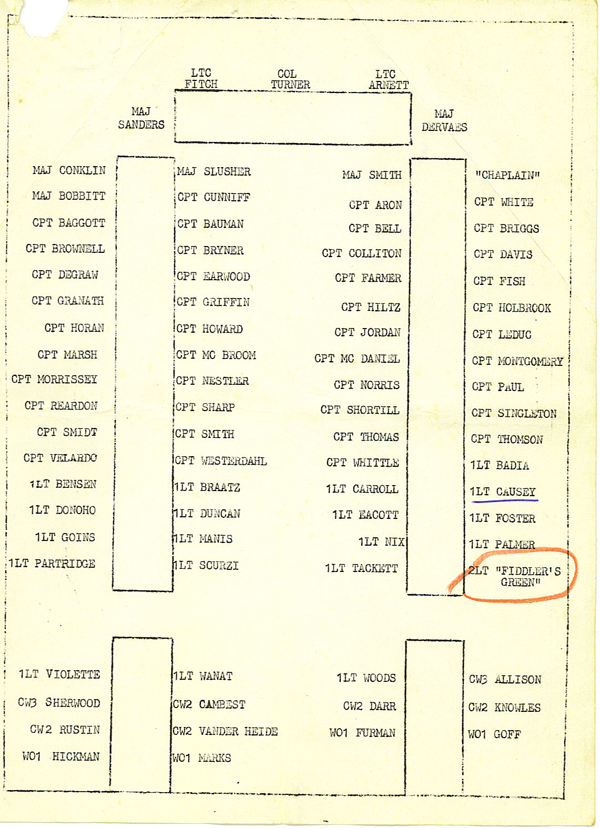
Well, the orientation pamphlet wasn't written by Marcel Proust, but it got the job done of "orientating" me. I now knew how to re-up in the Nam, and how to recognize the signs and symptoms of Vietnam's fabled incurable venereal diseases. I found another piece of paperwork in my pile of stuff as I sifted through it. It was an invitation to dinner, given as a written order by a superior officer. Included in the invitation to dinner was a request, again issued as an order, to memorize a poem for recitation at dinner. A second superior officer was detailed to oversee my memorization of the poem. I started to get the impression that the 3/17h kept second lieutenants under orders and on a very short leash at all times. Since I was now in a cavalry unit, the powers-that-be decided that I needed to be indoctrinated into the mysteries of the cavalry contained in that poem. I memorized it, but I never really solved one of the mysteries of the poem. Somebody had added an extra two lines to the first stanza:
All other units of the 17th Cavalry, as well as all other Army cavalry units, use those two lines only at the finish of the fourth and final stanza. Ahh, the mysteries of being a cavalry officer with the 3/17th. |
|
DEPARTMENT OF THE ARMY 1 August 1969 GENERAL ORDERS TC 000. It is with the most distinguished pleasure that I formally notify you, 2LT Robert F. Bennett Jr, XXX-XX-XXXX, of your exonerated position within the Squadron. I personally assure you that only great care and attention to detail resulted in your selection to be the Narrator of the famed "Fiddlers' Green". This is a most discerning honor indeed. After careful scrutiny of the Officers Roster, it was determined that you have the distinction of having one of the lowest Dates of Rank. Much deliberation occurred, but YOU were ultimately selected through the complex process of numerical elimination. I would like to take this opportunity to present my Congratulations and further inform you that the attached iambic verse, "Fiddlers' Green", will be memorized and ready for recitation not later than 1900 hours, 6 August 1969 at the scheduled "Dinner Party". This recital is in keeping with the highest of Cavalry Traditions, and most befitting of your impeccable position within the Squadron. The Executive Officer of your Troop will render his professional guidance in assuring that you have committed to flawless memory, "Fiddlers' Green". FOR THE COMMANDER: JAMES P. CAUSEY Jr |
|
FIDDLERS' GREEN Half way down the trail to Hell, Marching past, straight through to Hell, Though some go curving down the trail And do when man and horse go down |
|