The Ambush at Ben Muong |
Charles Black Reports from Viet Nam
Sgt. Davie Saved the Day for Whole OutfitBy Charles Black TAY NINH, Vietnam - The big fight hit suddenly on the morning of May 30, and Sgt. Robert Davie and Troop D, 3rd Squadron, 17th Cavalry were right in the middle of it. Sgt. Davie was manning his gun jeep with its 106 mm recoilless rifle like a PT boat skipper, his driver sending it bounding and bouncing over the rough ground into the edge of the rubber plantation on the east of Highway 28. Big anti-tank rockets -- RPG's -- and AK47 automatic rifles were blasting into jeep and dirt was kicking around the gun jeep as it and its two occupants charged toward the enemy bunker complex. A soldier covered when Cpt. Mengell's troop was outnumbered in an ambush south of Tay Ninh. The jeep got into firing position and opened up, the 106 knocking out bunkers with tremendously devastating direct fire. But the enemy fire wasn't subsiding. Davie was hit in the leg from shrapnel from the ear shattering burst of the antitank rockets from enemy RPGs. Fire was coming at the jeep from three directions, the enemy main force having arrived at Delta Troop's flank now. The fighting had a complex pattern. Mengell had maneuvered and cut off an enemy force on the east of the road -- the first element in an ambush and enemy in bunkers hidden in huts on the edge of a village on the west of the road. Mengell was moving down the east side from the north, flanking the two positions nicely. He was then flanked by a big force, a third enemy force, the assault element, which ran in from the rubber groves. This meant his south and east sides were being shot at, and that, although he had the enemy to his south at his mercy, the enemy on his east was too much to handle without regrouping. "I got my flank platoon pulled up to fight the side where the new firing came from and consolidated without plenty of support, gun ships and air, and I still had those guys in the positions by the road where I wanted them. They had a strip of cleared ground to cross to get to their buddies in the rubber grove and I was looking right down it. They had to move or die and if they moved I'd kill them anyway. Davie got me the time to do it with his shooting, " Mengell said. Then Davie's driver was hit hard. His gunner fell from the 106 recoilless, wounded. Davie did it by himself, ignoring the shrapnel in his leg, loading, aiming, and shooting, knocking out the bunkers. The enemy on Mengell's south became frantic, the fire slackened from there. They started moving out of their holes and bunkers. I saw men wearing gray-green khaki with the trousers too baggy, and sleeves rolled down, despite the heat of the morning, feet bare or in "Ho Chi Minh" sandals cut from truck tires -- running fast, dodging and ducking, scrambling for cover. Mengell's rifles and machine guns methodically cut them down. They killed 17, counting the ones Davie blasted in his foray. Davie saw the platoon was in position and fighting its fight. He limped out in the open, and pulled his two wounded crew back. Then went back out to his jeep and shot some more rounds so that two other of Delta's wounded could be pulled under cover. Davie then got behind the wheel of the jeep; it had four flat tires. Bullets and shrapnel had made a sieve of it.The frame of the jeep, for example, was shattered and broken into five pieces. The engine shouldn't have started. When it started, it shouldn't have run. Even when it did run, it was impossible for the battered hulk of the jeep driven by a wounded sergeant to be moved. Davie moved it. All of the fire seemed to come at him while he did it. His companions shot as fast and straight as they could to help him, but it looked hopeless. He drove it neatly into line with his platoon, got a good shooting position for the 106 recoilless rifle, and asked a medic take a look at his shrapnel slashed leg. Spec. 4 Melvin F. Berninger, said that Davie " in my mind saved the lives of everybody that was involved in this contact." "Risking his life he drove the 106 mm recoilless rifle on line and fired after his crew and the driver got hit, before getting hit himself. He kept the enemy down so we could get firepower and pull back to get a good position. After this, the jeep had already been hit with an RPG round and the rest of that fire; he drove the gun back a ways and still fired that gun again. He not only saved everyone's lives, he also saved the recoil-less rifle from getting into the enemy's hands, he was up front all the time, right with Charlie." Berninger said. Berninger's view was that of another gunner. He was caught over on the flank, when the main enemy force got into the fight from the rubber grove's back reaches. He was with the men that took the full force of that flanking fire. Davie staying out there and shooting saved them, he was emphatic on that point, and when they got under cover and took up the fight, Mengell was right back in good position when again with the big chunk of the enemy still at his mercy. S. Sgt. Robert F. Brown with the scout section was taking part in the flanking maneuver against the bunkers in the village and in the fringe of trees by the road. He said the fire from the village was heavy and Sgt. Davie had moved out and was shooting it out with them. "A gun ship from our Squadron -- from B Troop -- was immediately adjusted on those positions. At the same time this was taking place, two scout jeeps were pinned down by heavy automatic weapons, including RPG rounds. "Davie's crew was hit quickly by the new fire. He got on his rifle and fired the weapon numerous times. Even though wounded, hit in the leg when the jeep got a direct hit from an RPG, he kept the enemy down while the other jeeps were pulled back behind a berm and three wounded crewman crawled to safety. "I saw all of that, then it got busy with the gunships and the maneuvering, but I heard he kept on going like that the rest of the fight," Brown said. Spec. 4 John Dungan and Spec 4 Sager said the three crewmen caught in the open were "as good as dead" if Davie hadn't kept shooting. "They were in the open, they didn't have a chance. We were in fast, deep trouble there when that flank fire hit us from beyond the strip of clearing on our left, on back in the grove. He put fire on Charlie and our boys got back, then he got his own two boys back, and then brought his jeep back. After that, it was too bad for Charlie. The gun ships from Bravo Troop worked them over and shot them up bad, " Sager said. "When that convoy came though, they didn't even know there'd been a fight going on, we were in position and it was all over in less than a hour. We couldn't sweep out after them, we'd busted the ambush and we had to get the convoy on, but there were 17 of them dead where we'd cut them off. We killed 4 or 5 times that many, I'm certain of it." Brown said. Hot, dusty truck drivers got to Tay Ninh, unloaded, picked up empty trailers and headed for Long Binh. |
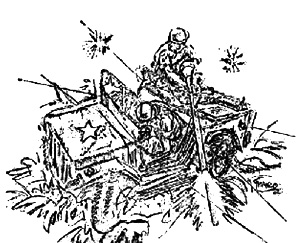 The Drawing from the Original Newspaper Article From the John Dungan Collection |
 Sgt. Robert Davie, 1968 |
|
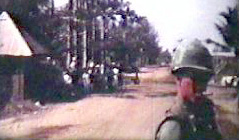 Captain Mendell, 1968 |
|
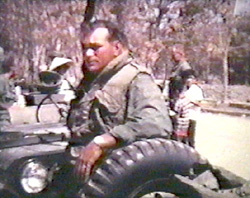 Sgt. Robert F. Brown, 1968 |
|
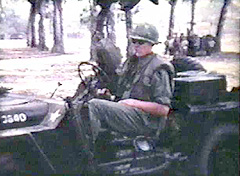 John Dungan, 1968 |
|
 Jack Sager, 1968 |
Charlie Black was not the only person to watch Delta Troop break the ambush. Skip Davis, webmaster of the B Troop website and Loach driver for B Troop, 3/17th Air Cavalry, remembers the ambush as seen from the cockpit of his aircraft:
|
I am sure from looking on my map that this was the one and only time that I worked with the BlueTigers, and although brief, it was exciting. I would also like to hear from anyone else involved in this fight, especially from any of the three BlueTigers in the jeep I was hovering over. I had just spent an hour working the southern end of our AO to the west of Duc Hoa (the pineapple plantations) and my intended replacement, Stogie 16 (Mike Vecellio), had departed Duc Hoa early, responding to your call for a scout. I had a little fuel left and decided to join him. I came up the highway from the south and was briefed that intelligence reported NVA in the village and the BlueTigers were about to enter. The first thing I noticed was a large group of villagers, including a large oxcart, about 500 meters south on the road. I arrived with my gunship, joining Stogie 16 and his cover, just about 2 minutes before the shooting started. There were a substantial number of NVA there and it was strangely quiet, considering the proximity of everyone. Stogie 16 moved off to the eastern edge and I circled the village, talking to BlueTiger 16, or 26a (I don't remember the callsign), but I kept telling him that the NVA were everywhere (I think I saw about a dozen in the first minute). Amazingly, the BlueTigers continued to advance, some coming out of the treeline down the small slope from the rubber, and one jeep, with three guys in it, creeping slowly thru the village, headed north. Another jeep was on the edge of the village but not quite into it. It was very tense, and I again repeated my warnings that the shooting was going to start any second. As I circled that single jeep, I spotted an NVA about 30 yards directly ahead of them, head and shoulders out of a well (the wooden cover slid back), aiming an RPG at the jeep. The jeep's recoiless rifle was pointing straight at him and the three Blue Tigers obviously did not see him. In that split second, I decided against having my observer shoot at the NVA - the seconds of adjusting rounds would surely prompt him to fire - so I began yelling "Fire the recoiless!.. Fire the recoiless!", hoping they had their radio on (I also envisioned 6 jeeps simultaneously firing). They apparently had their radio on (or spotted the RPG guy themselves) and finally fired the gun and the shooting began. I was at a 30 foot near-hover and saw the jeep still sitting there as I pulled in power to get some airspeed up. The shooting was going on all over the place and our gunships were finally able to set up a pattern on the east side, but I think that it may have been too far from the contact area to have been much good. I also think it would have been too dangerous to have tried to use my minigun in such close quarters, with everyone scattered throughout the village. In a few minutes, I was low on fuel and had to return to Duc Hoa, leaving Stogie 16. I did not hear about what happened there and how things turned out, until now. Skip |
We can add a third perspective on the action at Ben Muong on May 30, 1968 with the testimony of Lee Thompson, BlueTiger 26. Thompson led the second platoon reaction force into the village to provide cover and relief to the first platoon:
|
On May 30th 1968, second platoon 3/17 was assigned to be the trail element behind the first platoon 3/17 scout section on a road clearing mission on Highway 26 between Tay Ninh and Cu Chi. The scout section from the second platoon was following approximately 10 to 15 minutes behind the first platoon and consisted of the platoon leader's vehicle, two machine gun jeeps and a recoilless rifle jeep. When the first platoon was approximately fifteen miles south of Tay Ninh, just at the edge of the Michelin Rubber plantation which bordered the east side of Highway 26 and approaching the village of Ben Muong, the helicopter covering the two platoons' route spotted what was estimated to be a company of VC in the village. The pilot reported his observations of the presence of a VC with an RPG near the highway to the first platoon scout section. Within what seemed a matter seconds from the receipt of the report, all hell broke loose on the ground. The second platoon kicked it in and made for the lead elements location as fast as it could. By the time the second platoon arrived, the first platoon scout section had been able to disengage from the kill zone and find some cover in the rubber plantation and behind a berm on the north side of the village. 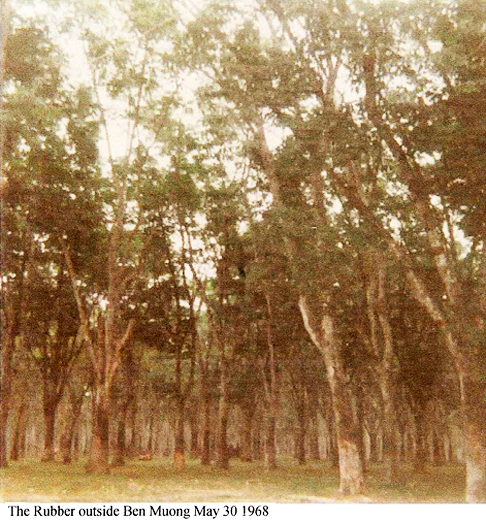 Upon the second platoon's arrival, it was discovered that Sgt. Sinnock had been killed and that another E-5 had received a very serious wound to his left forearm and was in severe pain and showing signs of going into shock. Sgt. Marley stayed with Sgt. Sinnock, and the second platoon leader gave instructions to his platoon scout section on where to deploy its firepower to best provide suppressive fire. This allowed the first platoon to withdraw and regroup. At the same time, the second platoon leader helped place Sgt. Sinnock and the wounded E-5 into a jeep. Sgt. Marley was asked to insure that both soldiers were evacuated and taken care of properly. At that time the second platoon began returning fire and deployed its elements in such a manner as to provide protection to the front and flank of the troop from an enemy attack. The second platoon was also able to position its firepower so that the VC was prevented from reinforcing its troops or withdrawing from the village. 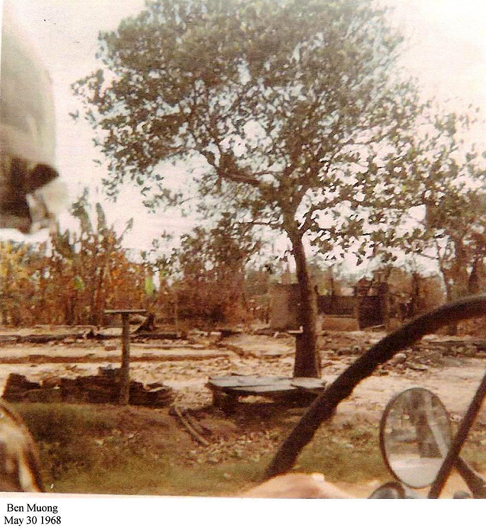 The berm, which provided the second platoon with cover, was just north of the village and was backed by the rubber plantation. On the south side of the berm was an open field in which a jeep with a machine gun, radios and other equipment was abandoned during the ambush. At the far end of the field was a church and about ten yards north of the church, toward the second platoon's position, was a line of 4 or 5 bunkers that ran east to west. On the west side of the field was a row of houses that faced the road. To the east of the field was another berm, a ditch then rice paddies. On several occasions the VC tried to capture the Jeep but the second platoon was able to keep them pinned down. Once the platoon was able to identify each bunker the second platoon started picking them off with the 106 recoilless rifle and M-79 grenade launchers. After some of the bunkers had been destroyed the second platoon leader crawled to the abandoned jeep in an effort to recover it, however he was driven back to the berm by a withering enemy cross fire. This firelight went on for the rest of the day until the platoon was able to get some F-4 air support. The air support seemed to break the VC's desire to continue the fight. The second platoon was able to recover the jeep and depart the area before dark. The convoy made it through to Tay Ninh without losing any vehicles. 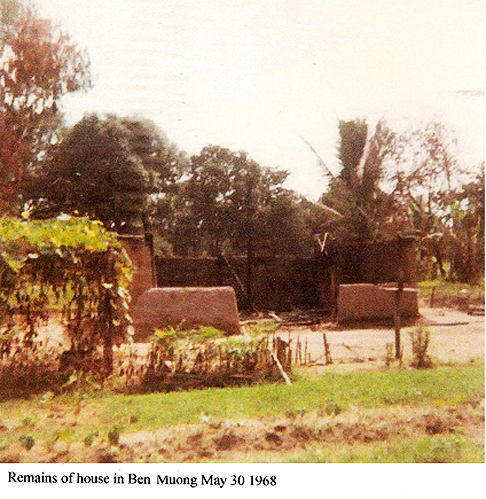 The next morning the second platoon was able to return to the village. The second platoon's leader was able to take the attached pictures of the aftermath of the battle. Lee Thompson |
It is rare, indeed, for a Delta Troop fight to be recorded by three different observers, and even rarer to be able to put those observations together after more than 30 years. Charlie Black's coverage of Sergeant Robert Davie's bravery at Ben Muong is permanent testimony to the way of war for Delta Troop in Vietnam.