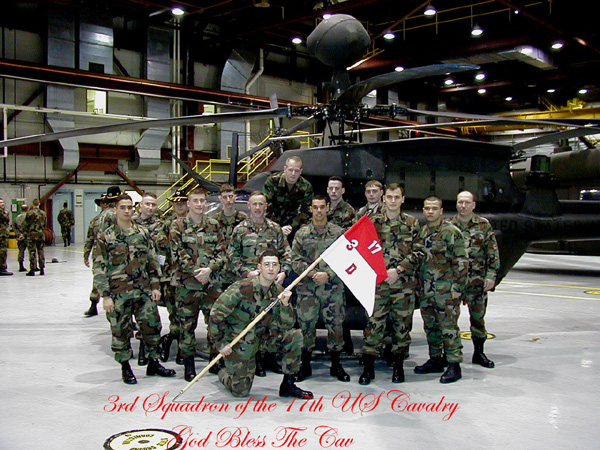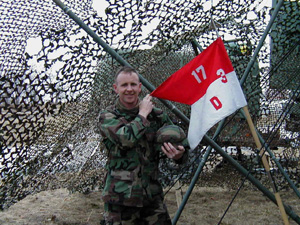
The Blue Tigers of Delta Troop, 3/17th Cavalry |
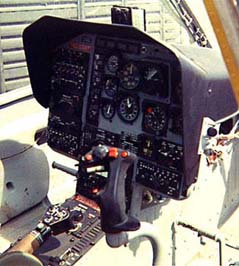 The OH-58A Cockpit, circa 1970 |
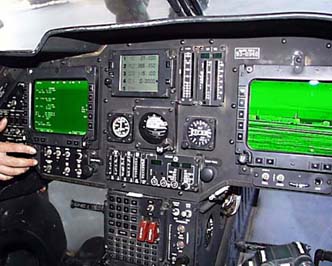 The OH-58D Cockpit, circa 1999 |
However, it was not peacetime, and combat raised some problems that complicated the lives of the Silver Spurs' crew chiefs and maintenance crews in Vietnam.
I, too, was sent where I was needed to do what the Army needed me to do. My stateside background and training qualified me as "close enough for government work" to serve as a crew chief in the Silver Spurs' Scout platoon. When I first arrived in Vietnam, I had a great bunch of guys, both crew chiefs and maintenance guys, to show me the ropes around the OH-6. I had been trained on the OH-58! Guys like Chandler, Brandenberg, Schwartz, et al. took me under their wing and gave me a crash course in 6's, and helped me every step of the way. When I came to the troop, the only thing an OH-58 had in common with a OH-6 was the engine.
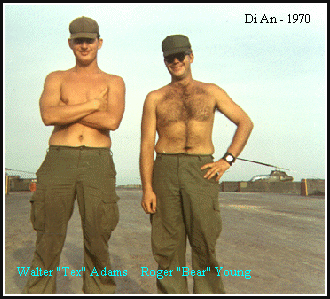
Scout C.E.s Walter "Tex" Adams &
Roger "Bear" Young -- Di An 1970
Roger Young Photo
In June 1970, they made me line chief when the OH-58's came on the scene. Since I was the only school-trained OH-58 mechanic in the field, the platoon basically grounded me. I guess they were afraid they would drop out of the sky or something without me sticking around.
Most of the guys who trained me had gone home by the time the 58's came on line. So, it was my turn to start schooling the FNG's on the 58's. About the same time, the Aussies (call sign Possum) started working with us, learning about the turbine engines. Prior to that time, the Possums flew the old piston-powered OH-13 like you see in M.A.S.H. I had experience on the OH-13 when I was going to Airframe & Powerplant school here in Seattle. That was before Uncle Sam decided I had better things to do with my time than graduate and go to work for Pan Am.
After my return to the States in 1970, I learned much more about the Cobras in Savannah, GA at Hunter Army Airfield, where I was made a P.E. team leader. I learned, first-hand, the extensive maintenance required to keep these gunships flying, even without the combat damage that was often the case in Vietnam. The armorers had more weapons systems to maintain on the Cobras, including bore sighting rocket tubes and gunsights which was a never-ending task. Avionics kept busy with the Cobra's more complex systems. The SAS system, which made the Cobra's flight controls much more stable than other helicopters, ensured a more stable platform for its weapons systems and improved the Snake's guns' accuracy.
In Vietnam, we had two levels of maintenance, what we called "-10" and "-20" maintenance. Ideally, crew chiefs were assigned to do "-10" maintenance that consisted of:
Scout crew chiefs also often flew with their birds on missions, and lift platoon Huey crew chiefs almost always flew with their birds. It was common for a ship and its crew to fly six to eight hours each day. The result was that the ten Scout crew chiefs and ten 575th Maintenance personnel assigned to our Scout platoon were usually very, very busy. Eighteen- to twenty-hour days were common when a heavy push was underway.
"-20" maintenance was allocated to our 575th Maintenance Detachment and our 812th Signal Detachment. The 575th was divided into several sections, such as Periodic Inspection (PE) crews, engine shop, sheetmetal shop, and armorers. The 575th took care of heavier maintenance like engine and transmission changes, engine compressor changes, tailboom replacement, and rotor and blade replacement. The 812th was responsible for general avionics, including our radios, wiring harnesses, and batteries.
Of course, this was just Army SOP, based on an ideal (peacetime) allocation of work. The SOP flat flew out the window when combat conditions set in. The norm during my stint as Scout Line Chief was that the Scout crew chiefs and 575th personnel worked side by side long into the night. Our maintenance training was the same, so it was common to see a crew chief pulling heavy maintenance, or a 575th crew filling in on post-flight inspections and oil changes. It was a TEAM effort all the way.
The most important maintenance order of each and every day was to maintain a 70% combat-ready status of our ships. A Troop seldom dropped below this level despite combat losses and damage. However, such damage and losses certainly did throw a curve ball into the entire maintenance schedule. For example, we scheduled Periodic Inspections (P.E.'s) for the OH-58A (and Cobras too) for every 300 hours. With 10 ships, we tried to keep their flight hours 30 hours apart so that we could maintain a nice steady flow of ships in and out of P.E.s.
In reality it seldom worked out that nicely. Combat loss or damage always threw a monkey wrench into the SOP. For example, while the troop was at Soc Trang, we had 10 OH-6's shot down and many destroyed in a 90-day period. Thank God no Scout trooper lost his life during this intense period of combat. But when we lost a ship, somebody had to decide which of our existing aircraft we would fly the blades off to close up the hour difference between P.E.'s. We usually could not replace a lost ship very quickly because the replacement aircraft, often a used ship, had to go through a very thorough inspection before the troop would accept it.
One result of these combat losses was that, at the end of the day, we might be down to 40% - 50% combat ready. We often worked until the early morning hours to get damaged ships back up and flying. Thanks to the team effort among the Silver Spur crew chiefs and the 575th and 812th crews, it was not uncommon to see sheet metal shop personnel patching bullet holes, splicing destroyed wiring bundles, and replacing bubbles, while others replaced damaged fuel cells, rotor blades, or tail rotor assemblies, tracked main rotors, and balanced tail rotor assemblies.
Those doing the repairs signed off on the "Red X" conditions as the repairs were completed. The Tech Inspector (TI) inspected all repairs, and then signed off on the repair. After all this, the aircraft had to fly its required maintenance test flight in the darkness, and then be rearmed and refueled to bring the aircraft back on line for the "first light" mission the next morning. The maintenance test pilots, who had to fly the required test flights, joined the enlisted crew chiefs and mechanics in staying up to all hours of the night when things got busy.
The enemy was not the only source of combat damage to aircraft. Our aircraft also suffered occasional self-inflicted damage when the LOH had to bank sharply to take evasive action while the M-60's were busy putting down suppressive fire. We knew what happened when the ship started to vibrate after such a maneuver - little round holes in its blades, victims of "friendly fire." Of course, we had to remove, exchange, and re-track the blades when we returned to base, and then we had the test pilot run the mandatory maintenance test flight before we got the ship operational again. Sometimes, we could repair the blades if the holes were not too close to the leading edge or "spar." But such repairs required several days to fill, patch, and dry. Fortunately, we always had a good supply of blades on hand for quick replacement.
Because we conducted our Scout missions at low-level, trees were also a constant problem and threat to the aircrews. Although our pilots were excellent and limited such strikes to a very low percentage, we occasionally did some rather heavy "tree pruning" on missions. Such rare rotor strikes required replacement of ALL the running gear (blades, hubs, engines, transmissions, and shafts) before returning to the flight line.
Fuel cell replacement was also very common. The ship's belly was a favorite target for Charlie. We spent more time looking for bullet holes during a post-flight inspection than anything else.
We tried to extend battery life - which was a constant problem with both the Cayuse and the Kiowa - by "jump starting" each ship with APUs for their first start each day. New batteries were always in short supply.
The OH-6's had specific problems of their own that led to non-combat losses. When flying in rain, the rotor blades quickly deteriorated from erosion, even to the point of starting to peel back the thin aluminum behind the spar. Well, if we had three OH-6's caught in the rain, we had to replace 12 blades, retrack them, and test fly the repaired ships into the wee hours of the morning. I hear this is still a problem with the Hughes 500 civilian models to this very day. Fortunately that was not a problem with the OH-58s when they started replacing the OH-6s in June of 1970.
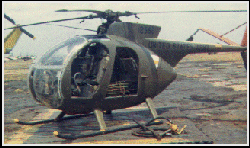
A-3/17th ACS's OH-6, tail number 962, SP/5 Schwartz, C.E.
(now at Ft. Rucker's Army Aviation Museum)
Roger Young Photo
After we got the OH-58A's in June 1970, their particular problems became apparent quickly. They had the same engines as the OH-6's, but were no longer de-rated to 285 shaft horsepower (shp). The engines had to function at maximum power in a heavier bird. In the Cayuse, it was common for the Allison T-6 engine to sing along nicely until its time change was due. In the OH-58A, however, these same engines struggled to make 300 hours before they flat gave up. The minimum acceptable shaft horsepower of the T-6 was 317 shp. Those engines that put out around 340 shp held up pretty well. However, those engines that ran near the minimum acceptable Army shp rating (like the OH-58A's) made the aircraft very sluggish at best, or led to an early demise for the engine. We generally did not like the OH-58A's because of these limitations. Sluggish performance endangered the ship's crew in flight, and a ship downed by a dead engine endangered both the aircrew and those who had to guard and extract the downed bird.
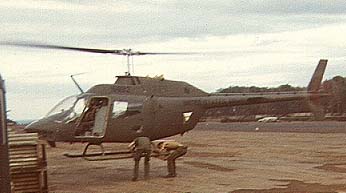
Two of our guys changing the skid plates on an A-3/17th OH-58A while at a hover at Quan Loi.
We did not have any jacks there at the time.
Roger Young Photo
Another "flaw" the OH-58's had when they came in-country was their short shaft seals. When the seals blew, the grease that was packed in them decided to sling itself all over the inside making a nice mess, and the coupler could run out of lubrication and seize. The first couple of weeks on each mission, we blew at least one of the two seals per aircraft. Bell soon came out with a new seal and the problem was solved. This was one of the few times we fell below the 70% flyable status.
The only other time I remember our troop failing the 70% threshold was when the Cobras were grounded due to tail rotor blade problems. An "urgent modification work order" (MWO) came down from the DoD and grounded all our Snakes for about three days. When the new tailrotor blades came in, I guess you know the Cobra teams were humpin' their butts off getting them all airborne again! In the interim, we flew two OH-6's (doubling our platoon's commitment per mission) to attempt to provide some fire support for the low level LOH. That didn't work well. A minigun was no substitute for a Cobra! But we survived!
Besides combat damage and loss, the heat and low air density took its toll on engines. Under such conditions, power levels were greatly reduced and lift from the blades also reduced. This caused the engines to work hard, often nearing the maximum acceptable levels of torque and exhaust temp (TOT, EGT depending on manufacturer). This shortened the life of the engines and required compressors to be cleaned often in the dirty environment.
At times, a new compressor would bring life to sluggish powerplant. However, cleaning the existing compressors seldom made any real improvement on the OH-58's. The compressor's barrier filters did a pretty good job of keeping the compressors relatively clean. Even so, it was common to see the engine shop personnel or a crew chief disassemble the compressor and clean it with a toothbrush - a long and seldom rewarding experience as power level increases were barely noticeable, and it took hours to remove the barrier filter and compressor in a Kiowa.
The jungle heat took its toll in other ways, too. Few of the Cobras had functioning air conditioning systems and I can only imagine the heat build-up inside the cockpit on their missions. At least the Scouts flew with their doors off and the Lift (Hueys) with their rear doors open. The Cobra pilots did not have that luxury while they baked in the unshaded confines of the Cobra.
Our skilled armorers had the never-ending task of cleaning and repairing the 7.62 mm miniguns that were on most of our Scout and Cobra aircraft. A good armorer was worth his weight in gold if he could keep the mini's working well. Without the minigun, the Scout ship had to add a third man in the back seat to make up for the loss of firepower. This raised the risk of more casualties because the majority of enemy rounds went through the center of the aircraft where the third crewman was seated.
Cannibalization was often the norm to keep the ships flying. Contrary to what many might think, spare parts coming down the supply line were often not available, and that only added to the problem of down time. So, we cannibalized parts from existing aircraft. However, most components were time-change items. We could not simply remove a component from one ship and install it in another ship. The log books and time change logs had to be changed also to insure that the records were in order for both the cannibalized ship and the receiving ship. Many combat units failed IG inspections because the components in the aircraft did not match the serial numbers in the log books. The Scout platoon never failed these inspections thanks to the dedications of the maintenance personnel and tech inspectors.
We did notice some specific differences between the OH-6 and OH-58A. The two-bladed rotor system of the OH-58A was a setback in agility compared to the highly agile OH-6A. However, OH-58A's circuit breaker panel, being located overhead in the cockpit, ended the constant problem of dirt and water destroying the breakers in the OH-6A panel, located between the pilot and observer near the floor. The Kiowa also had better avionics and flight instrumentation than the OH-6. The majority of our OH-6's were restricted to daylight flight only because of failed instrumentation.
I have not covered much of the maintenance of the Cobras and Hueys, but the jobs were similar. The Cobra crew chiefs did not fly on missions, but keeping a "Snake" up and operational with the high stresses it encountered was a herculean task for the Cobra C.E's, and the 575th Maintenance and 812th Avioncs personnel. The Cobra C.E.'s also had the burden of rearming the aircraft after each flight, often during "hot refuels" when the Cobra's firepower was badly needed in support of ground troops.
The crew chiefs in our Lift platoon (Huey's) seldom had it easy either. They performed daily maintenance, in addition to the long hours they flew every day. The C.E. usually had his door gunner clean the guns and then help the C.E with maintenance into the late evening, only to repeat the routine beginning at first light the next morning. The Slicks' primary mission was to insert and extract our Rifle platoon, protect our downed aircraft, and fly C & C missions while the Cobras and LOH's worked hunter-killer missions. The Slicks often suffered heavy combat damage during insertions or extractions which made all night repairs common in the Lift platoon, too. While I was there, the Slick called "Foxy Lady" had three tailbooms basically shot off.
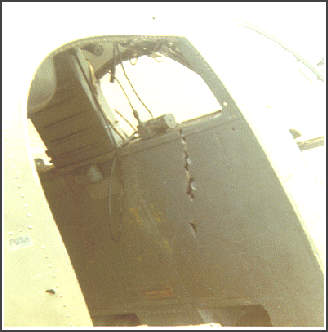
"Kathie" - the last of several OH-6's I named. The rest were
known just by their tail number. CPT Reynolds was wounded
in the leg in this downing and survived - April
1970
Roger Young Photo
At night, the troop kept ships and crews available for scrambles to support firebases that were being hit that evening. Each operation aircraft was refueled and rearmed after every mission so that we could be airborne within 5 minutes to support our forces. At least, we in A Troop had cold showers and some cots to sleep in. Our mess hall personnel would often whip up something for us when we came in off the flight line after the long night getting the ships ready. It was always a nice luxury to grab a late-night bite to eat before we went off to cop a few Z's, waiting for the birds to make their next "first light" missions.
-Roger Young
Back to The Greybeard Home Page