Delta Troop, The 3/17th Air Cavalry,
and II Field Force, Vietnam
It bothered me that I spent a year in Vietnam with Delta Troop and didn't know why we didn't have a home, why nobody claimed us, and why we did such weird stuff.
I spent a good number of years puzzling over it after I got back, too. I eventually found that the short answers to my questions were that:
- Delta Troop wore the 1st Aviation Brigade patch simply because we were on its organizational chart.
- Our real boss was the commander of II Field Force, Vietnam.
- Our job always involved protecting the approaches to Long Binh, Bien Hoa, and Saigon.
- Our history is not found in standard Army histories because we were not part of the standard Army.
The Long Answer
So, I served with Delta Troop for a year 35 years ago. I decided I wanted to look up old Delta Troop and see if I made it to the history books. I looked at Don Starry's "Armored Combat in Vietnam", which is about the 11th ACR, and I found nothing about Delta Troop. There is one paragraph, and one line in a footnote, about the 3/17th, but nothing really substantial.
I tried Shelby Stanton's "Anatomy of a Division", which is about the 1st Cav, and I found three entries: one line in a footnote; one sentence about an accident in the States in 1964; and, a curious paragraph that starts out "On 26 October 1970 Putnam secured the 3d Squadron of the 17th Cavalry, an independent aerial reconnaissance unit from his former 1st Aviation Brigade, and attached it to the division. . ."
I found the same pattern in the histories of the 25th Infantry Division and all the other divisions and brigades that I know Delta Troop worked with in Vietnam. No trace of Delta Troop. So much for making it to the history books.
Or, perhaps, it is simply a case of "we did not make it to the standard history books".
A Non-Standard History of Delta Troop, 3/17th Air Cavalry
Since 1998, veterans of Delta Troop have been assembling the "what, where, and with whom" of Delta Troop's experience in Vietnam. It is now possible, with a few minor lapses, to document what Delta Troop was doing, where it was doing it, and with whom, every month from November 1967 to March 1972. We have, in fact, written our own history of Delta Troop in Vietnam. The month-by-month data, called the Delta Troop Chronology, tell the actual story.
The secret to following Delta Troop through the course of the Vietnam War is to ignore the obvious. Ignore the 1st Aviation Brigade, whose patch we wore on our left sleeve. Ignore the 1st Cav, the 25th Infantry Division, the 9th Infantry Division, the 199th Light Leg, and all the other brigades and divisions we worked with. Ignore even the 3/17th Air Cavalry Squadron, because the troops of the 3/17th pursued their own individual destiny for most of the war.
Consider the following statement about the troops of the 3/17th Air Cav, made by the 1st Aviation Brigade in mid-1969:
The 3rd Armored Squadron, 17 Air Cavalry, one of three air cavalry squadrons in the 1st Aviation Brigade, provides direct support to several units in III Corps. Headquartered at Di An, the "Red Horse" squadron . . . consists of four troops. Also headquartered at Di An is "A" Troop, better known as "Silver Spur." and "C" Troop or "Charlie Horse" . . . "B" Troop [is] at Dong Tam. Finally, "D" Troop, the "Hatchet Force" or ground troop, is located in Bien Hoa . . . "D" Troop is known as the "Hatchet Force" because it is strictly a combat cavalry organization. It is completely ground and air mobile and is used as a guard force for the Long Binh and Bien Hoa areas.
The "Silver Spurs" work in direct combat support of the Capital Military Assistance Command (CMAC) and the units under this command. This command covers primarily the Saigon area. . . The Bien Hoa Tactical Area (BTAC) is directly supported by "Charlie Horse" Troop. This troop also supports units in the Tay Ninh, Cu Chi, Xuan Loc, Black Horse and Dau Tieng areas. The Dong Tam area is directly supported by "B" Troop. (Wood, David R., SP4, "Looking for Trouble - 3/17th Air Cavalry" in Hawk Magazine, Aug. 1969)
The statement, made by the 1st Aviation Brigade, says that we were part of the 1st Aviation Brigade.
Compare that with the 3/17th's "Combat Orders and Distribution" list that Redhorse 6 used for the 3/17th Air Cavalry. If you follow the orders, you find the chain of command:
	2.  Orders issued by this squadron will be distributed as follows:

		a.  II Field Force

		b.  Division (If OPCON has been established)

		c.  12th Combat Aviation Group

		d.  Each Troop

		e.  Principal Staff

		f.  Direct Support or Attached Units

		g.  Fire Support Coordination Element

		h.  File
(Source: 3/17th Air Cavalry file, "3rd SQDN, 17th AIR CAV TACTICAL SOP", dated September 1969, Army History Center, Carlisle, PA.)
Well, there you have it. Officer types would not think of doing something without telling the boss. Looking down the chain of command, Redhorse 6 told the troops, his staff, the attached units, the arty FO, and the file what to do. Looking up the chain of command, Redhorse 6 told 12th Aviation Group, the particular division he was OPCON to at the time (if any), and II Field Force, Vietnam what he had ordered his troops to do. II Field Force, Vietnam was at the top of the combat chain of command for Redhorse 6.
However, II Field Force was not a part of the 1st Aviation Brigade. Exactly how did that work? Who were the 1st Aviation Brigade and II Field Force, Vietnam? And how did II Field Force, Vietnam determine the destiny of Delta Troop, 3/17th Air Cav?
The 1st Aviation Brigade and II Field Force, Vietnam
The answer starts by momentarily ignoring the advice to ignore the 1st Aviation Brigade. The 1st Aviation Brigade was invented in Vietnam in 1966 as a way to control the helicopters needed by straight leg and airborne brigades and divisions in the new style of "airmobile" war to be fought in Vietnam. Early on, the 1st Cav was the only division that had organic aviation units, including an air cavalry squadron (1/9th).
The situation in 1966 looked something like this:
The Army faced a dilemma at this period of time in that it had spread its aviation assets in Vietnam to support the Army of the Republic of Vietnam divisions, one Republic of Korea division, the 1st U. S. Army Division, the 173d Brigade, and the 1st Brigade of the 101st Airborne with non-organic aviation units. Only the 1st Cavalry Division had sufficient organic aircraft. There was little experience in supporting non-airmobile divisions with separate aviation assets and the Army was not sure of the proper mix.
The 1st Aviation Brigade was formed provisionally on 1 March 1966 with Brigadier General George P. ("Phip") Seneff in command. General Seneff's career had been sprinkled with key assignments related to airmobility and he had been a major commander in the testing of the 11th Air Assault Division. He was quick to assemble many of his former "11th Air Assault Team" to form a brigade staff and to publish the first handbook and standard operating procedures of the brigade. With the publication of basic operational manuals, the 1st Brigade was able to standardize aviation operational procedures throughout Vietnam, establish training schools, enforce safety regulations, and in general more effectively manage the growing aviation assets.
Essentially, General Seneff commanded the non-organic Army aviation elements in Vietnam, but operational control was vested in the supported ground commander. It was a tribute to the personalities involved that this unusual system worked; retaining the best features of centralized command (training and standardization) and the best features of decentralization (operational control and support). (Tolson, John J., LTG, Vietnam Studies: Airmobility 1961-1971, Washington, D.C., 1989, page 102)
The organization chart of the 1st Aviation Brigade looked something like this by July 31, 1968:
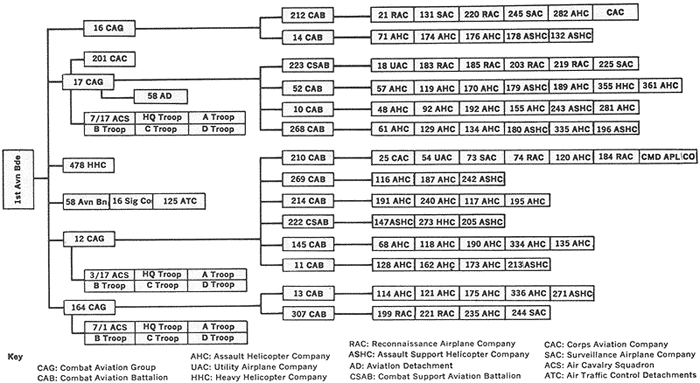
Source: Tolson, John J., LTG, Vietnam Studies: Airmobility 1961-1971, Washington, D.C., 1989, Chart 2
The 1st Aviation Brigade held three independent Air Cavalry Squadrons - 7/1st, 3/17th, and 7/17th.1 The three independent Air Cavalry Squadrons were assigned as follows:
The 7th Squadron, 17th Cavalry belonged to the 17th Aviation Group which had the mission of commanding and controlling all non-divisional assets in II Corps Tactical Zone, under I Field Force, Vietnam. The 3rd Squadron, 17th Cavalry belonged to the 12th Aviation Group which controlled all non-divisional assets in III Corps, under II Field Force, Vietnam. The 7th Squadron, 1st Cavalry belonged to the 164th Aviation Group which covered all non-divisional assets in IV Corps.
In II Corps and III Corps Military Regions, the aviation group commander was also the aviation officer for the U. S. Field Force commander in the Military Region.
Therefore, the CO, 12th Combat Aviation Group was both the aviation group commander for the 1st Aviation Brigade (the holder of aviation assets and responsible for training and standardization), and the aviation officer for II Field Force, Vietnam (the combat command responsible for operational control and support). The 12th Aviation Group commander was the link between the patch we wore on our arm and the guy who gave us combat orders.
Maybe the other side of "ignoring the obvious" is "paying attention to the obscure". What was this II Field Force, Vietnam? In mid-1970, the Army identified it as follows:
Since its arrival in Vietnam, on March 15, 1966, II Field Force, Vietnam, has grown into the largest combat command in the world.
Though only three years old, II Field Force, Vietnam, traces a proud lineage to its predecessor, XXII U. S. Army Corps. Prior to its inactivation at the end of World War II, XXII Corps saw action in the Rhineland and in various central European campaigns. When reactivated at Ft. Hood, Texas, in January 1966, the command received its new name, II Field Force.
Upon arrival in Vietnam, II Field Force had operational control of five major units; the 1st and 25th infantry divisions, the 173rd Airborne Brigade, the 12th Combat Aviation Group and the 23rd Artillery Group.
During the following three years, numerous U. S. and Free World Military Forces came under II Field Force's control. Currently operating under II Field Force operational control are such diverse units as the 25th Infantry Division, the 1st Cavalry Division (Airmobile), the 11th Armored Cavalry Regiment, the 1st Australian Task Force, the Royal Thai Black Panther Regiment and the Capitol Military Assistance Command (CMAC).
Also with II Field Force are the 199th Light Infantry Brigade and the 3rd Brigade, 9th Infantry Division. The 23rd and 54th Artillery Groups, the 12th Combat Aviation Group and the 20th Engineer Brigade provide support for the II Field Force combat units. (MACV, Tour 365 Magazine Summer 1970 For Soldiers Going Home, Summer 1970)
The thing I didn't realize is that II Field Force actually did stuff. It only looks like a corps-sized command. I thought it was just a command structure that told other people, like divisions and brigades, to do stuff. But II Field Force was actually a field Army. It had its own recon organization of companies and troops, reporting directly to II Field Force G-3 (Operations). II Field Force took the old saw about recon being "the eyes and ears of the commander" seriously, and had their own people (like the II Field Force LLRP company and Delta Troop) on the ground, gathering the information. (Stanton, Shelby L., Rangers at War, LRRPs in Vietnam, New York, NY, 1992, pages 217, 222)
II Field Force, Vietnam was the command that had the reach to balance its own reconnaissance needs with the reconnaissance needs of the 25th Infantry Division, the 1st Cav, the 11th ACR, CMAC, BHTAC, and all the other units the 3/17th worked for. And 12th Aviation Group was the command that gave Delta Troop and the other troops of the 3/17th its orders and assignments, whether the orders were to work directly for II Field Force, Vietnam or to take temporary assignment to a unit of a combat brigade or division in III Corps Tactical Zone.
From our arrival in 1967 on, II Field Force, Vietnam only loaned us out to combat brigades or divisions for particular assignments. It never gave us to any unit permanently. It held on to us because we were part of the eyes and ears of IIFFV.
Delta Troop and II Field Force, Vietnam
Perhaps the greatest difficulty in writing Delta Troop's history in Vietnam is that one tends to look to the next larger military unit (in our case, the 3/17th Air Cav) to find out what they were doing, and then to determine how we fit into the overall picture. But that approach is decidedly NOT the case with Delta Troop. The month-by-month accounting of where we were, what we were doing and who we were doing it with is, in large measure, a story without any important combat relationship to Headquarters Troop, A Troop, B Troop, or C Troop of the 3/17th.
From 1967 to 1970, Delta Troop's history in Vietnam is directly related only to the reconnaissance and security needs of the II Field Force commander. When one watches the actions of units directly under the control of the II Field Force, Vietnam commander, one sees Delta Troop jump. The units that make up most of Delta Troop's history are not 3/17th troops. They were II Field Force, Vietnam units, such as Co. F (LRP), 51st Inf. (ABN), Co. D (Ranger), 151st Inf., Co. D (Ranger), 75th Inf, 5/2nd Artillery (Duster), Bien Hoa Tactical Area Command, and something called the "joint field force recon regiment".
The relationship between Delta Troop, 3/17th and II Field Force, Vietnam started with recon, and is most easily traced through the history of the several ranger and LRRP companies that worked directly for II FFV. The ranger and LRRP companies have long captured the imagination of the public, and their histories, unlike that of the 3/17th Air Cavalry, are well documented. What is not so well known is that IIFFV ranger companies were OPCON to the 3/17th Air Cavalry (or vice versa) from the beginning to the end of their use in Vietnam.
Although Delta Troop and the 3/17th Air Cavalry are largely ignored in the "official" histories of II Field Force reconnaissance, the best general history of II Field Force Rangers is Chapter 11 (II Field Force Rangers) of Shelby Stanton's Rangers at War-LRRP's in Vietnam, New York, NY, 1992. Co. D (Ranger). General histories of D-151st and D-75th can also be found in the pages of the 75th Ranger Association.
The month-by-month documentation of Delta Troop's activities shows Delta Troop working directly for II Field Force as the reaction force for II Field Force ranger and LRRP companies from June 1968 until II Field Force LRRP operations were discontinued in April 1970. Unfortunately, Delta Troop is not mentioned in the ranger and LRRP histories. We have found a few documents that detail Delta Troop's actions in the first half of 1970, and it is now possible to compare LRRP and ranger accounts of actions with our documents detailing Delta Troop's contributions to the same actions.
Phantom Regiments and Unauthorized Brigades
The Delta Troop chronology shows several instances where Delta Troop was used creatively by officers working ad hoc to create instruments of war for which there was no Army pigeon hole. Vietnam was too weird and the Air Cavalry too new for these officers to limit themselves to what had been done before. Since Delta Troop and the 3/17th Air Cavalry Squadron were "independent" of any division or brigade control, the officers had the freedom to put us to use for their purposes with a minimum of subterfuge.
Delta Troop and "the joint field force recon regiment"
The first instance arose when Tet 1968 impressed the CO of II Field Force, Vietnam, MG Frederick C. Weyand, that Long Binh and Bien Hoa were vulnerable.
To keep the place safe, General Weyand used troops under his control to create two entities so obscure that they do not appear in Shelby Stanton's Vietnam Order of Battle. One was the Bien Hoa Tactical Area Command (BTAC or BHTAC). Another was even more obscure in that it did not even acquire an Army acronym. It is simply referred to (in quotes and small letters) as "the joint field force recon regiment". It included the II Field Force LRRP's, Delta Troop, the ARVN 36th Ranger Battalion, and lots of helicopters. The "regiment" completed 60 missions and 300 ambushes around Bien Hoa in the last two weeks of July 1968, but netted only 13 VC. (Stanton, Shelby L., Rangers at War, LRRPs in Vietnam, New York, NY, 1992, pages 217, 221)
When MG Walter Kerwin took command of II Field Force, Vietnam in August 1968, he thought that the idea of the ad hoc "joint field force recon regiment" protecting Bien Hoa was so good that he reinforced it with a Special Forces unit, and Company D and Troop E of the 11th Armored Cavalry Regiment.
This move settled Delta Troop's activities for the next year and a half. Delta Troop's three platoons rotated three assignments: three or four days with the LRRP's; three or four days at Bien Hoa; and three or four days of night ambush outside the eastern perimeter of Long Binh. Delta Troopers referred to the ambush assignments, appropriately enough, as the "Palace Guard", although the II Field Force said that Delta Troop's ambushes were a part of Bien Hoa Tactical Area Command activity.
While serving II Field Force, Vietnam in this capacity, Delta Troop's history is mostly lost as a small cog in a big Army war-making wheel. The troop does surface occasionally, however, if you know where to look. Three early 1969 reports of Company D (Ranger), 151st Infantry from the IIFFV G-3 duty officer's log offer a fascinating glimpse of both Delta Troop and the II Field Force "joint field force recon regiment" in action. (II Field Force, Vietnam G-3 duty officer's log, Company D (Ranger), 151st Infantry, January-February, 1969)
The first report, in late January, 1969, identifies Delta Troop by name as the II Field Force Ranger's reaction force:
TEAM 3-2, 29 JAN 69, 0058HRS, LK PROV:YT272218, 13km NE TRANG BOM
ENGAGED UNKNOWN NUMBER OF ENEMY. SMALL ARMS AND AUTOMATIC WEAPONS FIRE EXCHANGED. LOFT SUPPORT. CONTACT LOST 0130HRS. TEAM EXTRACTED 0152HRS. D/3-17 CAV RELEASED AT 0155HRS. RESULTS:UNKNOWN ENEMY CASULTIES. NEGATIVE US CASULTIES.
The second report, in early February, shows that Delta Troop was under the operational control of II Field Force G-3 (Operations). Delta Troop is referred to as the "Bien Hoa Tactical RRF" (BHTAC Ready Reaction Force):
TEAM 4-2, 8 FEB 69, 1800HRS, LK PROV:YT136207, 11km NW TRANG BOM
ENGAGED BY ESTIMATED 10-12 ENEMY. SMALL ARMS AND AUTOMATIC WEAPONS FIRE EXCHANGED. LOFT SUPPORT. BIEN HOA TACTICAL RRF REQUESTED TO BE PUT ON STANDBY AND APPROVED BY II FFV G-3 OPS. CONTACT LOST 1811 HRS. TEAM EXTRACTED 1831 HRS. RRF RELEASED 1905HRS. USARV, MACV J-3, BIEN HOA TACTICAL COMMAND CENTER NOTIFIED. RESULTS: 6 ENEMY CONFIRMED KIA. 3 AK47's AND 3 9mm PISTOLS CAPTURED. NEGATIVE US CASULTIES.
The third report shows the full panoply of II Field Force's "joint field force recon regiment" in action. The 12th Combat Aviation Group gave "loft support" through Army 0-1 Bird Dog pilots from 73rd RAC, and "RRF" support from the Blue Tigers of Delta Troop. These units, along with the 1/11th Cavalry platoon and the III Corps ARVN (36th ARVN Ranger Battalion) were directly assigned to the II Field Force "joint field force recon regiment". The Thai unit was directly assigned to II Field Force, Vietnam. It is not clear whether the 1st Infantry Division unit, the artillery, and the air support were directly assigned to II Field Force, or whether they were borrowed for just this engagement. All movement operations were controlled by II Field Force's Bien Hoa Tactical Area Command (BHTAC) and the Chief, II Field Force G-3 (Operations) brought all the units needed to bear on the contact:
TEAM 3-1, 11 FEB 69, 1850HRS, BH PROV:YT141077, 5km N BEARCAT
OBSERVED 7 ENEMY IN OPEN. MADE CONTACT AT 1852HRS. RECEIVED SMALL ARMS AND AUTOMATIC WEAPONS FIRE FROM ALL AROUND PERIMETER FROM UNKNOWN NUMBER OF ENEMY. OBSERVED 122mm ROCKETS SET IN FIRING POSITION. RETURNED FIRE WITH ORGANIC WEAPONS. LOFT SUPPORT. CONTACT LOST AND TEAM EXTRACTED 1925 HRS. RRF ALERTED 1850HRS AND RELEASED 2000HRS. 1st DIV AND CAV PLATOON, 1/11th ACR MOVED INTO CONTACT AREA EARLY NEXT MORNING. III CORPS ARVN AND THAIS REQUESTED BY CHIEF,II FFV G-3, TO POSITION FORCES TO BLOCK ENEMY ATTEMPTING TO ESCAPE CONTACT AREA. ARTY FIRED IN AREA ALL NIGHT. FIREFLY OBSERVED ESTIMATED 100 NVA/VC IN CONTACT AREA AND ENGAGED WITH ORGANIC WEAPONS. CONTACT AREA ENGAGED WITH ARTY, SPOOKY, FIREFLY, FAC AND 7 TACAIR STRIKES. BIEN HOA TACTICAL TO COORDINATE ALL MOVEMENT. ASSISTANT CHIEF OF STAFF NOTIFIED. RESULTS: 72 ENEMY CONFIRMED KIA. UNKNOWN NUMBER OF TOTAL ENEMY PROBABLE KIA. 1 US KIA(LARKINS). REMAINS UNRECOVERED. 1 US WIA. CAV PLATOON, 1/11th ACR RECOVERED REMAINS NEXT DAY.
The U.S. KIA was Company D (Ranger), 151st Infantry soldier SP4 Charles Kenneth Larkins of Beech Grove, Indiana.
II Field Force, Vietnam either tired of the idea of a "joint field force recon regiment" or had a better idea at the end of 1969. Delta Troop returned to the fold of the 3/17th Air Cav at Di An after a 2 year absence. However, it left a LRRP reaction force platoon at Bien Hoa until March 1970, when the new CO of II Field Force, Vietnam, LTG Michael Davison, gave up on the idea of II Field Force LRRP's completely.
Delta Troop and the 9th (Air) Cavalry Combat Brigade (Provisional)
Following the 1970 Cambodian Invasion interlude in May and June 1970, II Field Force apparently lost interest in keeping a phantom regiment to secure Long Binh and Bien Hoa. It gave Delta Troop and the whole 3/17th to the 1st Cavalry for an experiment in raising an Air Cavalry Combat Brigade.
Like the II Field Force's "field force recon regiment", the 1st Cav's Air Cavalry Combat Brigade was unauthorized. It also had defensive responsibility for the approaches to Long Binh and Saigon just like II Field Force had. In fact, the "9th (Air) Cavalry Brigade (Provisional)" looked a lot like a latter-day version of II Field Force's "field force recon regiment". The experiment became the second instance where Delta Troop and the 3/17th were used creatively to fight the war a new way:
With the exception of decentralizing its maintenance, the organization of the 1st Cavalry Division [in 1970] had remained essentially unchanged since its deployment to Vietnam. Indeed, General Howze would find its organization very similar to the proposed plan his Board had prepared in 1962. However, after the Cambodian campaign, the ever-increasing area of operation, and the requirement to support more Army of the Republic of Vietnam operations, General Putnam [CO, 1st Cavalry Division] was prompted to examine means to increase his air cavalry capability.
In August 1970, General Putnam directed an analysis of the productivity of the aircraft assets of the 1st Cavalry Division. This analysis disclosed that airlift escort by a section of two Cobras from the gun company of the airlift battalions was the least productive mission being flown by the division. It was determined that the escort at that time could be forgone since aerial rocket artillery ships were always at the critical points, the pickup zones and landing zones. The analysis also revealed that essential general support missions normally flown by the OH-6A could be supported by fewer aircraft if careful controls were maintained. Based on these findings, two provisional air cavalry troops were formed using the Assault Weapons Companies of the 227th and 229th Assault Helicopter Battalions and attaching necessary OH-6's and personnel from other Division units. This enlarged the air cavalry squadron to five troops and greatly increased the Division's capability to cover its far-flung operations.
A short time later, the 1st Cavalry Division was given operational control of a separate air cavalry squadron, the 3d Battalion 17th Cavalry. General Putnam commented:
I then had two and two-thirds squadrons of air cavalry. Our ARA [aerial rocket artillery] battalion had always been responsive to fire support requirements from the air cav. But when we began supporting ARVN divisions with air cav (and the air cav under my OPCON), I then gave the ARA battalion the additional mission of supporting this air cav. What I had in essence was an Air Cavalry Combat Brigade as originally conceived by the Howze Board. This proved to be tremendously successful in supporting the ARVN in Cambodia.
After the Cambodian Campaign, it became the rule rather than the exception to conduct small unit operations down to separate squad and platoon-size forces, rather than the multi-battalion operations of previous years. In this way the Cavalry could cover a larger area more thoroughly, but this method of operation brought with it the requirement for a high caliber of leadership at the lowest level. The young Cavalry lieutenants and sergeants more than adequately proved they were up to the job. These small unit operations were enhanced by the inherent capability of the division to reinforce rapidly and the great flexibility and variety of firepower at its disposal. (Tolson, John J., LTG, Vietnam Studies: Airmobility 1961-1971, Washington, D.C., 1989, page 234-235)
This new 9th Air Cavalry Combat Brigade was charged with protecting the approach corridors to Long Binh, Bien Hoa, and Saigon, in a way echoing the "field force recon regiment" of II Field Force. Delta Troop filled a role to the 9th ACCB similar to the one that it had with II Field Force, Vietnam earlier in the war. It provided recon around the 1st Cavalry forward operations base at Forward Operating Base Mace with daylight sweeps and night ambushes, road security, and reaction force responsibilities. It returned to Nhon Trach, an important VC/NVA approach to Saigon, to do ground recon, just as it had done under II Field Force earlier. It went to Tay Ninh with a platoon of tracks to secure the road into Cambodia for the 1971 Cambodian invasion by the air cavalry troops of the 9th ACCB, just as Delta Troop secured roads for the 1970 Cambodian invasion for II Field Force.
The actual date of the 9th ACCB's demise is lost in the effective obfuscation of clerk-typists under an officer's orders. Since it was provisional and unauthorized, the Brigade reported its demise as February 15, 1971. However, a close reading of records shows that the 9th ACCB was disguised as the 1/9th Cav Task Force and transferred in toto to the 12th Aviation Group in April 1971.
The transfer brought the 1/9th Air Cav to the 12th Aviation Group. The ORLL for the 1/9th Air Cav, 1st Aviation Brigade, dated April 5, 1971 alludes to both the size and the unauthorized status of the experimental Air Cavalry Combat Brigade:
SUBJECT: Air Cavalry Brigade Operations
1. This squadron recently compiled the data concerning the formation and employment of the largest grouping of Air Cavalry the Army has known. This group was a de facto Air Cavalry Combat Brigade and we recorded our observations while conducting operations with eight Air Cavalry Troops, two ground Cavalry Troops, a Ranger Company, and a Combat Tracker Team. The report as you receive it has no official sanction; however, it can serve some purpose to those following in the footsteps of the "First Team." This document was officially submitted to the 1st Cavalry Division, prior to the Squadron being reassigned to the 1st Aviation Brigade on 10 April 1971. There has been no official comment returned. ( Operations Report - Lessons Learned, 1st Squadron, 9th Cavalry (Airmobile), period ending 30 April, 1971, page 15.)
However, there is no agreement among the headquarters types as to who was actually in the 9th Air Cavalry Combat Brigade (Provisional). According to the 1st Air Cavalry Division Order of Battle, the de facto ACCB was composed of the following units:
9th (Air) Cavalry Brigade (Provisional)
- 1st Squadron, 9th Cavalry
- "HHT"
- "A" Troop
- "B" Troop
- "C" Troop
- "D" Troop (formally "D" Company 227th Aviation Battalion)
- "E" Troop (formally "D" Company 229th Aviation Battalion)
- "F" Troop
- 3rd Squadron, 17th Cavalry
- "HHT"
- "A" Troop
- "B" Troop
- "C" Troop
- "D" Troop
- "E" Troop (formally 334th Aviation Company)
- 2nd Battalion, 12th Infantry
- 2nd Battalion, 20th Artillery (Blue Max, ARA)
- 62nd Infantry Platoon, (Combat Trackers)
- "H" Company, 75th Infantry (Ranger)11
(Source: 1st Cavalry Division - Order of Battle: Aviation Brigade)
There is no agreement that this is, in fact, the 9th ACCB (Provisional) organization that actually obtained. For example,
The 1/9th Air Cavalry reports F Troop, 4th Cavalry as "F" Troop of the 1/9th, while the 3/17th Air Cavalry ORLL for the same period reports F Troop, 4th Cavalry as "F" Troop of the 3/17th. The 1/9th reports C Troop, 3/17th as part of the 3/17th, while both the 3/17th and the 7/1st (in IV Corps) ORLL's reports C Troop, 3/17th as part of the 7/1st.
The reason for this O.D. green version of Abbott & Costello's "Who's On First" routine is probably that the officers who invented these innovations and the Army organizations in which they hid them disappeared in April 1971. In that month, both the 1st Cav and II Field Force, Vietnam ceased to exist in Vietnam. The only remnants were Task Force "Gary Owen" (3rd Brigade (Separate), 1st Cavalry) and Third Regional Assistance Command (TRAC).
Delta Troop sent platoons to fire bases around FOB Mace from May through July 1971, but it is not clear at all who we worked for. From August 1971 until March 1972, the only theme for any of the troops in Vietnam was who would be the last guy out, and would he please turn off the lights. Delta Troop finished out its days in Vietnam providing base security at Lai Khe, where A Troop, 3/17th had problems with parked helicopters blowing up on the ground at night. No offensive combat operations took place after President Nixon ordered them stopped on 12 November, 1971. But Delta Troop was there, keeping the outside out until the end.
It is fitting that even the withdrawal was fragmented. B Troop left for Hawaii on March 17, 1972. Headquarters and Delta Troop left Phu Loi together on April Fool's Day, 1972, picked up C Troop (which had wandered off to the 7/1st in 1971) in Saigon, and went to Hawaii. Nobody was sure where A Troop was, or when it left Vietnam.
The squadron was supposed to become the 3d Squadron, 4th Air Cavalry with the 25th Infantry Division when it arrived in Hawaii. There is no evidence that such a unit ever existed. (After Action Report, Headquarters, 3/17th Air Cavalry, dated 27 March, 1972.)
Footnote
1. A total of five air cavalry reconnaissance squadrons served in Vietnam - the 7/1st, the 1/9th, the 2/17th, the 3/17th, and the 7/17th. One squadron was assigned to each of the two airmobile divisions - the 1/9th to the 1st Cavalry Division (the 1/9th shipped over with the 1st Cav in 1965) and the 2/17th to the 101st Airborne Division in March 1969 when the division shifted to airmobile mode.
The other three reconnaissance squadrons were placed in the 1st Aviation Brigade, as independent cavalry squadrons. Stanton lists the 1st Squadron, 9th Cavalry with the 1st Aviation Brigade, but the listing is misleading. The 1/9th was with the 1st Aviation Brigade less than three months in 1971. It stayed in Vietnam after the 1st Cavalry Division pulled out, and was assigned to the 1st Aviation Brigade between April 1971 and June 1971. It belonged to the 1st Cavalry Division from September 1965 to April 1971. (Stanton, Shelby L.,Vietnam Order of Battle, Washington, DC, 1981, page 109)
BACK to the Big Picture Index
|