A Sketch of a POW Hooch
Marc Cayer was a Canadian who worked for the International Voluntary Services in Vietnam as an agricultural expert. He served in Hue, and was captured by the Viet Cong during Tet 1968. He eventually spent over five years in captivity in South Vietnam, along the Ho Chi Minh Trail and in North Vietnam, before being released in 1973.
Cayer stayed at two camps in South Vietnam, both in the A Shau Valley southwest of Hue, shortly after his capture. In his book,Prisoner in Viet Nam, 1990 translation, Asia Resource Center, Washington, D.C., he included a sketch of one of the hooches that served as a prison camp in the South Vietnam jungles.
The sketch is remarkably similar to the hooches in Bob Bennett's photographs. I have included the sketch here because the sketch and the photos together work well to explain the nature of POW camps in South Vietnam:
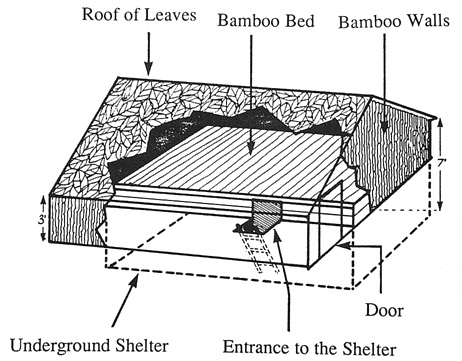
Source: Cayer, Marc, Prisoner in Viet Nam, 1990 translation,
Asia Resource Center, Washington, D.C., page 16
Cayer writes of the camps:
The camp consisted of a primitive hut with bamboo walls and a straw roof, built into the side of the mountain. The rounded floorboards also served as the roof for a four-foot high underground shelter where most of us slept. There were twenty captives in all, mostly American civilians. There was also one Filipino and several Vietnamese guards.
. . .The guards made sixteen of us go down into the shelter to sleep.
. . . Only the Vietnamese [guards] and those Americans who were seriously sick could sleep in the room above. The rest of us had to stay down below, crowed together in the underground shelter.
There was a bed onto which could normally fit four or five Vietnamese of small stature. We had eight Americans on it, sleeping on our sides to make the most room for everyone. Our "mattress" consisted of a row of bamboo branches affixed to a frame. At the end of forty minutes, the situation became unbearable, and we had to turn on to our other side. Due to lack of space, we had to do it all at once and on command: first, the person closest to the wall, then the next, and so on, until everyone had turned over. A half hour later we all did it again. Sometimes in the transition, we bumped against the guards' hammocks suspended above us, and they woke up and cursed us.
As for the eight others down below, they were crammed next to us on the ground along the wall, waiting patiently for the middle of the night, when they could get their turn on the "mattress" and their "chance to sleep".
The worst part of it came when someone wanted to go to the bathroom. It was necessary to disturb everyone and wake up the guards. We usually waited until three or four of us had the same need. Then we would go out, one at a time, to urinate twenty feet from the hut. . .
Starting at dawn, the Vietnamese [guards] who slept above us went off to work far away, and we could climb into the main room of the hut where we would spend the day. . .1
Cayer spent two weeks at this camp, after which all twenty prisoners and their guards marched thirteen days west. They came to a second camp in South Vietnam, where they spent ten days.
As in the first camp, this one consisted of a hut in the middle of the jungle with an underground shelter. But the house was in deplorable condition, and our first task was to repair it as best as possible. . .
Two days later, the V.C. decided to have us build another hut of the same kind. . .
We began by digging a hole four or five feet deep with tiny shovels given to us by the Viet Cong. The shovels were not well-suited to the task. . .
While we were digging, the Vietnamese [guards] went around picking up branches of four or five inches in diameter to make a roof for the hut. Then, after two such trips, we put up bamboo walls and placed the "prefabricated" roof on top of them. These last two items were stalks of bamboo with leaves tied on to them to make the structure water-resistant. The Vietnamese [guards] told us that a structure of this kind might last for more than a year.
. . .It took us four days to build another hut, after which they let us rest for three or four days. During this time, the Vietnamese [guards] built a third hut after the model of the second.2
FOOTNOTES
1. Cayer, Marc, Prisoner in Viet Nam, 1990 translation, Asia Resource Center, Washington, D.C., page 17-18.
2. Cayer, Marc, Prisoner in Viet Nam, 1990 translation, Asia Resource Center, Washington, D.C., page 23-24.
BACK TO THE POW RAID PAGE
|