The 1970 Raid on a POW Camp in War Zone DThis story is catalogued under Item Number 3671415002 in the Vietnam Center and Archive at Texas Tech University. It is located in the George J. Veith Collection. The History of Bright Light RaidsThe prisoner of war issue is a mess. High emotions, controversy, and politics cloud the truth, which is wrapped in secrecy, inter-service rivalry, and governmental obfuscation. The public focus has always been on the American officers who were shot down over North Vietnam, held in the North, and exploited as pawns in the "peace process" by politicians around the world. There was a group of POW's in South Vietnam, too. The United States Department of Defense wrote about these POW's:
Responsibility for recovering the POW's in the South fell to the Joint Personnel Recover Center (JPRC) from 1966 through 1972. This small, 10 or 11 man staff office in MACV was charged to "establish a capability with MACV for personnel recovery operations after termination of SAR (search and recover) efforts."2 The JPRC was actually related to MACV-SOG (Studies and Observation Group), one of the most secret and closely held operations of the war. The JPRC's relationship to SOG was classified, although within SOG, the JPRC was known as Recovery Studies Division, or OP-80. Other spooky agencies, like the State Department, the CIA, the Defense Intelligence Agency (DIA), and the National Security Agency (NSA) were also involved in POW recovery.3 The JPRC acted in great secrecy because of its highly classified relationship with SOG. Its existence was known during the war, but it was believed to be just one of the multitude of military acronyms for inconsequential and obscure staff weenies until the 1990's. That was when a POW/MIA researcher stumbled across nearly all of the declassified reports that the JPRC made on its POW recovery efforts. They were stored in the Vietnam Archives at the Center for Military History at the Army War College, Carlisle Barracks, PA. These declassified JPRC reports told the story of the true scope and nature of the U.S. military's efforts to recover its prisoners of war in South Vietnam. U.S. and ARVN forces conducted more than 125 POW rescue missions over the course of the war. While almost 500 ARVN prisoners were rescued and 110 American bodies were recovered under the reward program, no living American POW was freed. Many of the recovered American bodies were MIA, but none was a POW. 4 George Veith, the POW/MIA researcher who found the JPRC documents at the CMH, explains the failure to rescue even one POW this way:
Leaving the "failure of results, not effort" for others to debate, we are concerned here with the effort of U. S. forces to rescue POW's in South Vietnam, and the Blue Tigers' role in that effort. One must remember that these operations, which had the unclassified code name Bright Light, were secret. The size and scope of the effort remained undiscovered until Veith found the files in the 1990's. Information on who did what and when must be pieced together from accounts generally outside the "official" channels of government information. In the early years, SOG thought its soldiers could could handle most of the rescue missions, and the Special Forces mounted several in 1966 and 1967:
By 1968, the JPRC shifted more of the burden from SOG to field commanders. Veith notes, however, that by that time ". . . it was too late in the war. After the Tet offensive, political momentum began to swing away from the United States, and the desire to hold down casualties precluded making risky assaults into enemy territory with units whose morale was badly eroded." Field commanders of maneuver units often refused to send line troops on POW raids, citing a variety of reasons including the risk of high casualties and that the POW camp "was in enemy territory".7 It appears that elite units (Rangers, SEALS, and recon) carried the burden of Bright Light raids on POW camps after 1968. The first head of the JPRC, Heinie Aderholt from the Air Force's 1st Air Commando Group, first proposed using Army Rangers backed by air assets in 1966. But the Air Force Director of Intelligence, BG Ernest Johns, did not want the Army involved:
The JPRC originally held the only authority to authorize POW camp raids. By mid-1969, after over three years of no American POW rescues and following a 12 month period that saw JPRC headed by five different commanders (the tour for a JPRC commander was supposed to be one year), the JPRC decided to "move out of the shadows and decentralize to reduce the secrecy". MACV commander Creighton Abrams ordered every command in Vietnam down to the division level to provide a liaison to the JPRC. He also ordered that "the JPRC remains the focal point for PW recovery operations. Prior approval of JPRC for a recovery operation is not required and commanders are strongly encouraged to initiate unilateral action."9 In late 1969, the JPRC and SOG S-3 (Operations) created blank Operations Plans for commanders at the division level and above that had pre-approved authorization for POW raids with any available forces. The blank plan was code named Monterey Angler. SOG assets were tied in with any available ground forces. MACV gave blanket authorization to use up to battalion-sized forces as backup. This "chaos and band-aid" approach to POW recovery was the context in which the Blue Tigers were sent on a January 1970 POW camp raid. Reflecting the chaos of JPRC from 1967 to 1969, I have found only one account of a POW raid prior to 1970 in the available literature. Co. N (Airborne Ranger), 75th Infantry, 173rd Airborne Brigade raided a POW camp raid on 20 April 1969 in the Tiger Mountains of Binh Dinh Province. It is on the Co. N (Airborne Ranger), 75th Infantry web site. Perhaps reflecting the effects of the 1969 Monterey Angler band-aid on POW raid attempts, author Shelby Stanton mentions two Ranger raids on POW camps in South Vietnam after 1969 in his book on the Rangers. One occurred on February 16, 1970. Co. K (Ranger), 75th Infantry of the 4th Infantry Division put an entire ranger company into a reported POW prison in the central highlands of South Vietnam. Stanton wrote:
The second raid Stanton mentions was on February 19, 1971, when four eight-man ranger teams from Co. N (Airborne Ranger), 75th Infantry, 173rd Airborne Brigade were inserted on information that 6 U.S. captives were held in a VC prison west of the Kron River in Binh Dinh Province. The rangers did not find the prison compound:
We now add Bob Bennett's account and pictures of a POW camp raid by Co. D (Ranger), 75th Infantry and D Troop, 3/17th Air Cavalry in January 1970 in northeastern War Zone D of III Corps. To better understand the pictures, please take a look at a sketch of a POW hooch in South Vietnam. The page has a description of the construction techniques and of the POW living arrangements as well. Bill Nevius The 1970 Raid on a War Zone D POW Campby Bob BennettThe raid was a joint Ranger and Blue Tiger raid. As I recall, we were with at least two Ranger teams and one other Blue Tiger platoon. Ranger 6 had overall command of the operation, with Blue Tiger 6 in command of the Blue Tigers. I believe that the Ranger unit was the Delta Rangers [Company D (Ranger), 75th Infantry]. I do not have any direct notes on either the exact date or which Ranger unit it was, but my photo slides are dated 2-70, meaning that the operation took place in either in January or February 1970. The Delta Rangers were OPCON to the 3/17th Air Cavalry from December 1, 1969 to February 8, 1970. They replaced Co. D (Ranger), 151st Infantry (the Ranger unit we worked with during most of 1969) which stood down on November 20, 1969. The raid date could not be later than the first week of February, because after February 8, 1970, the Delta Rangers were OPCON to the 199th Infantry Brigade. On March 18, 1970, they returned to II Field Force, Vietnam control and went to Nhon Trach11. If the raid did take place in January, 1970, Ranger 6 was MAJ Richard W. Drisko, and Blue Tiger 6 was CPT William R. Condos, Jr. The POW camp was in the far northeast quadrant of War Zone D. See the Blue Tiger AO map to find the general area of the raid. The location came to the Rangers from Intel at BHTAC (Bien Hoa Tactical Area Command). Because the location was known from intelligence sources, we went directly to the site. We didn't have to search around for it. It had been vacant 2-3 days when we arrived, so whoever found it first must have scared them off. The camp was deserted when we arrived. It had maybe ten thatched structures, on stilts, with covered pits dug under each one as "cells". |
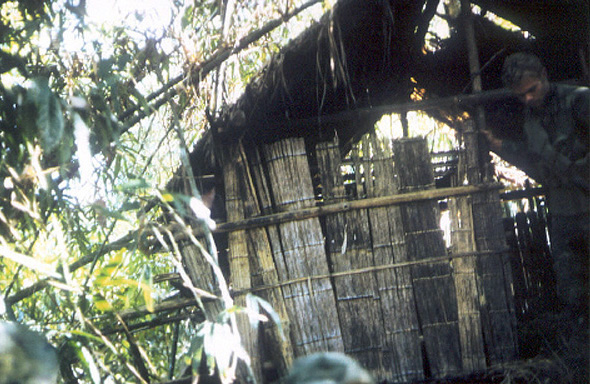 A Blue Tiger trooper inspects one of the hooches. The main floor of the hooches was elevated off the ground. According to POW Marc Cayer's statements,the VC cadre slept on this level at night and the POW's were stored here during the day. 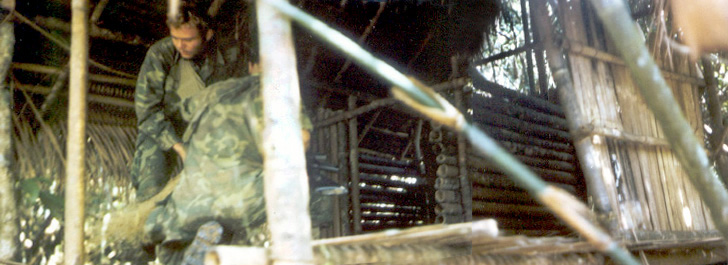 Since there are no doors visible on the rooms at the rear, At night, the POW's were stored in pits under the hooch. The pits were rancid smelling. The stench told us that the prisoners (Americans) must have been kept there, since no one could live voluntarily in such filth. 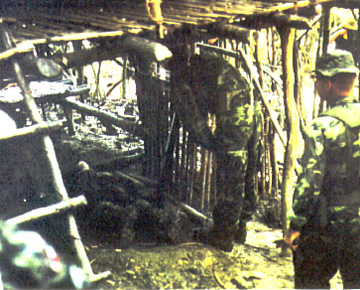
Barely visible in the center, a prone trooper (with boots toward the camera) We knew what had taken place there and we were very upset by the whole thing. 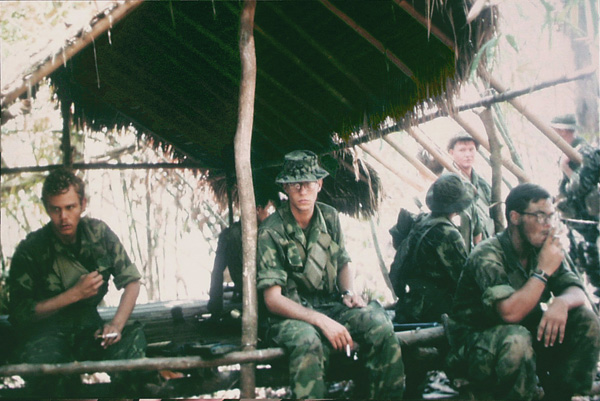 From the Bob Bennett Collection We were very pissed. We burned the place to the ground. 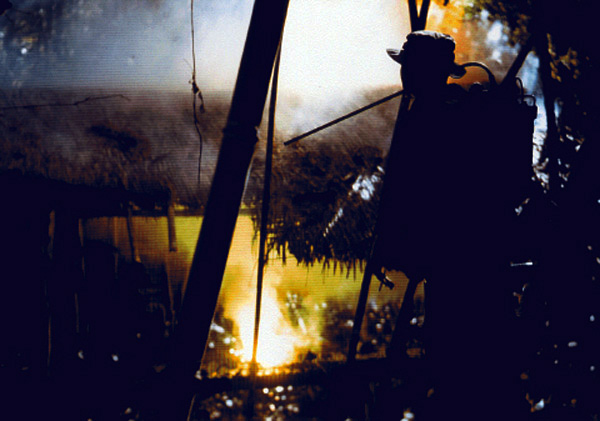 From the Bob Bennett Collection I snapped a final picture of Ranger 6, MAJ Richard W. Drisko, in a contemplative mood as he reflects on the destruction of the abandoned POW camp. 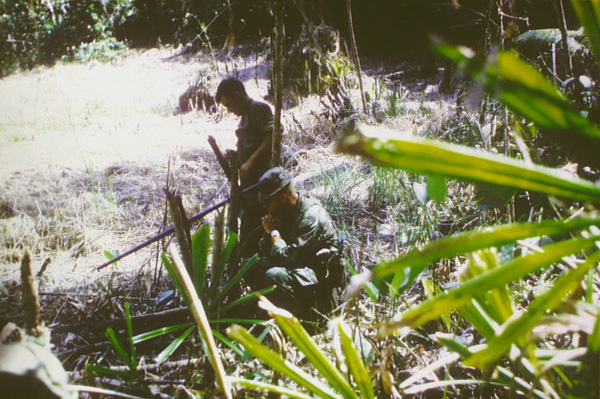 From the Bob Bennett Collection |
|
I cannot match our prison raid to any of the articles in Redhorse Review covering December, 1969, or January or February, 1970. The February issue has the following paragraph:
This report dovetails with our activity in War Zone D and the date on my pictures. But the Redhorse Review story does not mention the 2nd platoon, although it is possible that we went in on the January 21 "LRRP" operation and the story just forgot to mention us and the other Blue Tiger platoon in the January 21 operation. The "200-250 bunkers and hooches" does not make any sense either, if it refers to our POW camp raid. We found only about ten hooches. Two hundred fifty hoochs would be a huge camp, and I am sure I would have remembered that, rather than remembering a cluster of ten hooches. Finally, the story says that the camp "will be destroyed". My pictures show that we destroyed the POW camp while we were there. In the paragraph preceding the finding of the 200-300 bunkers in the Redhorse Review article, it simply states that second platoon, "while making their reconnaissance sweeps through the suspected enemy area . . . found many hooches and bunkers. These bunkers were destroyed, and the rest of the equipment and goods were brought back and turned over for intelligence purposes." Although ambiguously written, it covers the origins of my pictures. Since the Bright Light raids were secret, I am not surprised that the Redhorse Review article does not match our POW raid. I don't remember now whether the first Redhorse Review incident quoted above actually happened, or whether it is just a cover story for the secret raid. It is some relief to know that no POW raid succeeded in liberating POW's. The Blue Tigers who took part in the raid were very upset at failing to free any American captives. Bob Bennett Update - 10Jan01After viewing this page, George J. Veith reviewed his personal data base of all POW raids that he has been able to uncover from a variety of sources. He has identified this raid from a D-75th Ranger After Action report. It was named "Toan Thang IV," although that name was probably the overall name of the operation. The raid took place on 24 Jan 70 at grid YT 326527.12 I have left Bob Bennett's story of the raid as he originally wrote it so that the reader can measure the remarkable accuracy of his recollection of the units involved, the general location of the raid, and the approximate date of the raid. With Veith's information, the exact location of the raid can be mapped - about 35 clicks east of Phuoc Vinh and about 10 clicks southeast of Rang Rang, in the northeast quadrant of War Zone D: 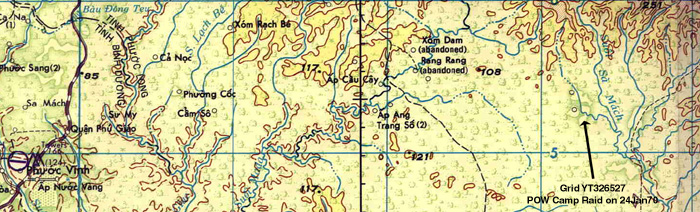 Map courtesy of Jim Henthorn George J. Veith also confirms that Bob Bennett and I did not have a prayer of finding reference to the raid in published sources. After Mr. Veith found the raid identified in a D-75th Ranger After Action report, he reviewed his extensive holding of original sources for JPRC activities and found no reference to the raid. He writes:
Bill Nevius FOOTNOTES1. Rochester, Stuart I. & Kiley, Frederick, Honor Bound - the History of American Prisoners of War in Southeast Asia, 1961-1973, Historical Office, Office of the Secretary of Defense, Washington, D.C., 1998, page 228-9. 2. "JPRC Terms of Reference, message from CINCPAC to JCS, 16 Aug 66", quoted in Veith, George J, Code-Name Bright Light, New York, NY, 1998, page 114. 3. Veith, George J., Code-Name Bright Light, Dell Paperback Edition, New York, NY, 1998, pages 3-5. 4. Veith, George J., Code-Name Bright Light, Dell Paperback Edition, New York, NY, 1998, page 397, and George V. Veith, Personal Communication, 2000. 5. Veith, George J., Code-Name Bright Light, Dell Paperback Edition, New York, NY, 1998, page 399. 6. Kelly, Francis J., U.S. Army Special Forces. 1961-1971 in Vietnam Study Series, CMH Publication 90-23, Department of the Army, Washington, DC, 1989, page 148. 7. Veith, George J., Code-Name Bright Light, Dell Paperback Edition, New York, NY, 1998, page 397-8. 8. Veith, George J., Code-Name Bright Light, Dell Paperback Edition, New York, NY, 1998, page 118. 9. Stanton, Shelby, Rangers at War: LRRPs in Vietnam, New York, 1992, page 104. 10. Stanton, Shelby, Rangers at War: LRRPs in Vietnam, New York, 1992, page 194. 11. Stanton, Shelby, Rangers at War: LRRPs in Vietnam, New York, 1992, page 231. 12. Veith, George J., Personal Communication, 2000. For a discussion of the CharlieHorse (C Troop, 3/17th Air Cav) rescue of POW Thomas H. Van Putten, For an extended discussion of POW issues, particularly as they relate to 1970 and the Cambodian incursion, The graphics and intellectual property at this site are the private property of the donors exclusively, and are protected by copyright law. Any commercial or for-profit use without permission is illegal and is expressly denied. Not-for-profit, educational, and similar organizations may be granted use of material contained herein upon application to Bill Nevius. |