Anatomy of a Fire BaseJerry Smith of Delta Troop took some pictures of Fire Base Judy from a cavalryman's point of view. Since it is difficult for words to draw accurate mental pictures of what Delta Troop did at the fire bases, Jerry's pictures help those who were not there to understand what a fire base was and what Delta Troop did there. The pictures show Judy from outside the perimeter, as well as the more typical shots of the artillery inside the perimeter. Fire Base Judy, as well as Fire Bases Nance, Evelyn, and Jay, were 1st Air Cavalry fire bases located around the major 1st Cavalry installation at Fire Support Base Mace in III Corps northeast of Saigon. William F. Boudreau gave a concise definition of the purpose of fire bases as they were used by the 1st Air Cavalry in Vietnam in 1970 and 1971:
Delta Troop was, of course, one of the "other elements" to which Boudreau referred. The troop usually split into its three platoons, with each platoon of 35-40 men assigned to a different fire base. Each fire base had about 90 men living on it, fairly evenly split between cannon-cockers and grunts. Each group had a distinct mission; the artillery concentrating on targets it could not see, and the cavalry concentrating on targets right under its nose. We really did not do things together. We just did our own thing at the same place. The Firebase from the InsideWhen Delta Troop's second platoon secured Fire Base Judy in April 1971, the guns were towed 155-mm howitzers. When Jerry Smith arrived at Judy with the third platoon in May 1971, the 1st Cav was in the process of changing the artillery pieces from the towed model to self-propelled 155-mm howitzers. The change in the style of guns required a change in the layout of the fire base, which Jerry captured on film.
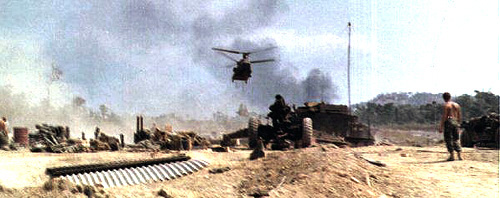
In the picture above, a towed 155-mm howitzer (the No. 1 gun) is still in its original firing position while a Chinook carries away another towed gun or other material in a sling suspended beneath it. The remains of the steel overhead cover from one of second platoon's sleeping positions is in the lower left of the frame. The sleeping position was originally 90 degrees to the position of the steel overhead cover (in other words, parallel to the bottom of the frame) and formed a tunnel large enough for three men sleeping head-to-toe. The new artillery battery's M557A1 tactical fire control vehicle is behind the old No. 1 gun, and a third platoon jeep is at the right margin of the frame. Highway QL1 is in front of the treeline at the right margin of the frame.
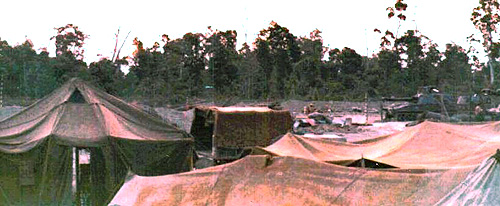
In a picture taken at the same time as the first photo but turned 270 degrees, Smith showed much of the remainder of the fire base. The new self-propelled guns are in place. Third platoon constructed the tents in the foreground for shelter, since the second platoon's existing reinforced sleeping positions were destroyed for the new fire base layout. It was no great loss because rats infested the sandbags that covered the reinforced sleeping positions. The remains of Delta Troop's mortar pit are in the area with trash and mounds of dirt between the self-propelled gun and the trailer and tent below it. The mortar pit was no longer needed because the mortars traveled with second platoon, which had left the fire base for another assignment.
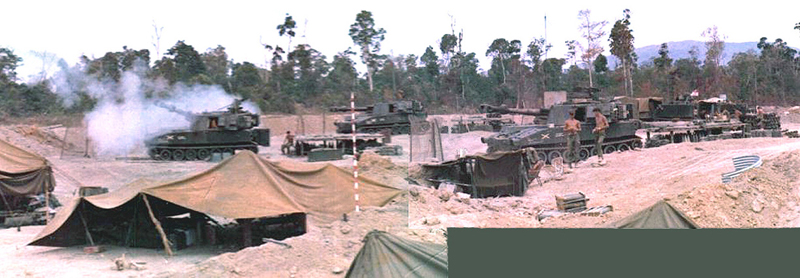
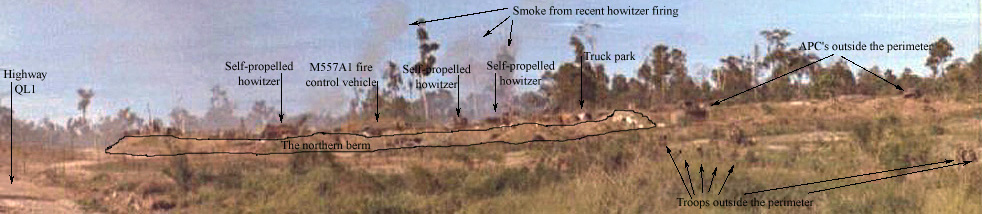
Two overlapping pictures spliced together show most (approximately 150 degrees) of the western berm and woodline of Fire Base Judy. These pictures were taken sometime after the first two (above) because the old mortar pit area near the firing gun is clean and smoothed, and a tent in the left foreground removed. The three guns of the artillery battery were laid in a triangle around the center of the fire base. The striped pole is an aiming stake for the guns. Each gun had a covered ammunition store behind it.The M557A1 tactical fire control vehicle relocated to a position barely visible behind the closest gun. The large antenna visible against the treeline most easily identifies it. Nui Chua Chan loomed in the background. The truck and trailer park was near the berm in the center right of the frame. There appears to be an APC near the truck park also, one of the several that reinforced third platoon at Judy. A red-and-white cavalry guidon near the APC snapped smartly in the breeze. The metal half sewer pipe in the foreground was part of the roof structure for your editor's sleeping position when second platoon was at Judy. The crates in the center foreground contained plastic canisters holding powder charges for the 155-mm guns. An empty canister was very useful because, if filled with water in the morning and left in the sun, it held enough hot water for a one-gallon shower from a canvas bucket for a Delta Trooper in the evening. The Firebase from the Outside
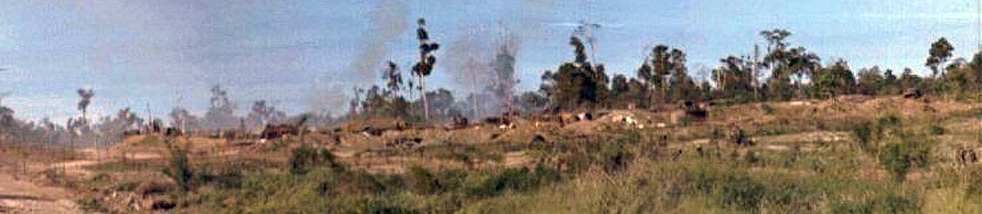
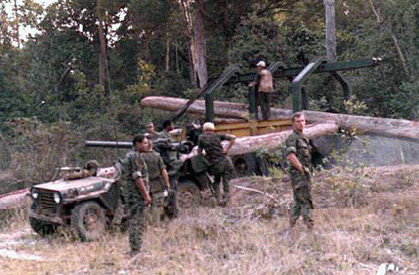
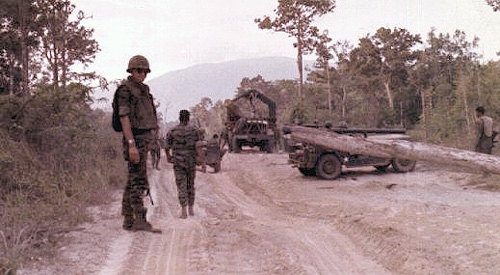
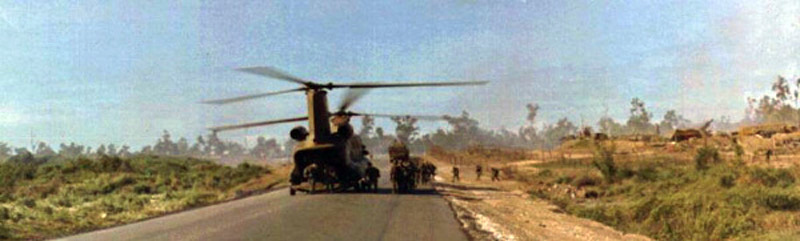 From the Jerry Smith Collection Jerry Smith took this picture shortly after the one above, and it explains all of the activity outside the perimeter. The troops and tracks were securing a landing zone on Highway QL1 for the Chinook. This picture shows Delta Troopers, under full packs, loading into the rear of the Chinook for a mission. Some troops remained behind to secure the fire base and man the bunkers on the berm at night. The Daily Routine at a FirebaseThe more usual daily routine while we pulled security at firebases involved small patrols of Delta Troopers reconning the forest along QL1 and checking the local loggers working in the forest. Although the following Jerry Smith pictures were taken while third platoon was at Fire Base Evelyn, just down the road from Judy, the pictures show typical daylight operations for Delta Troopers at Judy.
These pictures remind me of a story about life at Fire Base Judy, for which there are no pictures of the event. Shortly before second platoon left Judy, we sent a small patrol to recon the woodline between Judy and Evelyn. It was something we did almost every day. The patrol left Judy in gun jeeps, drove south on QL1 for a short distance, dismounted, and entered the woodline on foot. The patrol reconned into the forest and, just before returning to the woodline, was surprised by an NVA three-man patrol coming up from behind. The last man in the Delta Troop patrol engaged the three NVA soldiers and wounded one who carried a large backpack full of Vietnamese money, while the other two ran back into the forest. The second platoon at Judy, when notified of the contact by radio, mounted a reaction force of several gun jeeps, including one with a mortar in it. We arrived at the contact site quickly, and set up a hasty perimeter while our medic took care of the wounded NVA. As other second platoon jeeps spread along QL1 to search for the two NVA who had escaped, we were surprised to see a UH-1-H helicopter from the 1st Cav land on QL1, and an officer run toward the hasty perimeter we had established. The officer was none other than Brigadier General Jonathan Burton, Commander of the 3rd Brigade, 1st Air Cav. As the PFC's, Spec4's, and buck sergeants tried to figure out exactly what one does when confronted by a general in the bush (to salute or not to salute, that was the question), General Burton said to "carry on" and explained that he had heard our radio traffic and wondered if the NVA soldier we had downed was a courier with pay for the 33rd NVA Regiment. He took a quick look at the wounded NVA soldier, waved good-bye to us, and was airborne before the medivac helicopter arrived. One of the reaction force jeeps soon found the two other NVA soldiers as they tried to cross QL1. They had hidden their rifles and picked up axes and chainsaws to disguise themselves as woodsmen, Delta Troopers captured them, and sent them to FSB Mace for interrogation. I think General Burton was the only officer above the grade of captain I ever saw in the field in Vietnam. Jerry Smith remembers different details from the same incident:
 Bluetiger Home PageThe graphics and intellectual property at this site are the private property of the donors exclusively, and are protected by copyright law. Any commercial or for-profit use without permission is illegal and is expressly denied. Not-for-profit, educational, and similar organizations may be granted use of material contained herein upon application to Bill Nevius. |