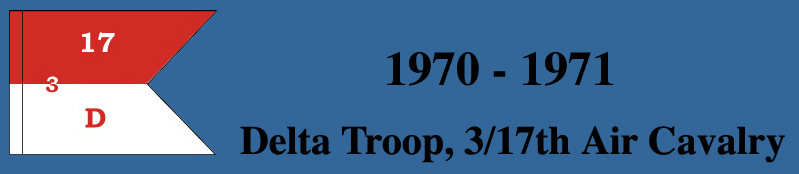
Dispatches from APO SF 96289 - 1971
Delta Troop documents are hard to find. In searching
various archives, I have found only one 3/17th Air Cavalry "Operational
Reports - Lessons Learned" (ORLL) for the time I was there, and it concentrates
on air cavalry problems. Delta Troop is mentioned only parenthetically
in the squadron tabular reports, and is unmentioned in the text of "Lessons
Learned" for the period November 1970 to April 1971. The full text of the ORLL is available here.
Delta Troop was a ground cavalry reconnaissance unit in an air cavalry squadron. The official Army records were written by squadron officers who apparently focused on things that flew. Delta Troopers will not be surprised to discover, therefore, that the things we did in the field were ignored by the official chroniclers as well.
Absent good records, developing an "official" Dispatch from APO SF 96289 describing Delta Troop's role in the 3/17th Air Cavalry required some searching in the unit's history and a lot of reading between the lines. For example, one needs to go back to 1969 to find an "official" description of Delta Troop's role in the 3/17th Air Cavalry:
DEPARTMENT OF THE ARMY
HEADQUARTERS, 3RD SQUADRON, 17TH CAVALRY
APO 96289
AVBACA-G
5 August 1969
SUBJECT: Air Cavalry Employment
Commanding Officer
12th Combat Aviation Group
APO 96266
. . . . .
4. DISCUSSION
. . . . . .
b. Troop employment:
. . . . . .
(8) The squadron's organic ground cavalry troop is
capable of conducting road clearing, convoy escort and security, FSB security,
night ambush, road reconnaissance, and reinforcing missions throughout
the entire area of operations. Because of its lack of tracked vehicles,
the troops' cross country capability is rather limited. However the above
mentioned missions are conducted very successfully. Although the troop
would rely on squadron for its air support during enemy contact, it does
have the capability of supplying its own indirect fire support within 5000
meters of its mortars. The troop can be used to reinforce the air cavalry
troops' airmobile capabilities by being utilized as an airlifted infantry
or by reinforcing ground elements and could be extensively used as a security force for forward aircraft laager positions, POL and rearmament points,
and providing radio relay.
. . . . . .
JOHN B. FITCH
LTC
Commanding
|
LTC Fitch's "troop employment" is a fair description of the role Delta Troop actually played in the field in 1970 and 1971. The most confusing part was figuring out who we worked for. Delta Troop took to the field with tracked elements of both the 11th Armored Cavalry Regiment and the 1/5th Mechanized Infantry, 25th Infantry Division as mounted recon forces on occasion. Individual platoons were occasionally separated from the Troop to fly as "Blues". We spent much of the time alone as a dismounted reconnaissance and ambush cavalry unit for the 1st Cav. The troop also ran convoy security out of FSB Mace for the 1st Cav. Stand-down time was spent as a security force for artillery fire bases.
From the field, it was difficult to see, let alone understand, our role in defeating the enemy and making San Francisco safe. However, Army documents show that, at a large scale, Delta Troop was part of a defacto Air Cavalry Combat Brigade. Between 2 November 1970 and 10 April 1971, the brigade was part of the 1st Air Cavalry Division, and after 10 April 1971, the brigade was transferred to the 1st Aviation Brigade.
|
DEPARTMENT OF THE ARMY
HEADQUARTERS, 1ST SQUADRON (AIRMOBILE) 9TH CAVALRY
1ST AVIATION BRIGADE
APO San Francisco 96289
AVBAUX-C
5 April 1971
SUBJECT: Air Cavalry Brigade Operations
1. This squadron recently compiled the data concerning the formation
and employment of the largest grouping of Air Cavalry the Army has known.
This group was a defacto Air Cavalry Combat Brigade and we recorded our
observations while conducting operations with eight Air Cavalry Troops,
two ground Cavalry Troops, a Ranger Company, and a Combat Tracker Team.
The report as you receive it has no official sanction; however, it can
serve some purpose to those following in the footsteps of the "First Team."
This document was officially submitted to the 1st Cavalry Division, prior
to the Squadron being reassigned to the 1st Aviation Brigade on 10 April
1971. There has been no official comment returned.
2. As so often happens when administrative reports are compiled
in the midst of actual combat operations, the most important lessons are
overlooked. While omitted in the report, we must emphasize two important
points.
a. The proposed combination of
the attack helicopter battalion with the Air Cavalry Squadron within the
Air Cavalry Combat Brigade is extremely important. Air Cavalry must operate
with maximum fuel and go light on ordnance to increase time for visual
reconnaissance in the operational area. On the other hand, the attack helicopter
battalion operates with maximum ordnance since time on station is not as
important as is the firepower it delivers. This concept was proven time
and again in the 1st Air Cavalry Division which used its Aerial Field Artillery
to provide that additional firepower.
b. There are pros and cons about
arming the LOH with the minigun. It is my opinion, after observing the
Scout with and without the minigun, that the minigun is a hindrance to
the Scout. First, if the minigun is mounted, there is one less crewmember
on the aircraft. This reduces the "Visual Reconnaissance" capability of
the Scout by one third. Second, with the minigun mounted there is a tendency
on the part of the Scout to use his aircraft as a "Gunship, again reducing
the VR capability of the Scout.
3. Our hope in compiling the attached report was to assist in the
formation of the Air Cavalry Combat Brigade at Fort Hood. We are willing
to provide any additional data that may be available.
/s/ CARL M. PUTNAM
LTC ARMOR
Commanding
|
LTC Carl Haaland, commander of the 3/17th Air Cavalry, confirmed this
organization in his ORLL dated 1 May 1971:
|
1 May 1971
AVBAUX-CC
SUBJECT: Operational Report-Lessons Learned of the 3d Squadron,
17th Air Cavalry for the Period Ending 30 April 1971. RCS CSFOR (R2) (U)
. . . . .
9. (U) Other:
a. Observation #1
(1) Observation: During
the period 2 November 1970 to 10 April 1971 the 3/17th ACS was OPCON to
the 1st Air Cavalry Division and further OPCON to the 1/9 Air Cavalry Squadron.
(2) Evaluation: Initially,
this arrangement caused no command and control problems as the 1/9 Squadron
Commander was the senior commander. However, in January 1971, the 1/9 changed
commanders. The new commander was junior to the commander of the 3/17 but
no change was made in command relationship between the two units. Had the
two commanders not worked together previously and had they not been thoroughly
mission oriented conflicts could have arisen.
(3) Recommendations: When
one unit is placed under the Operational Control of another, the unit with
the senior commander should be the controlling unit.
(4) Command Action: None.
/s/CARL J. HAALAND
LTC, FA
Commanding
|
The defacto Air Cavalry Combat Brigade was composed of the following
units, according to the 1st Air Cavalry Division Order of Battle:
9th (Air) Cavalry Brigade (Provisional)
- 1st Squadron, 9th Cavalry
- "HHT"
- "A" Troop
- "B" Troop
- "C" Troop
- "D" Troop (formally "D" Company 227th Aviation Battalion)
- "E" Troop (formally "D" Company 229th Aviation Battalion)
- "F" Troop
- 3rd Squadron, 17th Cavalry
- "HHT"
- "A" Troop
- "B" Troop
- "C" Troop
- "D" Troop
- "E" Troop (formally 334th Aviation Company)
- 2nd Battalion, 12th Infantry
- 2nd Battalion, 20th Artillery (Blue Max, ARA)
- 62nd Infantry Platoon, (Combat Trackers)
- "H" Company, 75th Infantry (Ranger)
Delta Troop did not spend much time with the units in the Air Cavalry
Combat Brigade. In fact, Delta Troop did not spend much time with the 3/17th
squadron. Most of us had no idea how big 3/17th was. It turns out that
it had 1204 men. Delta Troop, light on officers and heavy on the 11Bravo
enlisted types, had 118 men:
|
HEADQUARTERS
3D SQUADRON, 17TH CAVALRY
PERIOD ENDING
30 April 1971
UNIT STRENGTHS (MILITARY), Semi-Annual ORLL
|
Subordinate
Unit |
Officer Auth |
Officer O/H |
Wo Auth |
Wo O/H |
Em Auth |
Em O/H |
Total Auth |
Total O/H |
| Hq Troop |
24 |
27 |
7 |
4 |
181 |
175 |
212 |
206 |
| A Troop |
18 |
25 |
31 |
18 |
182 |
173 |
231 |
216 |
| B Troop |
18 |
21 |
31 |
19 |
182 |
162 |
231 |
202 |
| D Troop |
5 |
5 |
0 |
0 |
127 |
113 |
132 |
118 |
| F Troop |
16 |
24 |
34 |
27 |
216 |
196 |
266 |
247 |
| 334th Avn Co |
17 |
21 |
39 |
26 |
198 |
161 |
254 |
208 |
| 93rd Med Det |
1 |
1 |
0 |
0 |
5 |
6 |
6 |
7 |
| 3/17 Acs |
99 |
124 |
142 |
94 |
1091 |
986 |
1332 |
1204 |
The 3/17th Air Cavalry fought a war (that many at home thought was over)
from November 1970 to April 1971. Seventy-eight Troopers were casualties
during the period: 24 dead, 54 wounded.
February was the cruelest month:
HEADQUARTERS
3D SQUADRON, 17TH CAVALRY
PERIOD ENDING
30 April 1971
FRIENDLY LOSSES, Semi-Annual ORLL |
| KIA |
WIA |
MIA |
| Date |
Officer |
Warrant
Officer |
Enlisted
Men |
Date |
Officer |
Warrant
Officer |
Enlisted
Men |
Date |
Officer |
Warrant
Officer |
Enlisted
Men |
| Nov 70 |
0 |
0 |
0 |
Nov 70 |
0 |
0 |
3 |
Nov 70 |
0 |
0 |
0 |
| Dec 70 |
1 |
1 |
2 |
Dec 70 |
1 |
1 |
2 |
Dec 70 |
0 |
0 |
0 |
| Jan 71 |
0 |
0 |
1 |
Jan 71 |
0 |
1 |
2 |
Jan 71 |
0 |
0 |
0 |
| Feb 71 |
1 |
0 |
2 |
Feb 71 |
1 |
1 |
16 |
Feb 71 |
0 |
0 |
0 |
| Mar 71 |
0 |
0 |
0 |
Mar 71 |
0 |
1 |
3 |
Mar 71 |
0 |
0 |
0 |
| Apr 71 |
0 |
0 |
2 |
Apr 71 |
1 |
3 |
2 |
Apr 71 |
0 |
0 |
0 |
Died
Not As
A Result Of
Hostile Action |
Wounded
Or Injured
Not As A Result
Of Hostile Action |
Total
3/17 Air Cav
Losses For The
Period Nov70-Apr71 |
| Date |
Officer |
Warrant
Officer |
Enlisted
Men |
Date |
Officer |
Warrant
Officer |
Enlisted
Men |
Date |
Officer |
Warrant
Officer |
Enlisted
Men |
| Nov 70 |
0 |
0 |
0 |
Nov 70 |
0 |
0 |
5 |
Nov 70 |
0 |
0 |
8 |
| Dec 70 |
0 |
0 |
3 |
Dec 70 |
1 |
1 |
4 |
Dec 70 |
3 |
3 |
11 |
| Jan 71 |
0 |
1 |
3 |
Jan 71 |
0 |
0 |
1 |
Jan 71 |
0 |
1 |
7 |
| Feb 71 |
1 |
3 |
3 |
Feb 71 |
0 |
0 |
1 |
Feb 71 |
3 |
4 |
22 |
| Mar 71 |
0 |
0 |
0 |
Mar 71 |
0 |
0 |
2 |
Mar 71 |
0 |
1 |
5 |
| Apr 71 |
0 |
0 |
0 |
Apr 71 |
0 |
0 |
2 |
Apr 71 |
1 |
3 |
6 |
Delta Troop was at Nhon Trach during the month of February 1971.
Nhon Trach was a dark and bloody ground, a village surrounded by slit trenches and hardened bunkers, a launching area for 122-mm rocket attacks on Saigon, the home turf of 510 trained, battle-hardened VC experts in mines and booby traps from the 2nd VC Main Force Battalion, the 4th VC Main Force Battalion, the 8th VC Main Force Sapper Battalion and the 10th VC Main Force Sapper Battalion.
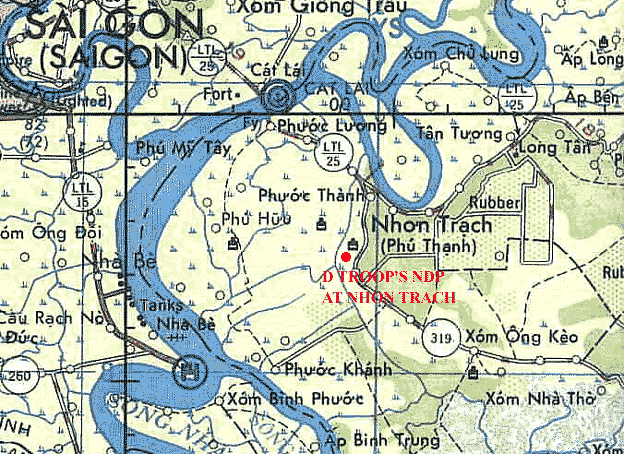
The squadron's ORLL is silent on Delta Troop's activities there. I guess
the squadron officers who wrote the ORLL's learned no lessons from it.
Delta Troopers did.
There is only one reference to the action in the
official records I have found. It comes from the 25th Infantry Division
ORLL. I guess we were working for them when it all went down:
|
DEPARTMENT OF THE ARMY
Headquarters, 2d Brigade, (Prov) (Sep)
25th Infantry Division APO SF 96289
AVBDHD
16 MARCH 1971
SUBJECT: OPERATIONAL REPORT - LESSONS LEARNED FOR THE PERIOD 1 NOVEMBER
1970 TO 26 FEBRUARY 1971
. . . . . .
1. (C) OPERATIONS: Significant Activities
. . . . . .
. . . D/3-17 Cav with elements of the 200 RF Company engaged an
unknown number of enemy with organic weapons and LFT 3 kms west-northwest
of Long Thanh (YS110930) at 1620 hrs on 25 February resulting in one enemy
killed and one M16 rifle evacuated. Enemy small arms fire wounded one RF
soldier. At 0920 hrs on 26 February, elements from D/3-17 detonated a grenade
booby trapped on a trail 2 kms west-northwest of Long Thanh (YS 120928)
resulting in one US soldier killed and three wounded. They swept the area
and found one 82mm mortar round which they destroyed . . .
|
The fine Delta Trooper who died at Nhon Trach in February 1971 was Michael William Langnehs, who was known as "Jarhead" to his friends. Mississippi, 'Toon Daddy, and others were wounded in the same incident, while many others were wounded in the fighting in the days before and after Jarhead's death.
The 25th Infantry Division ORLL will have to serve as the US Army's "Dispatch from APO SF 96289-1971" for Delta Troop. the 3/17th Air Cavalry Squadron's interest was elsewhere. The first, and therefore most important, "Operations Observation" made by the squadron officer who wrote the 3/17 ORLL for the period reads:
"(1) Observation: The need for a practical, safe and attractive base for our revetments was solved when this unit hauled in gravel for that purpose."
--Bill Nevius (BlueTiger 28, 1970-71)
The graphics and intellectual property at this site are the private property of the donors exclusively, and are protected by copyright law. Any commercial or for-profit use without permission is illegal and is expressly denied. Not-for-profit, educational, and similar organizations may be granted use of material contained herein upon application to Bill Nevius.
|