CHARLIE BLACK: |
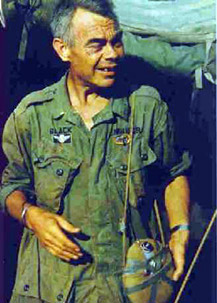 Charlie Black |
"The Cav also brought along with them their hometown reporter, a grizzled and, to we 20-somethings, ancient World War II veteran Marine named Charlie Black of The Columbus (Ga.) Ledger-Enquirer. We would all go to school on Charlie Black who lived with the Cav 24/7 and loved what he was doing. Charlie would go out with a battalion on operations and stay for a week or ten days or two weeks. When he came back to An Khe he would sit down at a battered old typewriter and write endless dispatches, single spaced, on onion skin paper. His stories were full of names and hometowns. He would find a friendly GI who would frank the letter so it went home airmail for free. His editor would run every line, because his readers included the wives and kids of many of the troops. Charlie was supposed to stay two or three weeks; he ended up staying more than a year that tour. Traded in his return air ticket for pocket money, slept on the ground or in the press tent for free and ate a steady diet of C-rations, also for free. The Cav troops would have happily passed the hat for donations if Charlie had gone totally broke. They loved him, and the love affair was mutual." (Galloway, Joe, "A Reporter's Journal From Hell" in The Digital Journalist, Feb. 2004) |
Al DeFleron was a crew chief with the 1st Squadron, 9th Cavalry, during the battle of the Ia Drang Valley in 1965. In 2002, he told war stories about Charlie Black in the field with the Cav in 1965:
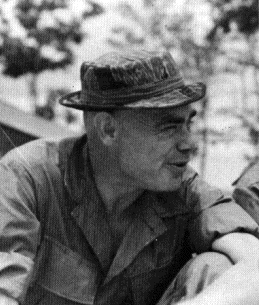 Charlie Black |
"Charlie Black was with us on the night of the 3rd [Nov. 3, 1965]. Charlie covered the 1st of the 9th extensively. He loved to fly with us. Charlie was an ex-Marine and I know he must have been a damn good one when he was on active duty. He was a reporter, but like we said earlier that first we were soldiers, Charlie was first a Marine. Now, I'm Army. You might say I'm ex-Army. A Marine is never an ex-Marine. He's a former Marine... but he's never an ex-Marine. . ." Charlie Black during this whole time, while this battle was going on... he was a Marine. He wasn't no reporter. That wasn't his primary duty. He was writing a note or two. But Charlie Black... you might run across him and... like Doug and the rest of us, we were either up in a hole fighting, or I was running back and forth carrying messages or I was carrying ammo or I was dragging wounded back. Charlie Black was up on there... you might run across him on a M-60 machine gun here; and the next time you saw him he was throwing grenades. He was fighting that war just like the rest of the infantry troops out there. (Sp5 Al DeFleron, quoted in Columbus Ledger-Enquirer, March 3, 2002.) |
The 3/17 Air Cavalry met Charlie Black in 1968. Black was on his fifth reporting assignment to Vietnam for the Columbus Enquirer. The 3/17th had been in-country for eight months.
Charlie Black began his series of reports from Vietnam in 1968 with three articles that explained why he decided to live with, and report on, the troops of the 3rd Squadron, 17th Air Cavalry.
September 11, 1968 Saigon Run-Around Rough Even For Old Timer
In his first report home, Charlie Black caught the essence of Saigon and the rear echelon - the do-nothing, regulation-bound world of the REMF.
September 12, 1968 First Day In Saigon Familiar; Then Off to War Zone
At the "Five O'Clock Follies", Black was intercepted by two officers from the 3rd of the 17th Air Cav, who were sent to take Black to meet Lt. Col. John Phillips, commander of the squadron and an old friend of Black's. Although Black had made arrangements to go to the 1st Air Cavalry Division the following day, he changed them to accompany the two officers to the 3/17th's headquarters at Di An.
September 13, 1968 Each War Visit New Experience
In this report, Black briefed his first four tours as a reporter. He explained his point of view that the North Vietnamese sanctuaries in Cambodia were the reason that war had continued as long as it had. In 1968, he found that the war had shifted to the defense of Saigon and that that was the story he would cover. The 3/17th, he argued, was the eyes and ears of the commander charged with the defense of Saigon, and the squadron operated throughout III Corps. So, he tied his fortunes to the troops of the 3/17th, and made the 3/17th his outfit for 1968.
Over the next several months, Charlie Black spent a great deal of time in the field or in the air with the troops of the 3/17th. He filed a series of war stories based on his experiences with the troops or on after-action accounts from the troops. The articles are listed here in chronological order because Black's articles were subdivided by his Columbus editor into smaller "installments" that would fit the space available in the paper. As a result, the articles make more sense when they are read in chronological order.
A Troop:
Black wrote the Silver Spurs' story in eight segments. The first six of theses have been published on the Silver Spurs web site. Please visit the Silver Spurs link for comments on the Black articles by some of the participants.
September 16, 1968 Cavalry Troop Draws Praise From Proud Units It Supports In Combat
September 17, 1968 Writer Nervous, Jumpy in Capture of Viet Cong
September 18, 1968 'Gangbusters' Lead Attack on Viet Cong
September 19, 1968 Enemy-Occupied Hut Goes Up In Flames
September 20, 1968 'People Sniffer' Ship Leads to New Action Areas
September 21, 1968 Bodies of Dead Sober Reminder
September 24, 1968 LOH Reaches Goal of 1,000 Hours
September 25, 1968 Things Look Up for Special Forces Officer
C Troop:
Black did not cover much of Charliehorse Troop's activities in his articles, even though the troop was apparently stationed with the rest of the squadron. The two stories he did write about Charliehorse pilots covered two heavy lifters: a warrant officer named Shy who crushed VC with the skids of his Cobra; and a Troop CO named Luck who was a snake-eater who wore a CIB, Ranger tab, and paratrooper's wings.
September 26, 1968 Pilot Wages One-Cobra War
September 27, 1968 Maj. Luck Has His Share
Skip Davis, B Troop webmaster, writes: "While with B Troop, Luck did one of those exceptional things that legends are made of. He took a couple volunteers back into an LZ near the Cambodian border, at night, to recover 2 bodies of B Troop Infantry lost during a hot LZ insertion a day earlier. They were in the jungle for 2 days and radioed for pickup after recovering the bodies. Luck made a career of the Army, eventually commanding US forces in Korea , and was a major influence in command of Desert Storm. He recently retired as a four-star general."B Troop:
Major James T. McManus smoked cigars, so his troop's call-sign was "Burning Stogie". Black knew McManus from the 1965 tour when McManus had been with the 1st Air Cav. Black wrote a lot about the B Troop aero-rifle platoon, of whom McManus was particularly proud.
September 28, 1968 McManus, Connolly Are Matched Pair
September 30, 1968 Hunting VC Is Science
Skip Davis, B Troop webmaster, is featured in this article. See his notes at the end of the article.October 1, 1968 Scouts Hunt for Enemy Hideouts
October 2, 1968 Wounded Pilot Makes Dramatic Landing
October 4, 1968 GI Plays Down Wound To Win Stripes Back
October 8, 1968 Thoughts Before Battle Private
October 9, 1968 Sometimes An Ambush - Sometimes Not
October 16, 1968 Rescuing Pilots Dangerous Job
D Troop:
Black said of the Blue Tigers, "Delta Troop wore red berets, an old fancy of my own over here where hats acquire a kind of mystique for the owners . . . I had one hell of a good time with them. We liked the same things."
October 10, 1968 Hospital Visit Brings Thoughts of Errors.
Black discusses the relationship between LRRP's and Blue Tigers. As one ranger, recovering in the hospital, put it: "It was close. I thought I'd lose this leg, but it's doing all right. I'll make it, no sweat. I wanted to tell you guys thanks. Will you tell 'Blue Tiger' that, for me?" Black also describes the living accommodations at Cu Chi, where the lurps and the Blue Tigers were isolated away from the rest of the squadron.October 11, 1968 Sgt. Davie Saved the Day for Whole Outfit.
Black describes the ambush at Ben Muong, May 30, 1968. The Blue Tigers killed seventeen enemy by body count, with an estimated four to five times that number killed but carried from the battlefield by the survivors, at the cost of one KIA, Sgt John Sinnock, from the 2nd Platoon, and several wounded. This action is also covered by D Troop's John Dungan and B Troop's Skip Davis.October 11, 1968 'Lurps' Have Pride in Rugged Duties.
Black discusses the tactics of Co. F (LRP), 51st Inf (ABN), the first of three lurp companies for which the Blue Tigers were a dedicated reaction force. Blue Tiger 6 described the relationship as one where "The [Blue Tiger] platoons might be called to sweep an area to search out some local situation, they put in night ambushes in likely spots, but getting the 'lurps' out of trouble is the primary responsibility."October 14, 1968 Morning Breaks Slowly Around Cu Chi
October 17, 1968 Enemy Hoped to Lure Command Into Power Use. Black expounds on his theme: "All of the U.S. dead and wounded from the northern border of II Corps south, since 1964, can be traced directly or indirectly to the sanctuaries in Cambodia. . . All of the talked-about and debated-over issues of this war are spurious when compared to the real basic problem of it all, Cambodian sanctuaries, which just never seem to come up as an issue."
October 18, 1968 Enemy Scores Victory In Supply Route Ambush.
Black discusses the role of D Troop in an air cavalry squadron: "A single troop of cavalry in each air cavalry squadron - there are five of these in the Army to my knowledge and a new reality of an idea that has been around since helicopters - is designated a 'ground troop.' It has half a dozen recoilless rifle jeeps, 'gun jeeps', and a fleet of other jeeps mounting machine guns and carrying riflemen, machine gunners and mortarmen as passengers with trailers containing their homes and possessions."Redhorse Six:
Charlie Black wrote one story about The Squadron CO that we have included here out of sequence. It is a tongue-in-cheek account of the adventures of the 3/17th SCO when he broke an oil line a few miles outside the Cu Chi wire.
October 3, 1968 Mutual Terror Shared Gracefully by 'Copter Crew
"So there we were, a squadron commander, the adjutant, the assistant personnel officer, the co-pilot, myself and the crew, all in a perimeter around the Huey, looking awkward and out-of-place in a dry paddy a few miles outside Cu Chi. It was a high priced squad, led by a Lieutenant Colonel with machinegun sections commanded by Captains and Majors, equipped with its own correspondent."
Back to The Big Picture